
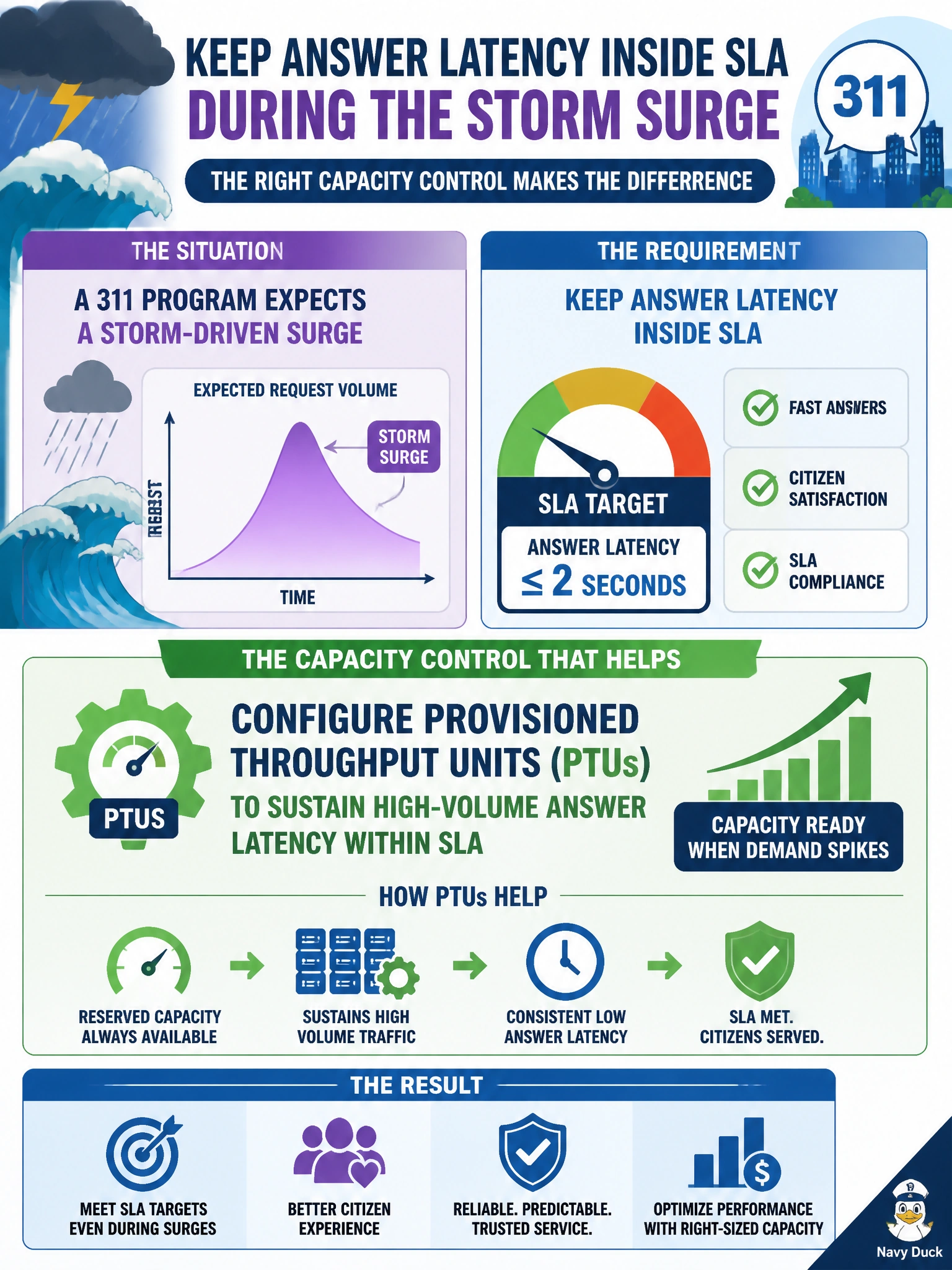
A 311 program expects a storm-driven surge and must keep answer latency inside SLA. Which capacity control helps?
Select an answer to reveal the explanation.
Short Explanation
Storm week isn't the time for maybe-capacity. You reserve PTUs so 311 answers stay inside the SLA when everyone calls at once — increasing the pay-as-you-go quota won't reserve throughput and extra best-effort endpoints won't protect latency.
Full Explanation
Configuring provisioned throughput units (PTUs) to sustain high-volume answer latency within SLA is the correct capacity control for a 311 program expecting a storm-driven surge. PTUs reserve throughput for Azure OpenAI / foundation-model style workloads so latency does not depend solely on best-effort pay-as-you-go contention during correlated civic demand. Storm weeks drive simultaneous resident questions; reserved capacity keeps answer times inside the published SLA when unconstrained consumption would throttle or slow.
Increasing the tokens-per-minute quota on the pay-as-you-go deployment to meet surge latency targets fails because a higher quota only raises the ceiling you're allowed to request — it does not reserve actual throughput, so the deployment still competes for shared best-effort capacity exactly when storm concurrency peaks. Distributing storm traffic across extra pay-as-you-go endpoints in paired regions to protect latency fails because every one of those endpoints is still best-effort capacity; spreading load across more best-effort endpoints improves availability, not guaranteed latency, and citywide demand can still throttle each one during the surge. Reserving provisioned throughput units (PTUs) sized for baseline throughput to control cost within SLA fails because provisioned capacity sized to baseline still runs out of headroom during the correlated surge the city already expects, missing the SLA precisely when demand is highest.
Exam caveat: PTUs are for reserved throughput and latency predictability under high volume; early pilots with uncertain traffic may stay serverless until metrics justify PTUs. Choose PTUs when the stem pairs known surge with an SLA that must hold.
Operational check: size PTUs from storm-tabletop or historical 311 concurrency, apply them before forecast weather events, and monitor latency/error budgets during the surge to confirm SLA compliance.
Prefer to study offline? Printable PDF study book + test engine ($7.50, unofficial). These questions stay free here.