
A permits chatbot sees spiky daytime traffic and quiet nights. Which foundation-model hosting choice fits variable load?
Select an answer to reveal the explanation.
Short Explanation
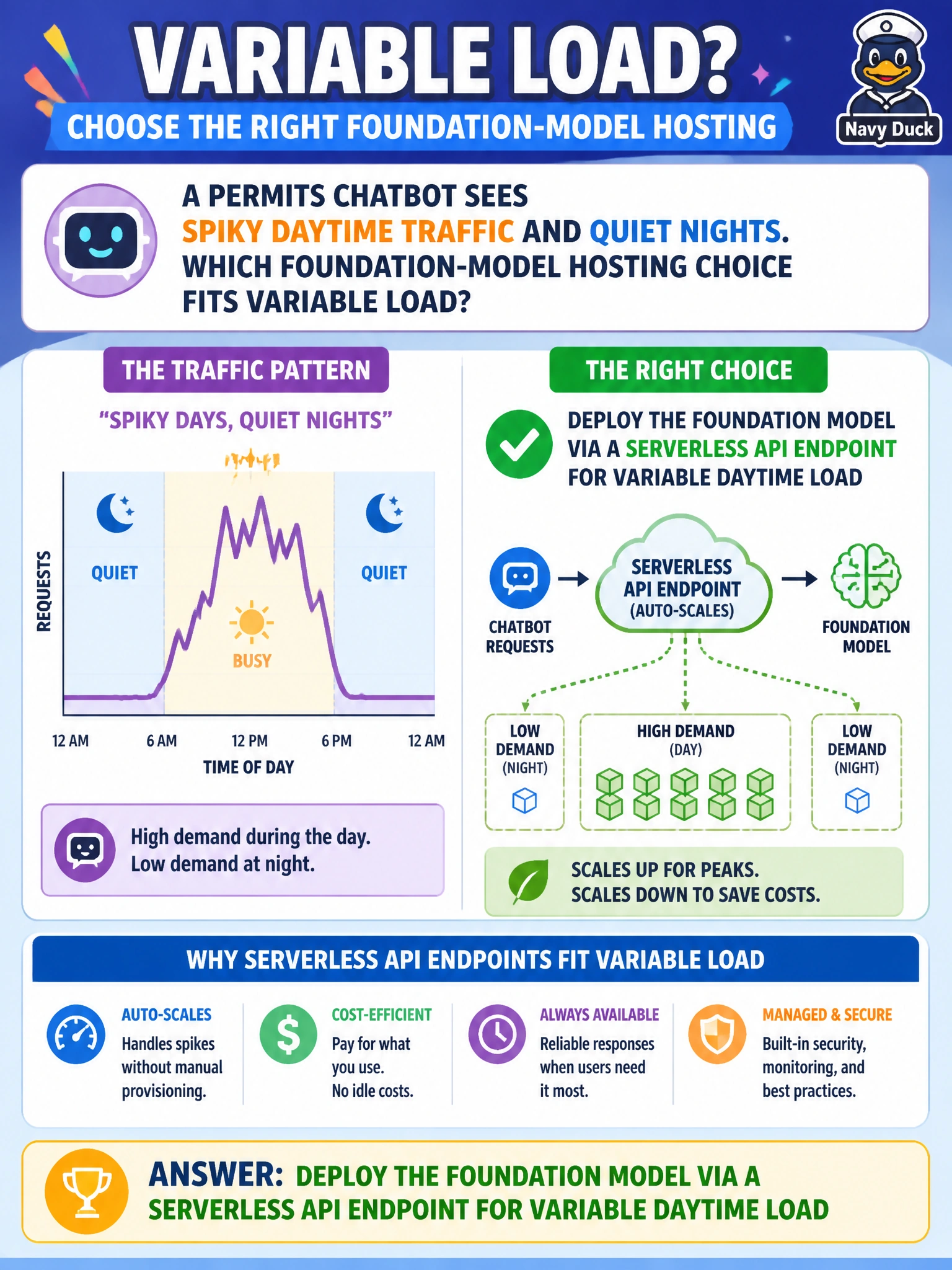
Permit questions spike when the office is open and nap when it is not. You'll flex with that daytime curve on serverless instead of paying for a provisioned throughput endpoint through quiet nights.
Full Explanation
Deploying the foundation model via a serverless API endpoint for variable daytime load is the correct hosting choice for a permits chatbot with spiky daytime traffic and quiet nights. Serverless FM endpoints meter consumption and scale with concurrency, which fits municipal permitting patterns where questions arrive during office hours and idle overnight. That elasticity avoids paying for a provisioned throughput endpoint for variable daytime load through quiet periods while still serving daytime peaks without committing to a batch endpoint for real-time variable daytime load.
Deploying the foundation model via a provisioned throughput endpoint for variable daytime load fails because it reserves and bills capacity through quiet nights when serverless would scale to zero, which wastes budget on predictable idle windows the stem already describes. Deploying the foundation model on managed compute with autoscaling for variable daytime load fails because autoscaling still requires managing instances, scaling rules, and minimum capacity with idle cost and slower scale, whereas serverless already provides automatic concurrency scaling to zero for quiet nights without that overhead. Deploying the foundation model via a batch endpoint for real-time variable daytime load fails because batch endpoints queue offline bulk jobs with high latency and cannot serve interactive chatbot responses, when serverless already matches variable real-time load.
Exam caveat: serverless fits variable or uncertain interactive load; managed compute or PTUs appear when the stem demands reserved capacity, vision/batch control, or hard latency under surge. Choose serverless when the scenario stresses spiky daytime / quiet night traffic without a reserved-throughput mandate.
Operational check: deploy the permits foundation model on a serverless API endpoint, monitor daytime concurrency and overnight idle cost, and revisit PTUs or managed compute only if SLA or quota evidence later requires reserved capacity.
Prefer to study offline? Printable PDF study book + test engine ($7.50, unofficial). These questions stay free here.