
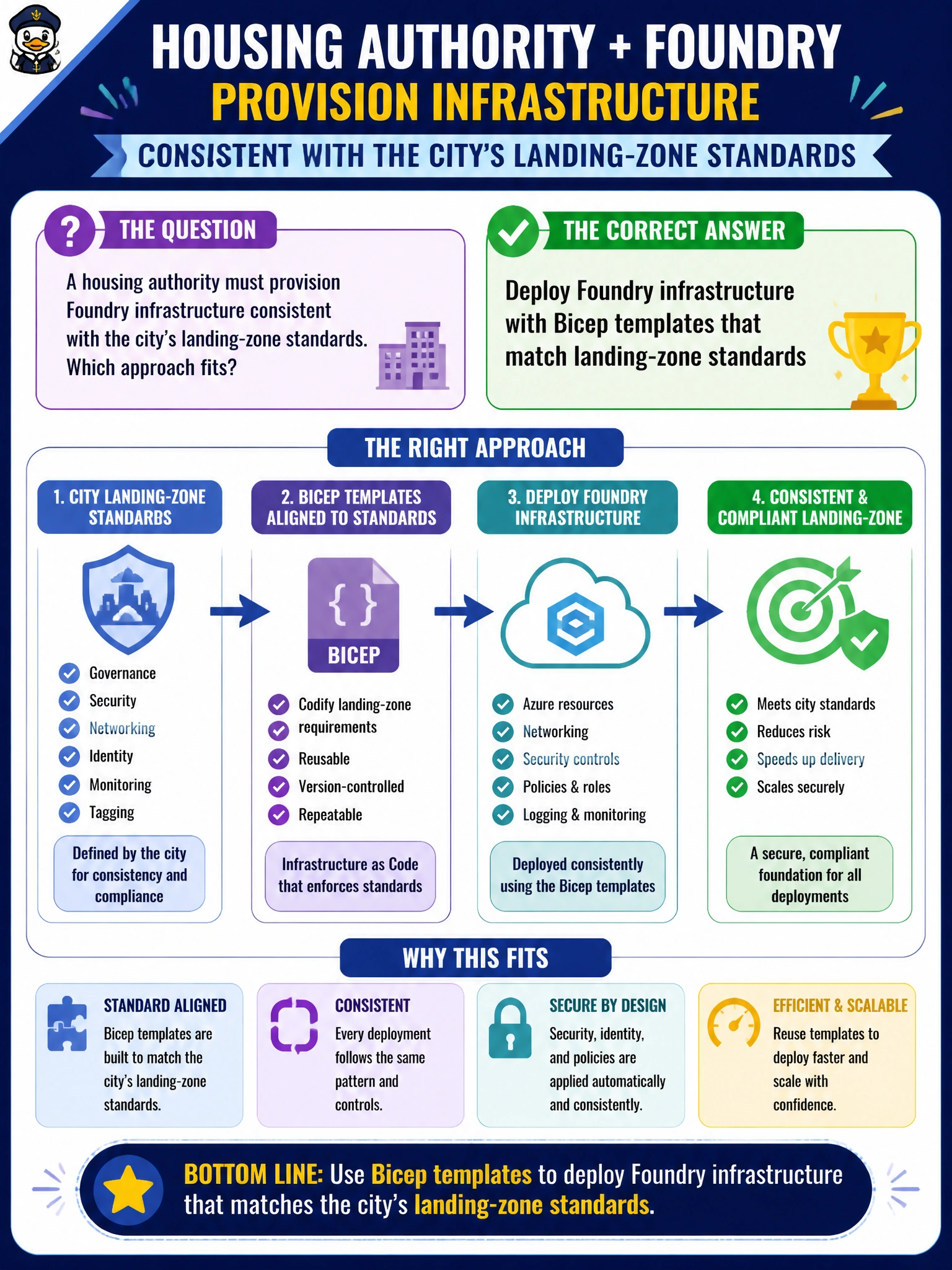
A housing authority must provision Foundry infrastructure consistent with the city’s landing-zone standards. Which approach fits?
Select an answer to reveal the explanation.
Short Explanation
Landing-zone rules are not suggestions — encode Foundry in Bicep so every housing environment matches the city’s standard. You'll break subscription rules if you drop Foundry into the connectivity subscription — it's for hub networking, not housing workloads.
Full Explanation
Deploying Foundry infrastructure with Bicep templates that match landing-zone standards is correct because a housing authority must provision GenAIOps resources consistently with city landing-zone policy—subscriptions, networking, identity, diagnostics, and resource organization. Infrastructure as code (Bicep, often with Azure CLI companion flows) makes Foundry projects and related resources repeatable, reviewable, and aligned to those standards instead of Bicep templates scoped to the connectivity subscription, which is reserved for hub networking rather than housing workload deployments. Consistency across environments is what landing zones exist to enforce.
Deploying Foundry infrastructure with Bicep templates scoped to connectivity subscription fails subscription organization and alignment because the connectivity subscription hosts hub networking, not housing authority Foundry workloads, which belong in designated workload subscriptions under city landing-zone standards. Deploying Foundry infrastructure with Terraform modules pinned to approved registry versions fails alignment because version pinning alone ensures repeatability but does not guarantee the modules encode the city's landing-zone standards for subscriptions, networking, identity, and diagnostics. Deploying Foundry infrastructure with ARM templates published to private template specs fails alignment because publishing to specs aids sharing and versioning but does not by itself ensure the templates encode city landing-zone standards for the housing authority's Foundry resources.
Exam caveat: landing-zone consistency for Foundry points to IaC authored to city standards, not Bicep templates scoped to the connectivity subscription, Terraform modules pinned to approved registry versions alone, or ARM templates published to private template specs without landing-zone alignment.
Operational check: author or reuse Bicep modules that encode city landing-zone requirements for Foundry, deploy to a housing non-prod subscription first, validate policy compliance, then promote the same templates to production with environment parameters only.
Prefer to study offline? Printable PDF study book + test engine ($7.50, unofficial). These questions stay free here.