
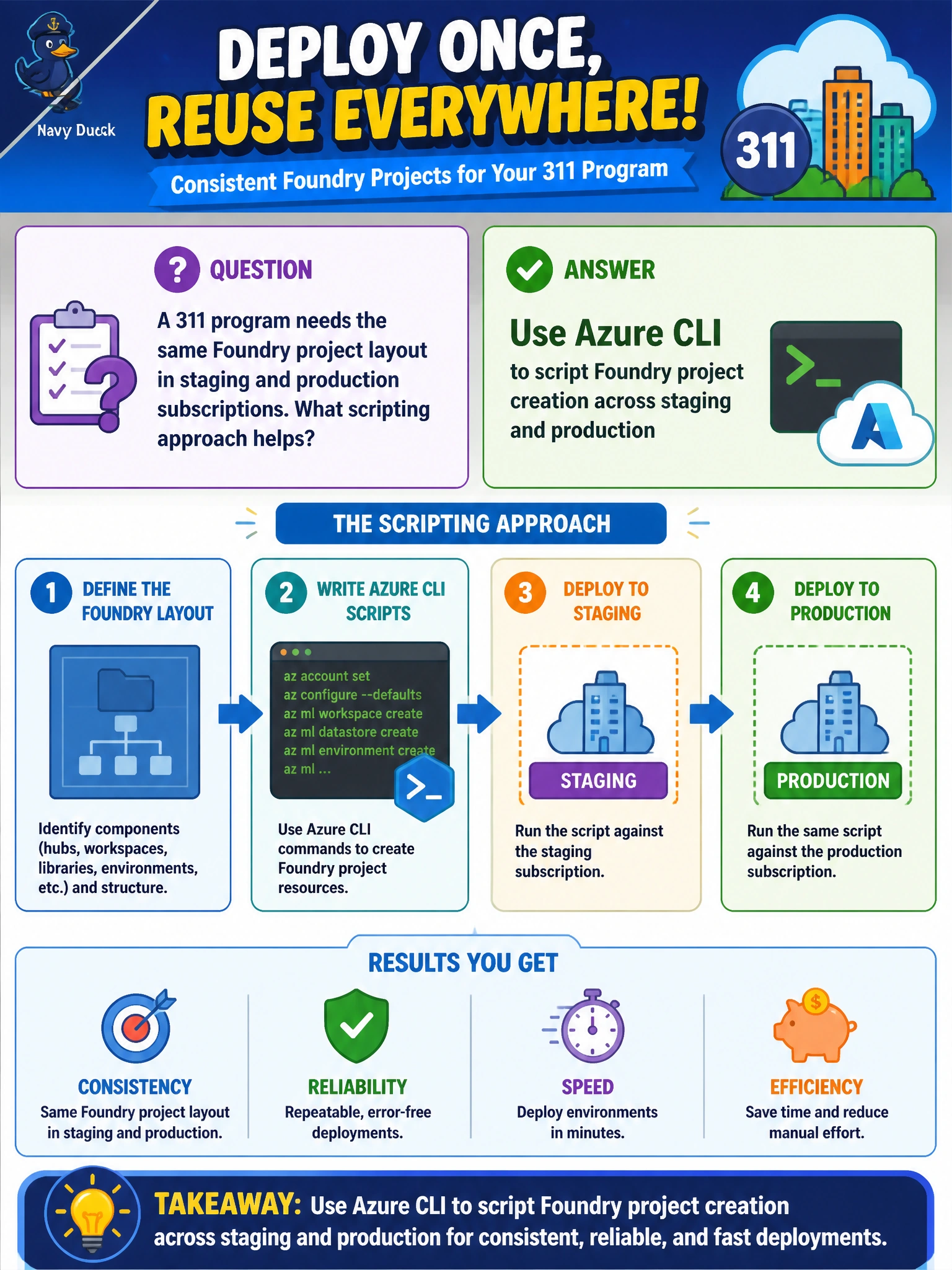
A 311 program needs the same Foundry project layout in staging and production subscriptions. What scripting approach helps?
Select an answer to reveal the explanation.
Short Explanation
Don't share one Foundry workspace across staging and production—that won't give you repeatable layouts and you'll lose environment isolation. Script Foundry project creation with Azure CLI so 311 gets the same shape in both subscriptions.
Full Explanation
Using Azure CLI to script Foundry project creation across staging and production is correct because a 311 program needs the same project layout in both subscriptions and scripting makes that layout repeatable. Azure CLI (often alongside templates) encodes project creation, connections, and baseline settings so staging rehearses what production will receive, reducing configuration drift between environments. Scripted provisioning supports municipal change control better than tribal knowledge. Using Azure CLI to copy Foundry project endpoints across staging and production misses the point because copying endpoints doesn't create or mirror the Foundry project layout, and each environment needs its own endpoints, so it won't give staging and production the same 311 project structure. Using Bicep templates to share Foundry project workspaces across staging and production is off target because the question asks for repeatable Foundry project layout in separate subscriptions, not a single shared workspace that would break staging and production isolation. Using Azure CLI to mirror Foundry project connections across staging and production is insufficient because mirroring connections alone doesn't provision projects or enforce full layout parity, and connections typically require environment-specific targets. Exam caveat: same layout across staging and production → scripted/CLI (or IaC) Foundry provisioning, not endpoint copying, shared-workspace Bicep, or connection mirroring. Operational check: capture Azure CLI commands (or wrap them in a pipeline) that create the 311 Foundry project and required connections, run them in staging, diff resulting configuration to the intended layout, then execute the same script against production with environment-specific parameters and verify parity.
Prefer to study offline? Printable PDF study book + test engine ($7.50, unofficial). These questions stay free here.