
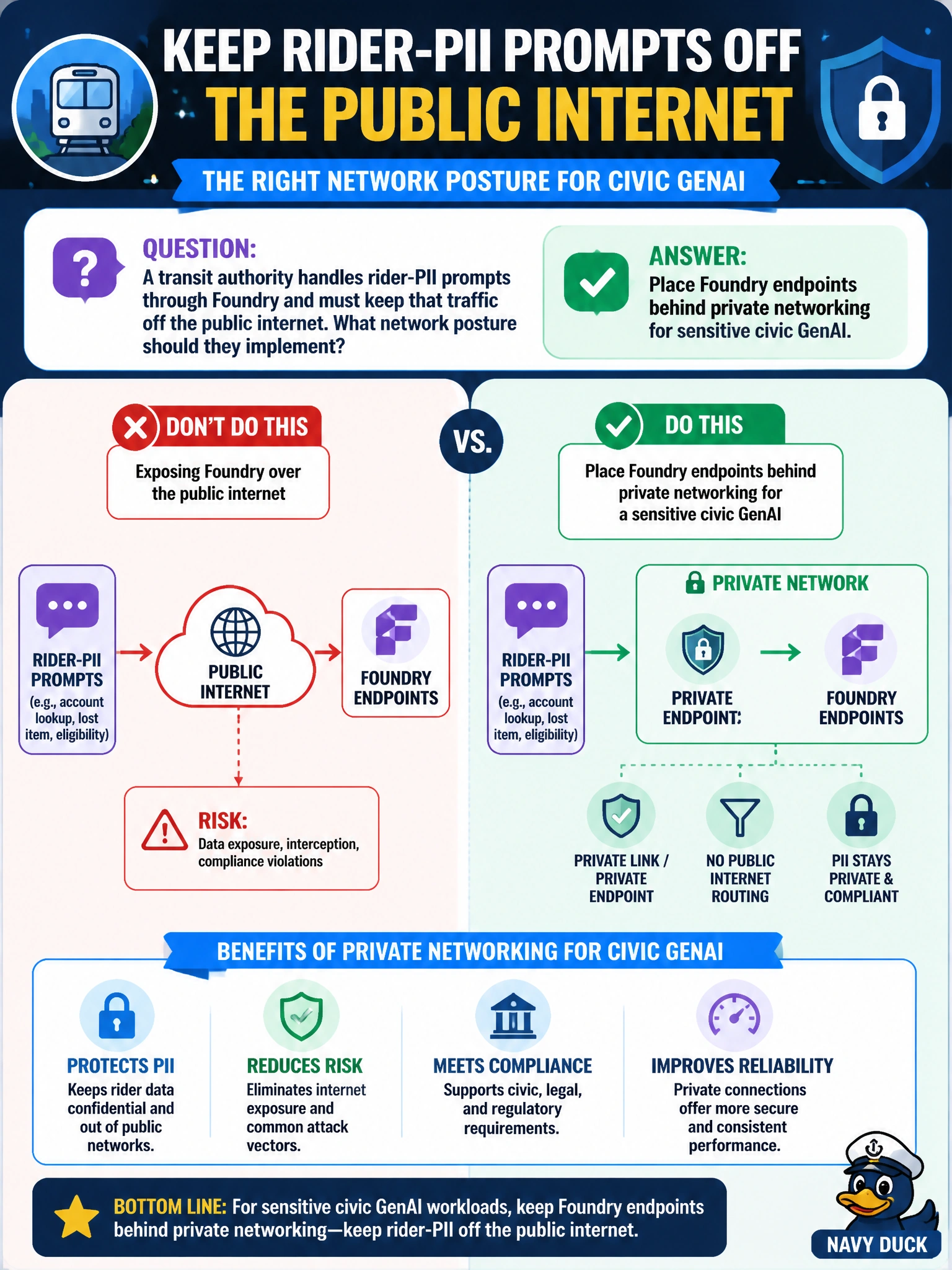
A transit authority handles rider-PII prompts through Foundry and must keep that traffic off the public internet. What network posture should they implement?
Select an answer to reveal the explanation.
Short Explanation
You'll keep rider PII off the public internet, but you won't fix it by isolating training nodes, the management plane, or evaluation jobs. Put Foundry behind private networking so prompts stay on the municipal path.
Full Explanation
Placing Foundry endpoints behind private networking for sensitive civic GenAI is correct because transit rider-PII prompts must not traverse the public internet when municipal policy requires private paths. Private networking (private endpoints / private link patterns and related network isolation) keeps Foundry traffic on the authority’s private connectivity, reducing exposure of prompts, embeddings, and responses that contain rider personal data. Network posture is a first-class GenAIOps control alongside identity and encryption.
Isolating Foundry training nodes behind private networking for batch civic GenAI fails the requirement because it protects batch training connectivity, not live prompt traffic; the rider-PII inference endpoints would still be reachable over public paths.
Placing Foundry management plane behind private networking for sensitive civic GenAI fails the requirement because it isolates control-plane operations, not the data-plane prompt traffic; rider-PII prompts to Foundry endpoints would still traverse public paths.
Applying Foundry private endpoints for evaluation jobs for sensitive civic GenAI fails the requirement because it isolates only evaluation workloads, not production rider-PII endpoints; live prompts, embeddings, and responses would still leave the private network.
Exam caveat: PII/sensitive civic GenAI + network posture → private networking for Foundry endpoints, not training-node isolation, management-plane isolation, or evaluation-job private endpoints.
Operational check: configure private network access for the transit Foundry endpoints, block public ingress for rider-PII workloads, test agent calls from an approved private network path, and confirm public internet clients cannot reach the same endpoints.
Prefer to study offline? Printable PDF study book + test engine ($7.50, unofficial). These questions stay free here.