
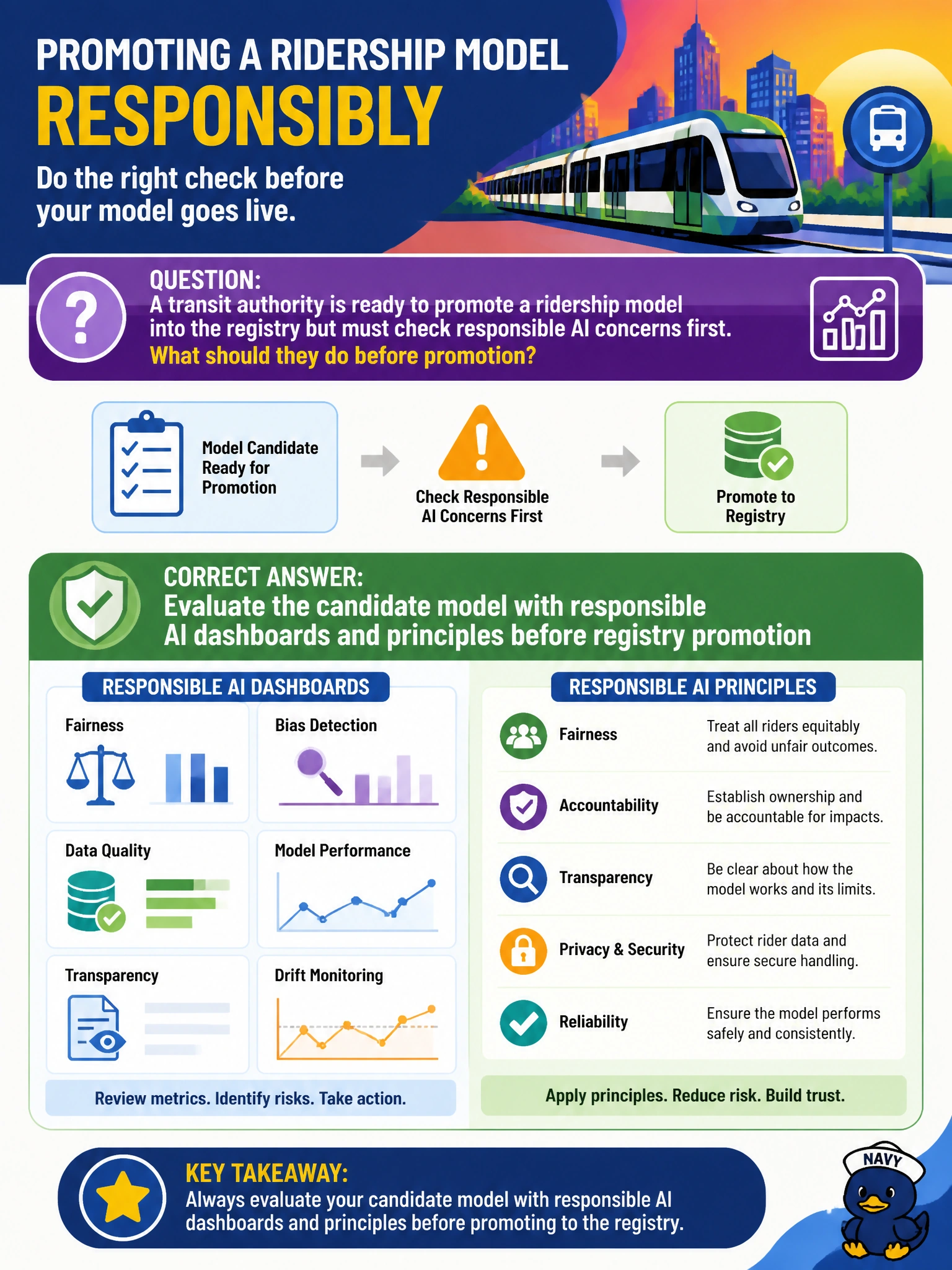
A transit authority is ready to promote a ridership model into the registry but must check responsible AI concerns first. What should they do before promotion?
Select an answer to reveal the explanation.
Short Explanation
Do not stamp the registry card before the fairness check. You'll get averaged accuracy across routes, but you won't see route-level fairness gaps without the Responsible AI check.
Full Explanation
Evaluating the candidate ridership model with responsible AI dashboards and principles before registry promotion is correct because transit authority promotion is a governance act, not only an accuracy contest. Responsible AI tooling surfaces fairness, error disparity, and related concerns while the model is still a candidate, so equity issues are addressed before a registry version becomes easy to deploy. Accuracy without RAI review is insufficient for passenger-impacting forecasts and operational aids. Validating the candidate model with data quality profiling and registry lineage verification before promotion fails because data quality and lineage checks do not replace responsible AI review; fairness, error disparity, and equity concerns still must be surfaced and addressed before the model is promoted to the registry. Evaluating the candidate model with interpretability tools for feature importance before registry promotion fails because feature importance alone is not a responsible AI review and does not reveal fairness or equity issues across rider groups. Evaluating the candidate model with accuracy metrics averaged across routes before registry promotion fails because an averaged number hides route- or neighborhood-level slice failures that responsible AI dashboards are specifically designed to reveal. Exam caveat: RAI dashboards inform a human decision; they do not auto-approve models. Define which principles and metrics are mandatory for this transit use case before the review meeting. Operational check: run responsible AI evaluation on the candidate, attach dashboard outputs to the promotion packet, require sign-off against stated principles, and only then register or advance the model in the Azure ML registry.
Prefer to study offline? Printable PDF study book + test engine ($7.50, unofficial). These questions stay free here.