
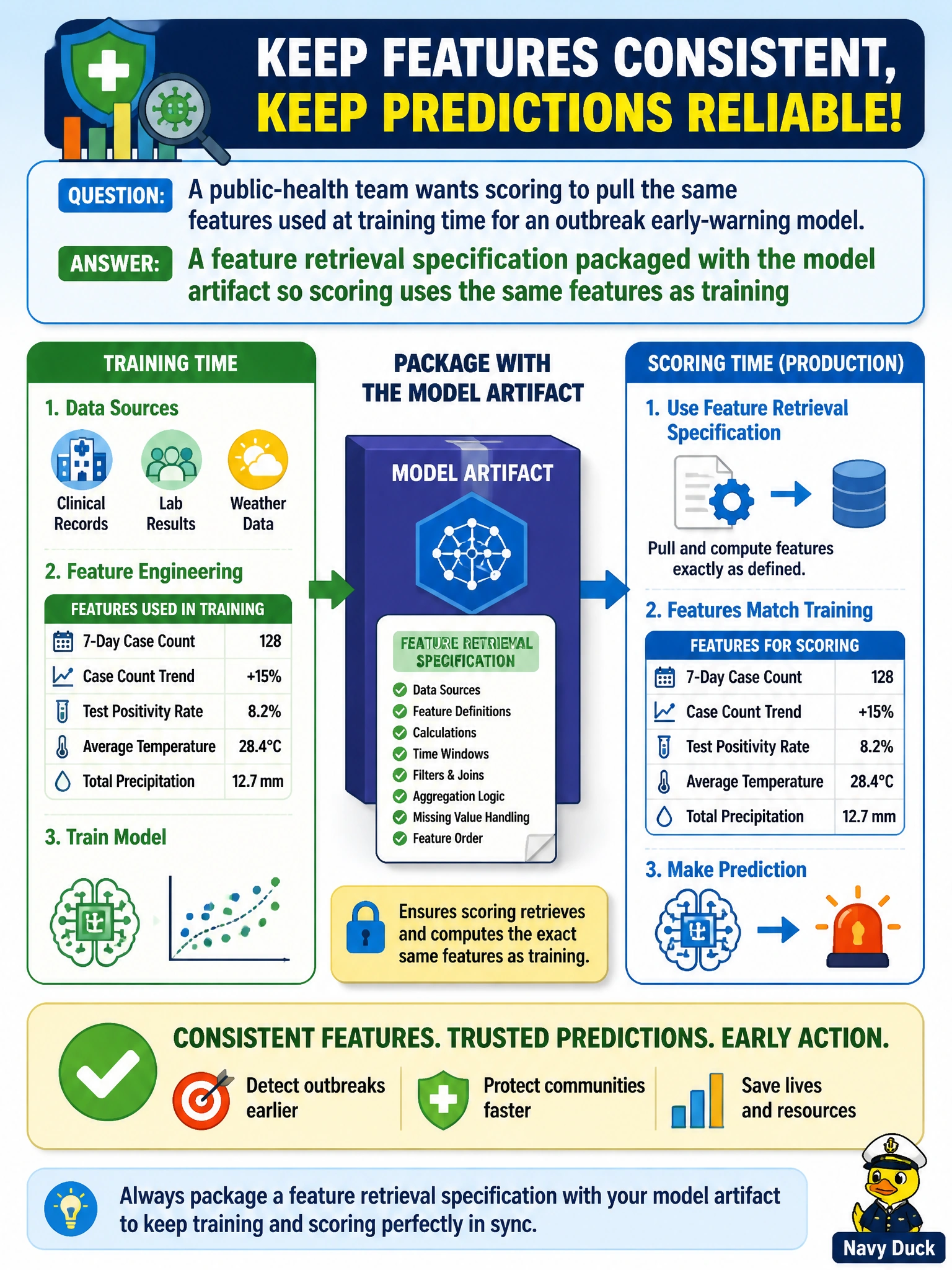
A public-health team wants scoring to pull the same features used at training time for an outbreak early-warning model. What should they package with the model artifact?
Select an answer to reveal the explanation.
Short Explanation
Training and scoring must speak the same feature language. Package a feature retrieval spec with the model so public-health scoring does not invent a different recipe at inference time.
Full Explanation
Packaging a feature retrieval specification with the model artifact so scoring uses the same features as training is correct for public-health outbreak early-warning models. Training–serving skew is a primary operational failure mode: if scoring invents alternate joins, windows, or encodings, calibrated risk scores drift even when weights are unchanged. A retrieval spec (or equivalent feature contract packaged with the model) makes the feature path part of the deployable unit Azure ML and downstream jobs can honor. Packaging a feature retrieval specification with the model artifact so scoring replays the training backfill job for audit fails because replaying the backfill reproduces historical point-in-time values for audit rather than resolving current features for new cases at scoring time. Packaging a feature retrieval specification with the model artifact so scoring pulls labels from the offline store fails because labels are training targets unavailable at inference time, and scoring must retrieve input features rather than ground-truth outcomes. Packaging a feature retrieval specification with the model artifact so scoring reuses the frozen training snapshot table fails because a frozen snapshot locks in stale training rows and does not execute live feature retrieval for new entities scoring needs to evaluate. Exam caveat: the retrieval spec must point at production-reachable feature sources with appropriate freshness and access control—training lake paths are not always identical to online/offline serving paths. Version the spec with the model so updates stay atomic. Operational check: package the feature retrieval specification with the registered model, run a scoring job that resolves features only via that spec, and compare a sample of scored feature vectors to training-time vectors for the same entities before outbreak alerts go live.
Prefer to study offline? Printable PDF study book + test engine ($7.50, unofficial). These questions stay free here.