
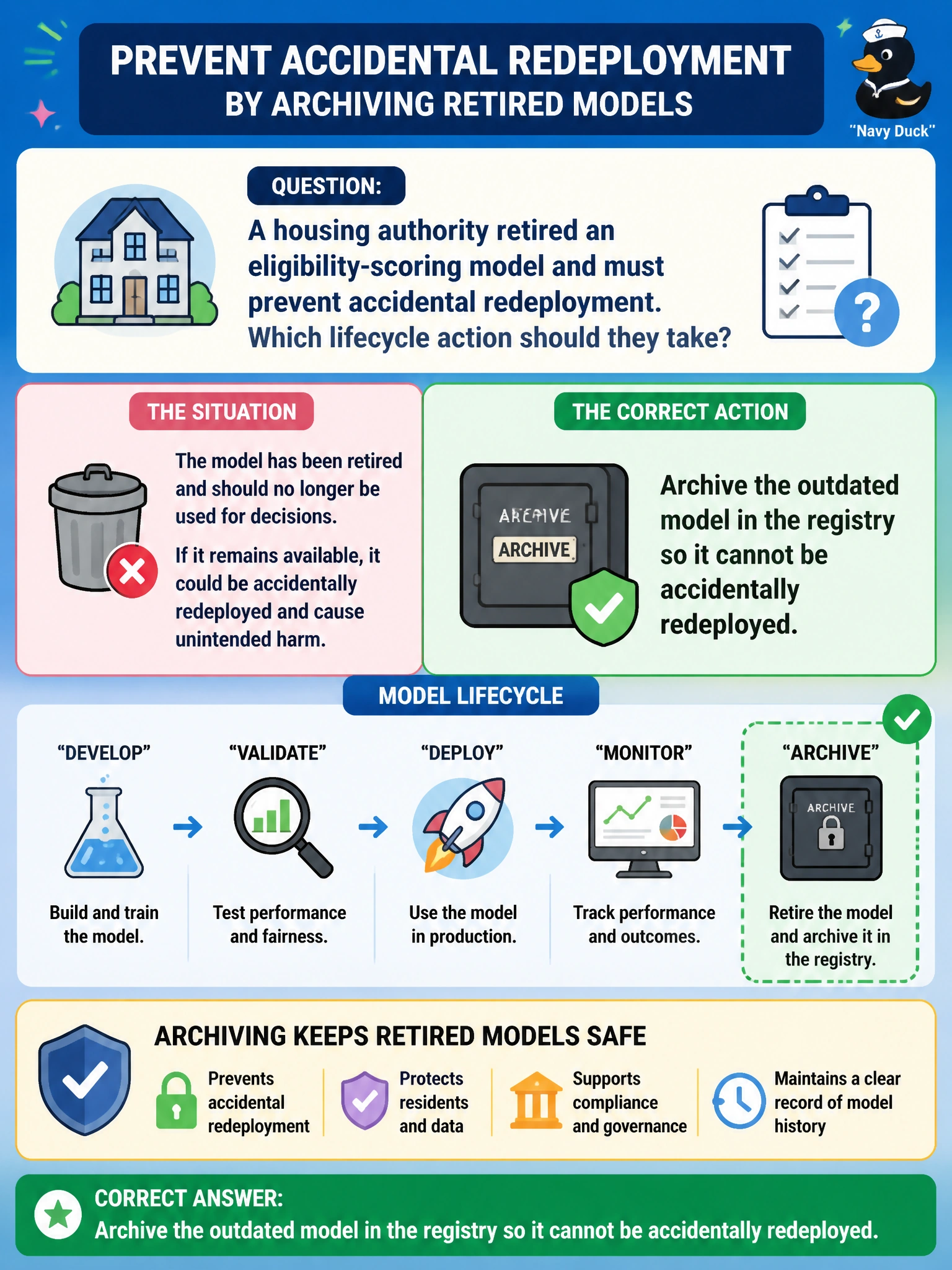
A housing authority retired an eligibility-scoring model and must prevent accidental redeployment. Which lifecycle action should they take?
Select an answer to reveal the explanation.
Short Explanation
Retired models are like expired building permits — archive them so nobody stamps them again by mistake. Archiving keeps history without leaving a live deploy path.
Full Explanation
Archiving the outdated eligibility-scoring model in the registry so it cannot be accidentally redeployed is the correct lifecycle action after a housing authority retires a model. Archive (or equivalent non-deployable lifecycle state) preserves history for audits and comparisons while removing the model from the path that endpoints and release pipelines treat as eligible for production. That separation protects residents from accidental reactivation of a superseded eligibility policy encoded in an old artifact.
Deprecating the inference endpoint for the retired model to block further scoring requests fails because it only stops traffic on that endpoint without removing the registry version from the deployable path, so pipelines and humans could still accidentally redeploy it elsewhere. Exporting the retired model package to cold storage for long-term audit retention fails as the preventive control because it preserves an auditable copy without changing the registry lifecycle, so the version remains eligible for deployment and accidental redeploy.
Transitioning the retired model version to Staging to restrict production promotion workflows fails because Staging still signals a live deploy candidate pending promotion, not a retired artifact that pipelines should refuse.
Exam caveat: archive is not the same as purge—confirm retention policies and whether certain jurisdictions require longer evidence retention for eligibility systems. Also update downstream endpoints and schedules so they no longer pin the archived version. Operational check: set the retired model’s registry lifecycle to Archived, verify deploy pipelines reject it, keep version history readable for auditors, and document the successor model version now authorized for housing scoring.
Prefer to study offline? Printable PDF study book + test engine ($7.50, unofficial). These questions stay free here.