
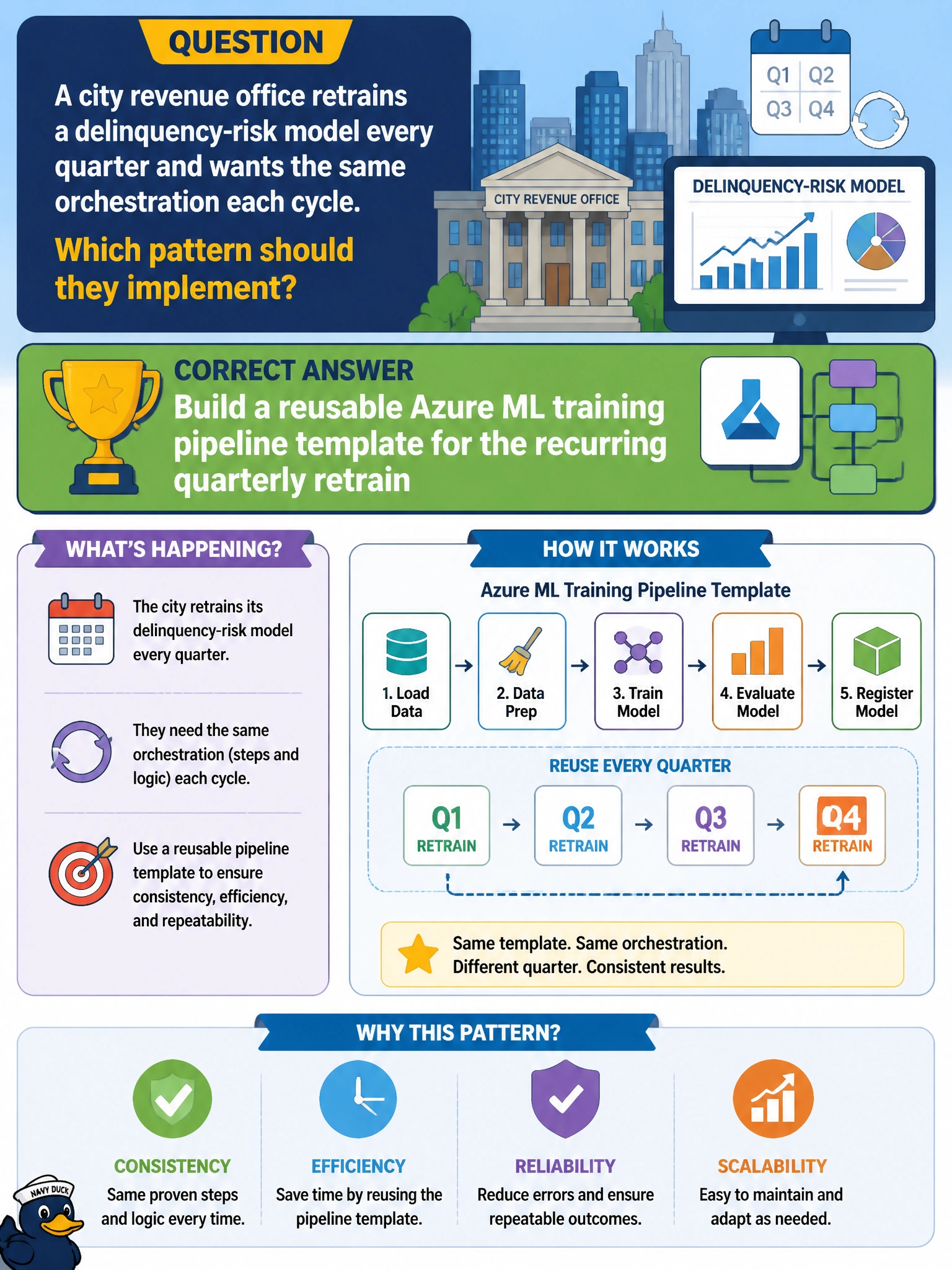
A city revenue office retrains a delinquency-risk model every quarter and wants the same orchestration each cycle. Which pattern should they implement?
Select an answer to reveal the explanation.
Short Explanation
Quarterly delinquency retrains should feel like a bus schedule, not a scavenger hunt. A reusable Azure ML pipeline template keeps the same prep-train-evaluate ride every cycle.
Full Explanation
Building a reusable Azure ML training pipeline template for the recurring quarterly retrain is correct because city revenue delinquency-risk models need the same orchestration—data prep, train, evaluate, register—every cycle without reinventing steps. A template encodes municipal process as code: pinned components, parameters for the quarter’s data asset, and consistent metric gates so finance and auditors see comparable runs over time. That pattern is the Azure ML answer to “same job, many quarters.”
Scheduling an Azure ML batch scoring pipeline to refresh predictions on the quarterly cycle fails because batch scoring runs inference against an already-trained model; it does not retrain the delinquency-risk model or rebuild the training artifacts, so it cannot satisfy the requirement for recurring model retraining. Configuring an Azure ML managed online endpoint to handle model retraining on a quarterly cadence fails conceptually: online endpoints are designed for real-time model serving and inference, not for orchestrating training jobs, so they cannot execute the quarterly retrain pipeline. Creating a versioned Azure ML component for data preparation to share across training jobs fails because a single reusable component addresses only one step; it does not provide the full reusable orchestration template—training, evaluation, registration, and scheduling—needed for the same quarterly retrain cycle.
Exam caveat: a reusable template still needs parameterization (data version, compute target, promotion rules) and ownership; an unused template is theater. Do not equate “pipeline exists” with “model is production-ready”—evaluation gates and responsible-AI checks remain separate promotion criteria. Operational check: publish a quarterly pipeline template, schedule or trigger it with the new data asset version, compare metrics to the prior quarter under the same evaluation definition, and require registry promotion only when the template’s gates pass.
Prefer to study offline? Printable PDF study book + test engine ($7.50, unofficial). These questions stay free here.