
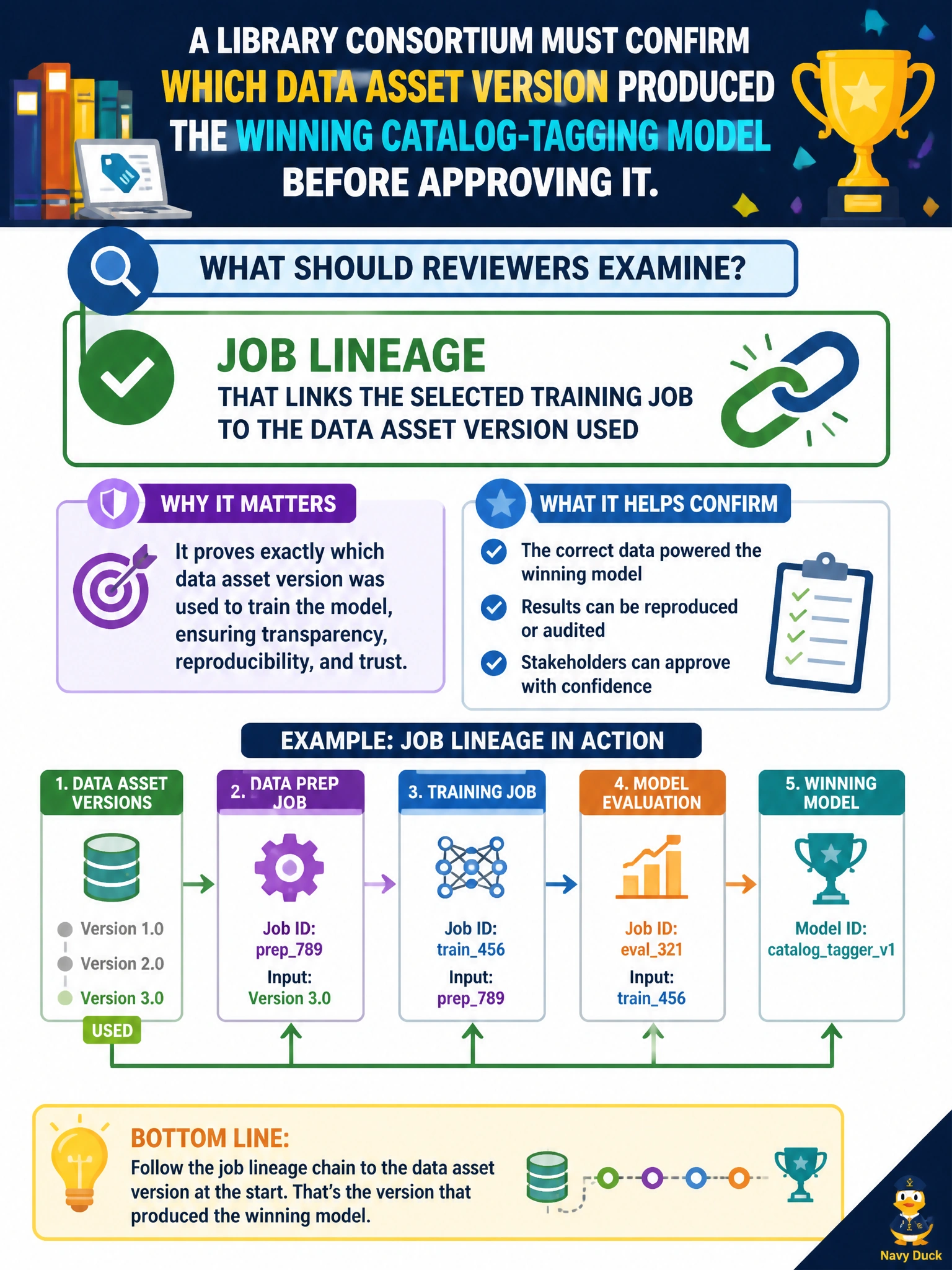
A library consortium must confirm which data asset version produced the winning catalog-tagging model before approving it. What should reviewers examine?
Select an answer to reveal the explanation.
Short Explanation
Accuracy without lineage is like a library card with no barcode — you can't tell which shelf the book came from. You'll prove it only when you trace the job to the exact data version. Job outputs just point to the stored model, storage lineage just points to the source files, and experiment lineage won't show you which job made the winner.
Full Explanation
Examining job lineage that links the selected training job to the data asset version used is correct because library-consortium governance must prove which catalog snapshot produced the winning tagging model before approval. Azure ML lineage connects runs to inputs so reviewers can reproduce training, investigate label quality issues, and reject a model whose “win” came from an unapproved or stale asset. Accuracy alone cannot answer the provenance question the consortium is asking.
Reviewing job outputs that link the selected training job to the model asset version stored fails because they show only the downstream result — which model was produced — and say nothing about which upstream data asset version was consumed, so they cannot prove which catalog snapshot produced the win. Checking data asset lineage that links the data asset version to the source storage path used fails because it proves where that data version came from in storage, not which training job actually consumed it for the winning model — storage provenance cannot substitute for job-input provenance. Relying on experiment lineage that links the tagging experiment to the data asset versions tried fails because an experiment-level link shows the set of versions tried across runs but does not pinpoint which selected training job used which version to produce the winning model; only job-level input lineage can confirm that match.
Exam caveat: lineage is only as strong as consistent use of registered data assets and tracked jobs—ad-hoc local paths break the chain even if a model scores well. Multi-step pipelines require tracing through intermediate assets, not only the final training step. Operational check: open the winning job’s lineage, confirm the exact data asset name and version, re-run evaluation against that asset if needed, and attach the lineage evidence to the consortium’s model approval record before any tagging service promotion.
Prefer to study offline? Printable PDF study book + test engine ($7.50, unofficial). These questions stay free here.