
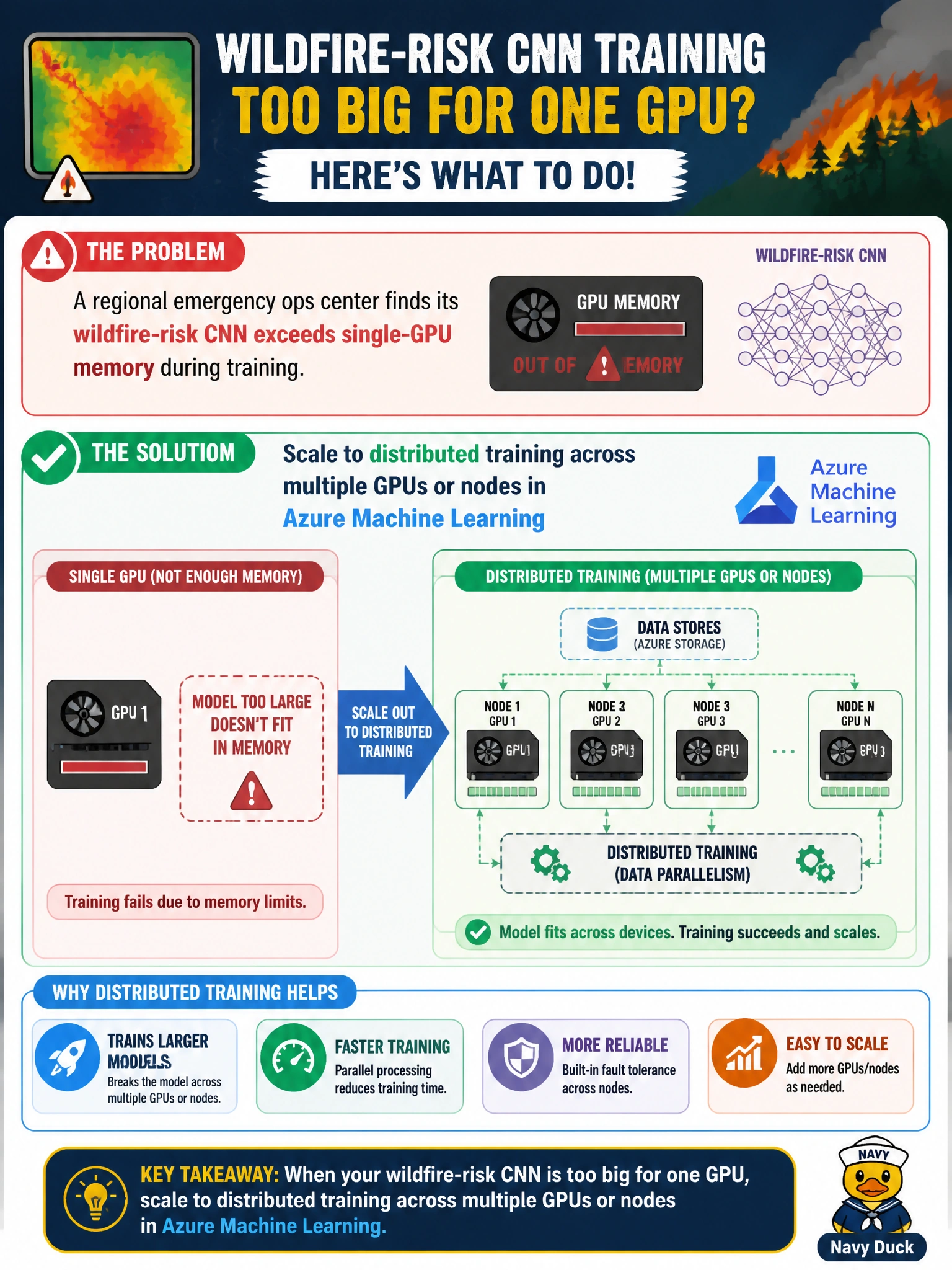
A regional emergency ops center finds its wildfire-risk CNN exceeds single-GPU memory during training. What should the MLOps team do?
Select an answer to reveal the explanation.
Short Explanation
When one GPU runs out of runway, you'll find pipeline caching can't reuse gradients to free memory and spot instances don't give you bigger GPUs. Distributed training spreads the civic deep-learning load across multiple GPUs or nodes.
Full Explanation
Scaling to distributed training across multiple GPUs or nodes in Azure Machine Learning is correct when a wildfire-risk CNN exceeds single-GPU memory. Emergency-ops models often combine high-resolution imagery with deep architectures; distribution (data or model parallel patterns supported by the training framework and Azure ML compute clusters) lets the regional center keep labeled coverage and model capacity, which enabling Azure Machine Learning pipeline caching to reuse gradients across GPU training steps cannot provide because caching only skips reruns of unchanged steps and does not lower the memory needed for forward or backward passes. Azure ML’s job and cluster abstractions exist precisely so civic deep-learning workloads can scale without rewriting the scientific goal.
Enabling Azure Machine Learning pipeline caching to reuse gradients across GPU training steps fails because pipeline caching only reuses outputs of unchanged pipeline steps to save rerun time and does not store or reuse gradients to lower peak GPU memory during training. Switching to low-priority spot instances in Azure Machine Learning to expand GPU memory capacity fails because spot pricing only changes cost and availability, not the memory size of the selected GPU SKU, so the same out-of-memory error occurs while adding preemption risk. Attaching an Azure Machine Learning inference endpoint to offload CNN backpropagation memory fails because inference endpoints only serve predictions from a deployed model and cannot participate in or offload gradient computation during training, so peak training memory is unchanged.
Exam caveat: distributed training introduces synchronization, batch-size, and fault-tolerance concerns; more GPUs do not automatically improve accuracy if hyperparameters are not adjusted and if data partitioning is uneven. Also confirm licensing and data residency for imagery before widening the cluster footprint. Operational check: move the CNN training job onto a multi-GPU/multi-node Azure ML cluster, validate that effective batch size and memory settings succeed, compare validation metrics to the single-GPU baseline, and document cost versus risk-map quality for the emergency ops center.
Prefer to study offline? Printable PDF study book + test engine ($7.50, unofficial). These questions stay free here.