
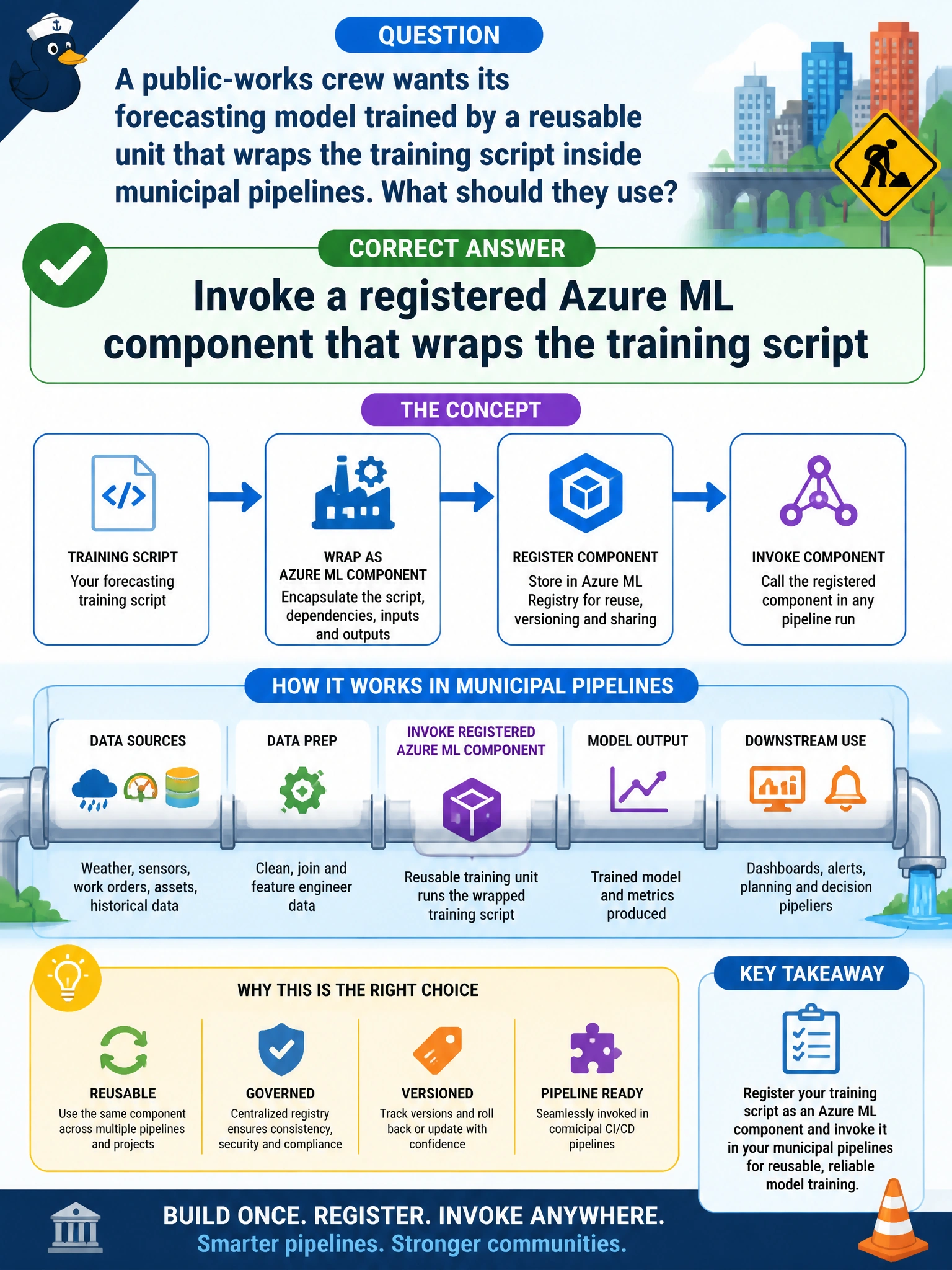
A public-works crew wants its forecasting model trained by a reusable unit that wraps the training script inside municipal pipelines. What should they use?
Select an answer to reveal the explanation.
Short Explanation
Think of a registered component like a city work-order template — same training script, reusable every time. Wrap it once, invoke it from pipelines, and public works stops reinventing the wheel.
Full Explanation
Invoking a registered Azure ML component that wraps the training script is correct because components are the reusable, workspace-governed units municipal pipelines call to train forecasting models the same way across seasons and crews. Registration binds the script, environment, and inputs/outputs into a versioned building block so public-works MLOps can compose prep → train → evaluate without copying ad-hoc files between laptops. That reuse is the operational core of Azure ML pipeline design for recurring civic forecasts. Deploying a registered Azure ML online endpoint that runs the training script fails because an online endpoint is built for model serving and inference, not for wrapping a training script as a versioned pipeline unit; it does not give municipal pipelines the reusable, registered component they need to rerun training the same way each season. Using a registered Azure ML environment that contains the training script fails because an environment only declares compute dependencies and does not register, version, or formalize the script as a reusable component with explicit inputs and outputs; the pipeline still lacks the governed, callable unit the question requires. Registering an Azure ML data asset that versions the training script fails because a data asset only versions and references files or data for pipeline input and does not wrap the script as an executable, reusable component with its own command, inputs and outputs; the pipeline still lacks the governed, callable training unit the question requires.
Exam caveat: registering a component is necessary but not sufficient—pipelines must still pin the component version and validate input schemas so a newer component does not silently change municipal forecast behavior. Prefer explicit inputs (data asset versions, hyperparameters) over hidden notebook globals. Operational check: wrap the training script as a component, register it, invoke it from a pipeline with pinned data and env, and verify the job’s lineage shows the same component version and metrics the public-works team expects before promoting the forecast model.
Prefer to study offline? Printable PDF study book + test engine ($7.50, unofficial). These questions stay free here.