
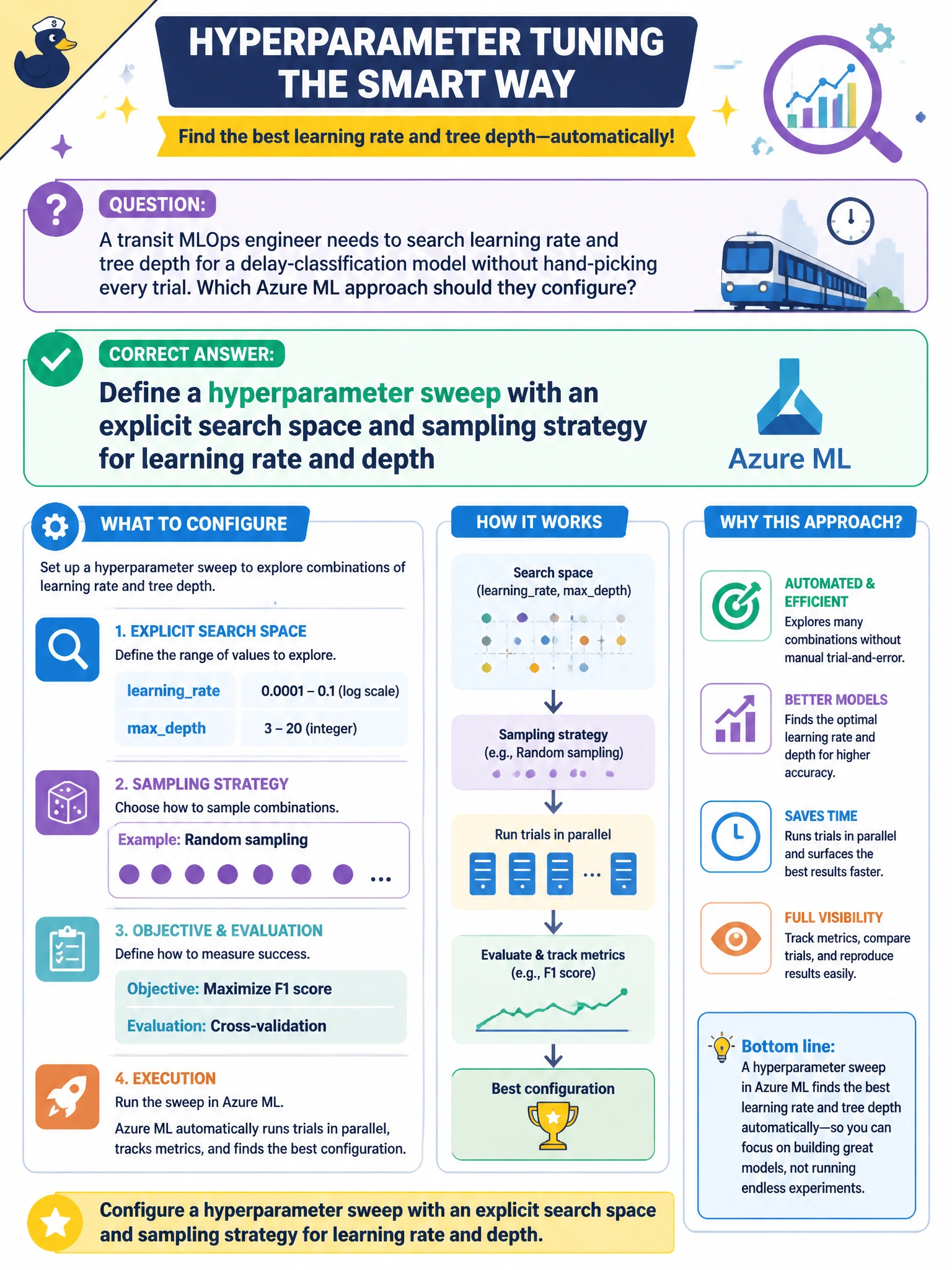
A transit MLOps engineer needs to search learning rate and tree depth for a delay-classification model without hand-picking every trial. Which Azure ML approach should they configure?
Select an answer to reveal the explanation.
Short Explanation
Sweeps are like transit route trials — you define the map of stops (search space) and how you sample them. Point Azure ML at learning rate and depth, then let the sweep explore instead of guessing overnight.
Full Explanation
Configuring a hyperparameter sweep with an explicit search space and sampling strategy for learning rate and tree depth is correct because Azure Machine Learning sweeps systematize exploration that would otherwise be manual guesswork for a transit delay-classification model. Defining the ranges (and how trials are sampled—random, grid, or Bayesian) lets MLOps compare runs under shared data and compute settings, retain metrics per trial, and select a champion without hand-picking every combination during schedule pressure. That structure is what Domain 2 expects when you must improve model quality under municipal compute budgets.
Training the delay-classification model in an Azure ML pipeline that logs learning rate and depth with MLflow for comparison fails because logging parameters is not the same as tuning them; without a defined search space and sampling strategy, it still leaves exploration to chance and cannot systematically compare trials the way a sweep does. Configuring an Automated ML classification job to evaluate algorithms for delay prediction using learning rate and depth ranges fails because AutoML is built to choose among algorithms and tune broadly, not to give the engineer explicit control over a search space and sampling strategy for just learning rate and tree depth; that generality misses the requirement to systematically sweep those two specific parameters without hand-picking every trial. Provisioning an Azure ML compute cluster with autoscaling to train delay-classification variants using learning rate and depth values fails because autoscaling only manages compute capacity; it does not define a search space, sampling strategy, or systematic sweep over learning rate and depth, so it does not replace hand-picking trials.
Exam caveat: a sweep still needs early termination, concurrency limits, and a primary metric tied to the transit objective—otherwise spend explodes without operational gain. Sampling strategy choice affects cost versus coverage; Bayesian can be efficient but is not magic without a well-bounded space. Operational check: declare learning-rate and depth ranges in a sweep job, set sampling and max concurrent trials, log validation metrics per child run, and promote only the best trial after comparing against a frozen baseline on a held-out delay window.
Prefer to study offline? Printable PDF study book + test engine ($7.50, unofficial). These questions stay free here.