
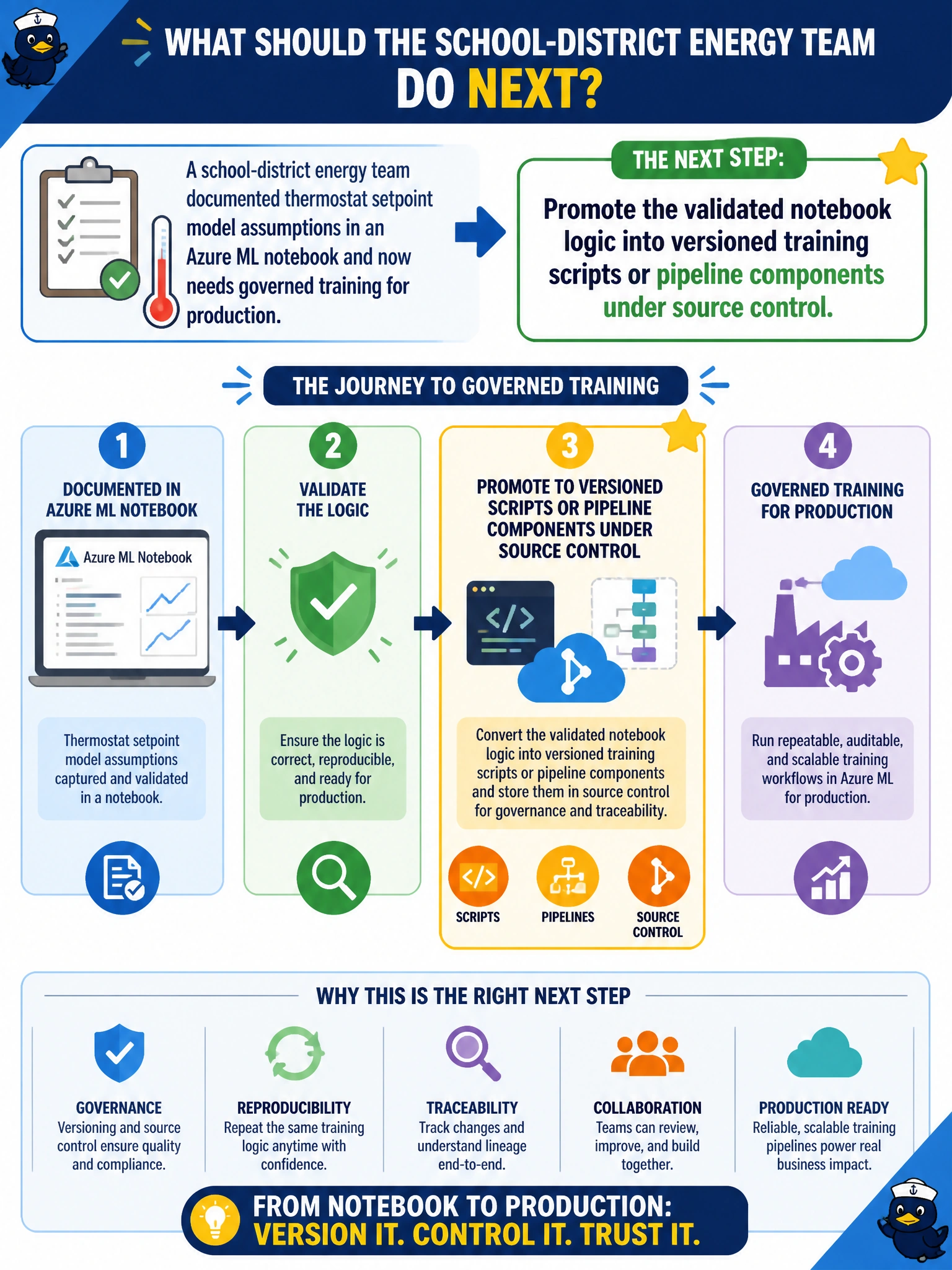
A school-district energy team documented thermostat setpoint model assumptions in an Azure ML notebook and now needs governed training for production. What should they do next?
Select an answer to reveal the explanation.
Short Explanation
Notebooks are the sketchpad — production is the blueprint. Once the thermostat model ideas check out, promote them into versioned scripts or components so the district can govern and repeat the train. Don't deploy it to a versioned managed online endpoint for training; endpoints serve predictions and won't give you governed, repeatable training runs.
Full Explanation
Promoting validated notebook logic into versioned training scripts or pipeline components under source control is the correct next step because Azure Machine Learning treats notebooks as an experimentation surface, not as the governed production training unit for a school-district energy workload. Once thermostat setpoint model assumptions have been proven in the notebook, those steps must be expressed as reviewable scripts or reusable components so training can be triggered the same way every cycle, reviewed in pull requests, and audited against municipal change-control expectations. Source control also preserves who changed feature prep, loss functions, and evaluation gates—evidence districts need when energy savings claims are challenged.
Promoting the validated notebook logic into versioned scheduled jobs configured to run on a compute instance fails because a compute instance is an interactive development target, not governed production training compute, and scheduling alone does not produce reviewable scripts or composable pipeline components that can be pinned and audited. Registering the validated notebook as a versioned MLflow model asset fails because MLflow model registration versions the trained output for deployment, not the training logic itself, and does not provide script- or component-based steps with declared inputs, pinned dependencies, and data lineage required for reproducible training runs. Deploying the validated notebook logic to a versioned managed online endpoint for governed production training jobs fails because an online endpoint is an inference serving target, not a governed training unit; versioning the endpoint still does not create versioned training scripts or components, and it serves prediction traffic rather than enforcing repeatable, auditable training cycles.
Exam caveat: promotion does not mean discarding the notebook; keep it as design history while production trains from scripts/components. Do not confuse “it ran once in my notebook” with pipeline readiness—missing dependency pins or data-path hardcodes still break governed runs. Operational check: extract the validated training path into a repo-backed script or component, register it in the workspace, run the identical job from a pipeline or CLI, and confirm metrics and lineage match the notebook baseline before any school-building deployment gate.
Prefer to study offline? Printable PDF study book + test engine ($7.50, unofficial). These questions stay free here.