
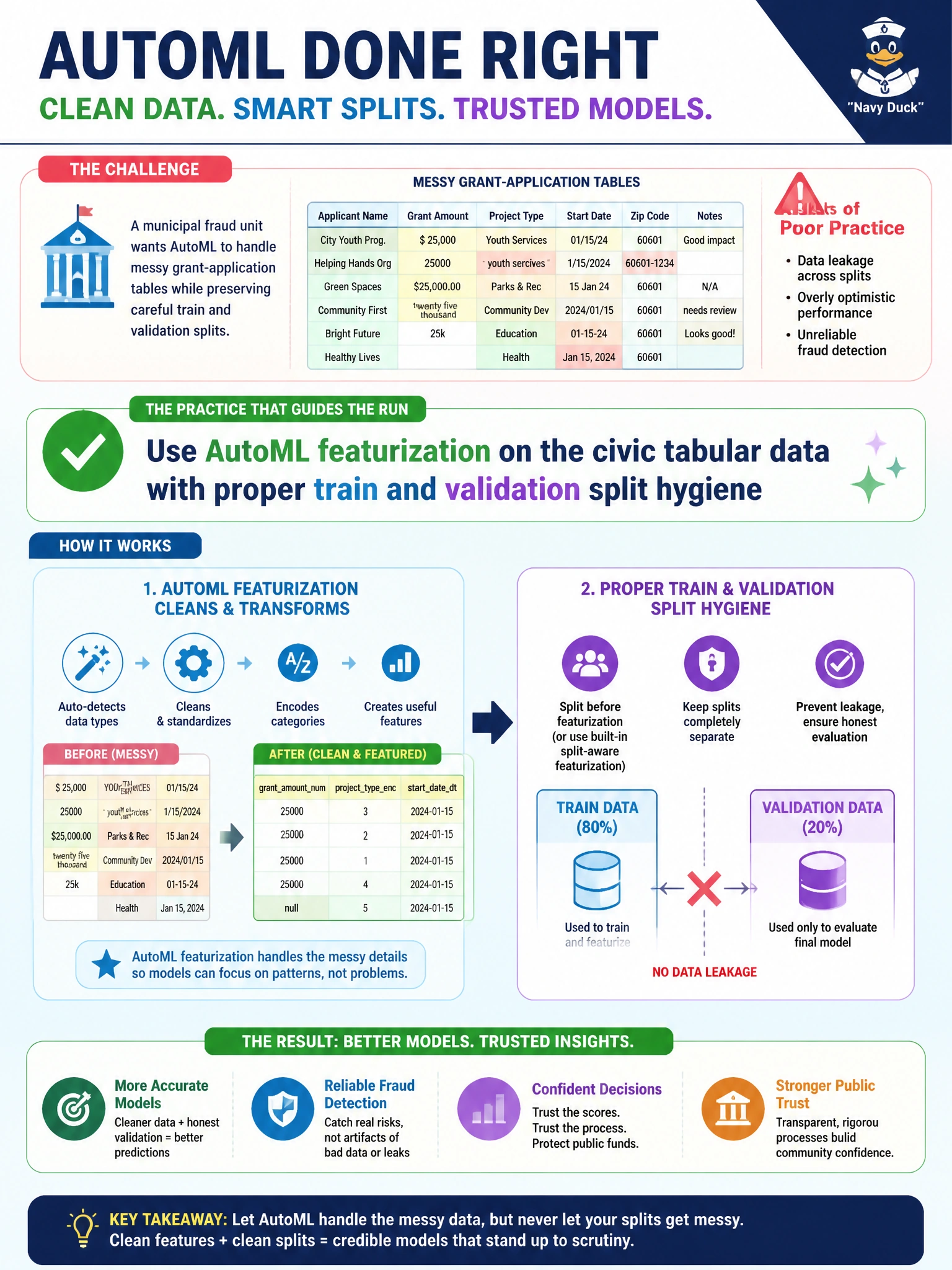
A municipal fraud unit wants AutoML to handle messy grant-application tables while preserving careful train and validation splits. Which practice should guide the AutoML run?
Select an answer to reveal the explanation.
Short Explanation
Messy grant tables love AutoML featurization — but don't use target-encoded grant types balanced across folds or you'll leak validation labels into training. Keep train and validation honest so your fraud model doesn't memorize the answer key. And don't use validation-tuned imputation for training rows or pre-scaled amounts merged before splitting; let AutoML learn those stats from training only.
Full Explanation
Using AutoML featurization on civic tabular grant-application data with proper train and validation split hygiene lets the municipal fraud unit handle messy tables without cheating the evaluation. AutoML can impute, encode, and generate features useful for messy municipal columns, but selection remains valid only when train and validation rows stay separated. Honest splits prevent memorizing the answer key and misleading fraud-unit decisions.
Using AutoML featurization on the civic tabular data with target-encoded grant types balanced across folds fails by concept: it lets validation labels influence training encodings, leaking target information across the split and inflating metrics. Using AutoML featurization on the civic tabular data with validation-tuned imputation for training rows fails split hygiene: it lets validation rows tune the values filled into training rows, leaking information across the split and inflating metrics. Using AutoML featurization on the civic tabular data with pre-scaled grant amounts merged before splitting fails split hygiene: merging scaled values before the split applies full-table statistics rather than learning scaling within the training fold, leaking information and distorting validation.
Exam caveat: AutoML tabular questions often combine featurization benefits with split hygiene; any option that uses target-encoded grant types balanced across folds, uses validation-tuned imputation for training rows, or uses pre-scaled grant amounts merged before splitting is wrong.
Operational check: configure AutoML with featurization enabled, enforce a validation split (or cross-validation) with no row leakage, review featurization summary and metrics, and reject runs whose target-encoded grant types are balanced across folds, whose imputation for training rows is tuned on validation, or whose pre-scaled grant amounts are merged before splitting ahead of any fraud-unit deployment.
Prefer to study offline? Printable PDF study book + test engine ($7.50, unofficial). These questions stay free here.