
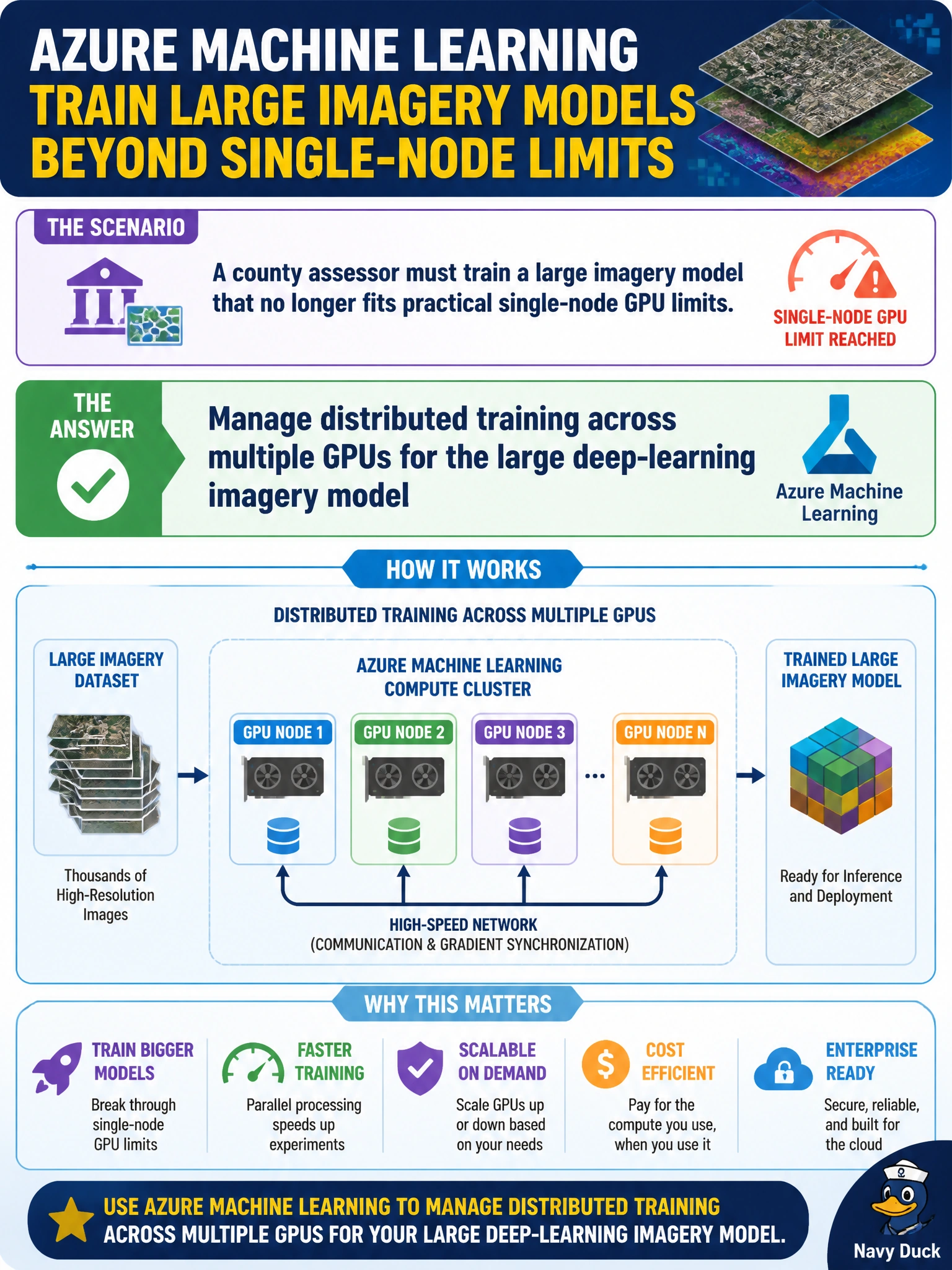
A county assessor must train a large imagery model that no longer fits practical single-node GPU limits. What should the team use in Azure Machine Learning?
Select an answer to reveal the explanation.
Short Explanation
When your imagery model outgrows one GPU, enabling MLflow autologging won't give you the capacity to train it — you'll need to spread the load. Distributed training across multiple GPUs is how Azure ML handles oversized civic deep-learning jobs.
Full Explanation
Managing distributed training across multiple GPUs for the large deep-learning imagery model is the Azure Machine Learning approach when county assessor workloads exceed practical single-node GPU limits. Distributed training frameworks and multi-node/multi-GPU compute clusters partition work so model size and throughput remain feasible. Domain 2 covers distributed training as the response to large and deep learning jobs rather than enabling MLflow autologging with distributed run tracking for the large deep-learning imagery model, which improves observability but does not add the GPU capacity needed for deep-model training.
Running Hyperdrive sweep jobs across single-GPU nodes for the large deep-learning imagery model fails by concept: Hyperdrive launches separate hyperparameter trials that each remain constrained by single-node GPU limits and does not partition and jointly train one oversized model across multiple GPUs. Enabling MLflow autologging with distributed run tracking for the large deep-learning imagery model fails methodology: autologging only records metrics, parameters, and artifacts for observability and does not supply the distributed GPU compute required when a model exceeds single-node limits. Running Automated ML vision tasks on a CPU compute cluster for the large deep-learning imagery model fails fit and capacity: Automated ML on a CPU cluster does not provide multi-GPU distributed training and cannot accommodate a large deep-learning model that no longer fits practical single-node GPU limits.
Exam caveat: Large/deep learning capacity questions point to distributed training in Azure ML; running Hyperdrive sweeps on single-GPU nodes, enabling MLflow autologging with run tracking, and running Automated ML vision tasks on a CPU cluster are distractors.
Operational check: configure a multi-GPU compute cluster, launch a distributed training job with the imagery script, confirm workers start and gradients synchronize as expected, monitor GPU utilization, and compare time-to-epoch against the prior single-node baseline.
Prefer to study offline? Printable PDF study book + test engine ($7.50, unofficial). These questions stay free here.