
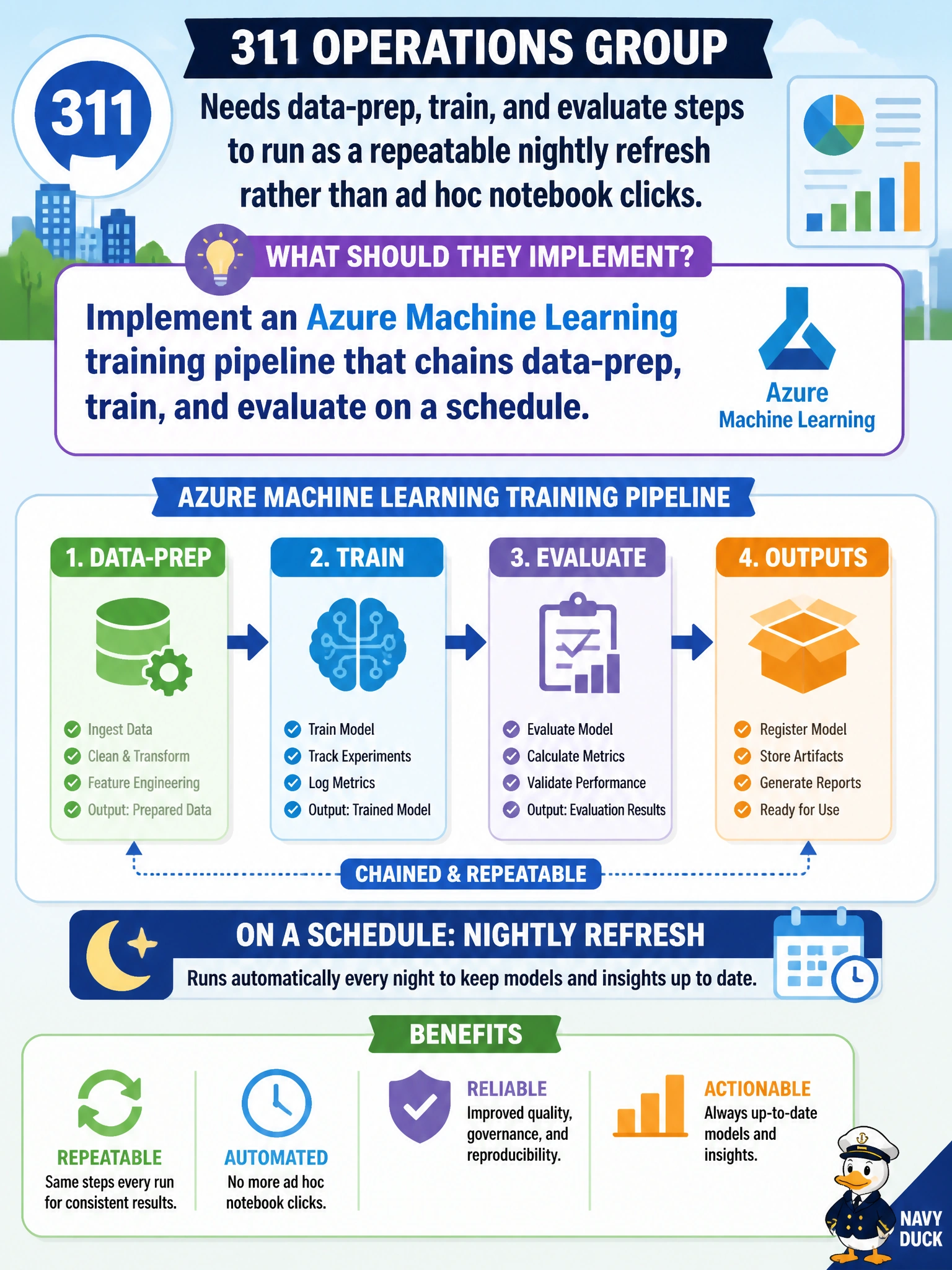
A 311 operations group needs data-prep, train, and evaluate steps to run as a repeatable nightly refresh rather than ad hoc notebook clicks. What should they implement?
Select an answer to reveal the explanation.
Short Explanation
You don't want a batch endpoint that's built for scoring, since it won't orchestrate retraining. Chain prep → train → evaluate in an Azure ML pipeline on a schedule so you'll stay current, since Data Factory is for data moves and a managed endpoint deployment is for serving, not nightly retraining.
Full Explanation
Implementing an Azure Machine Learning training pipeline that chains data-prep, train, and evaluate on a schedule gives 311 operations a repeatable nightly refresh, whereas implementing an Azure Machine Learning batch endpoint that chains data-prep, train, and evaluate on a schedule misapplies a scoring construct that hosts models for batch inference and does not orchestrate training. Pipelines encode step boundaries, inputs/outputs, and lineage so each night's model refresh is an orchestrated job with logs—not an Azure Data Factory pipeline, which orchestrates data movement and transformation but does not run Azure Machine Learning train and evaluate steps. Scheduling attaches the workflow to municipal clock time so the prep→train→evaluate refresh runs automatically, unlike a batch endpoint which is designed for scheduled scoring with a deployed model, not for retraining.
Implementing an Azure Machine Learning batch endpoint that chains data-prep, train, and evaluate on a schedule fails by concept: batch endpoints invoke an already-registered model for asynchronous scoring, so they do not orchestrate data-prep, train, and evaluate to produce a refreshed model. Implementing an Azure Data Factory pipeline that chains data-prep, train, and evaluate on a nightly schedule fails the requirement because Data Factory orchestrates data ingestion and transformation, not Azure Machine Learning training and evaluation, so no trained and evaluated model artifact is produced by the proper ML orchestration. Deploying an Azure Machine Learning training pipeline that chains data-prep, train, and evaluate to a managed endpoint fails freshness because managed endpoints serve models for real-time inference; deploying training work there does not create a scheduled nightly prep→train→evaluate refresh as ticket patterns drift.
Exam caveat: Domain 2 pipeline items expect multi-step orchestration with schedule for refresh scenarios; a batch endpoint for scoring or a Data Factory pipeline for data orchestration are wrong when the stem demands nightly repeatability of prep→train→evaluate. Operational check: publish the pipeline with prep→train→evaluate, attach a schedule, verify a night run completes with step logs and metrics, and confirm the evaluated model artifact is produced without substituting a batch endpoint, Data Factory orchestration, or managed endpoint deployment.
Prefer to study offline? Printable PDF study book + test engine ($7.50, unofficial). These questions stay free here.