
A water utility wants systematic search over hyperparameters for a leak-detection model instead of overnight hand-tuning. What should the MLOps engineer configure?
Select an answer to reveal the explanation.
Short Explanation
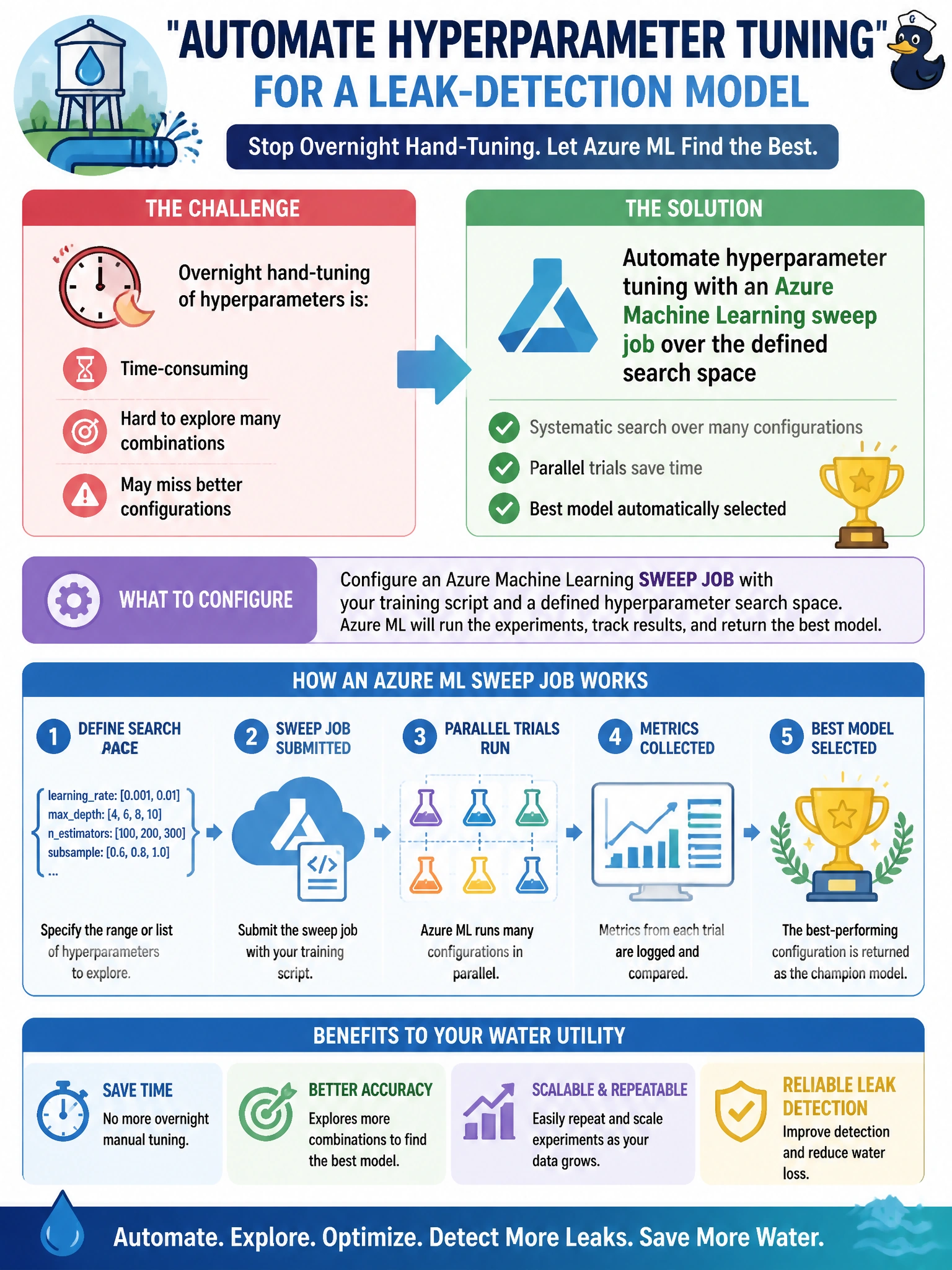
Hand-tuning overnight is like adjusting valves in the dark. You want a sweep job that searches the hyperparameter space on purpose, so leak-detection quality improves without guesswork. A command job just runs once, a pipeline component just packages a step, and an online endpoint just serves scores, so they won't search the space for you.
Full Explanation
Automating hyperparameter tuning with an Azure Machine Learning sweep job over a defined search space gives the water utility systematic search for leak-detection quality instead of overnight hand-tuning. Sweep jobs explore learning rates, depths, regularization, and related knobs under experiment tracking, producing comparable metrics across trials. Structured search reduces guesswork and keeps utility model improvement inside governed compute rather than ad hoc manual adjustment.
Automating hyperparameter tuning with an Azure Machine Learning command job over the defined search space fails by concept: a command job runs a single execution with fixed inputs and provides no sampling strategy, multi-trial orchestration, or early-termination policy — it cannot systematically explore a defined space the way a sweep job does. Automating hyperparameter tuning with an Azure Machine Learning pipeline component over the defined search space fails because a component only defines reusable step logic and a pipeline only sequences steps; neither provides the sampling algorithm and trial management needed to search for better hyperparameters. Automating hyperparameter tuning with an Azure Machine Learning online endpoint over the defined search space fails because an online endpoint is a serving construct for scoring with an already-trained model — it has no training loop, search space handling, or trial evaluation to find good hyperparameters in the first place.
Exam caveat: AI-300 expects automated hyperparameter tuning / sweep jobs for systematic search; a command job, a pipeline component, and an online endpoint described as tuning over a search space are all distractors that lack sweep orchestration and skip the actual tuning question.
Operational check: define the search space and primary metric, submit a sweep on non-production data, review trial metrics in Azure ML, promote the best trial's parameters into the training pipeline definition, and ensure production endpoints only receive validated parameter sets.
Prefer to study offline? Printable PDF study book + test engine ($7.50, unofficial). These questions stay free here.