
A city data scientist needs to prototype feature ideas for an illegal-dumping classifier before the team builds a production training pipeline. Which approach is most appropriate for that early stage?
Select an answer to reveal the explanation.
Short Explanation
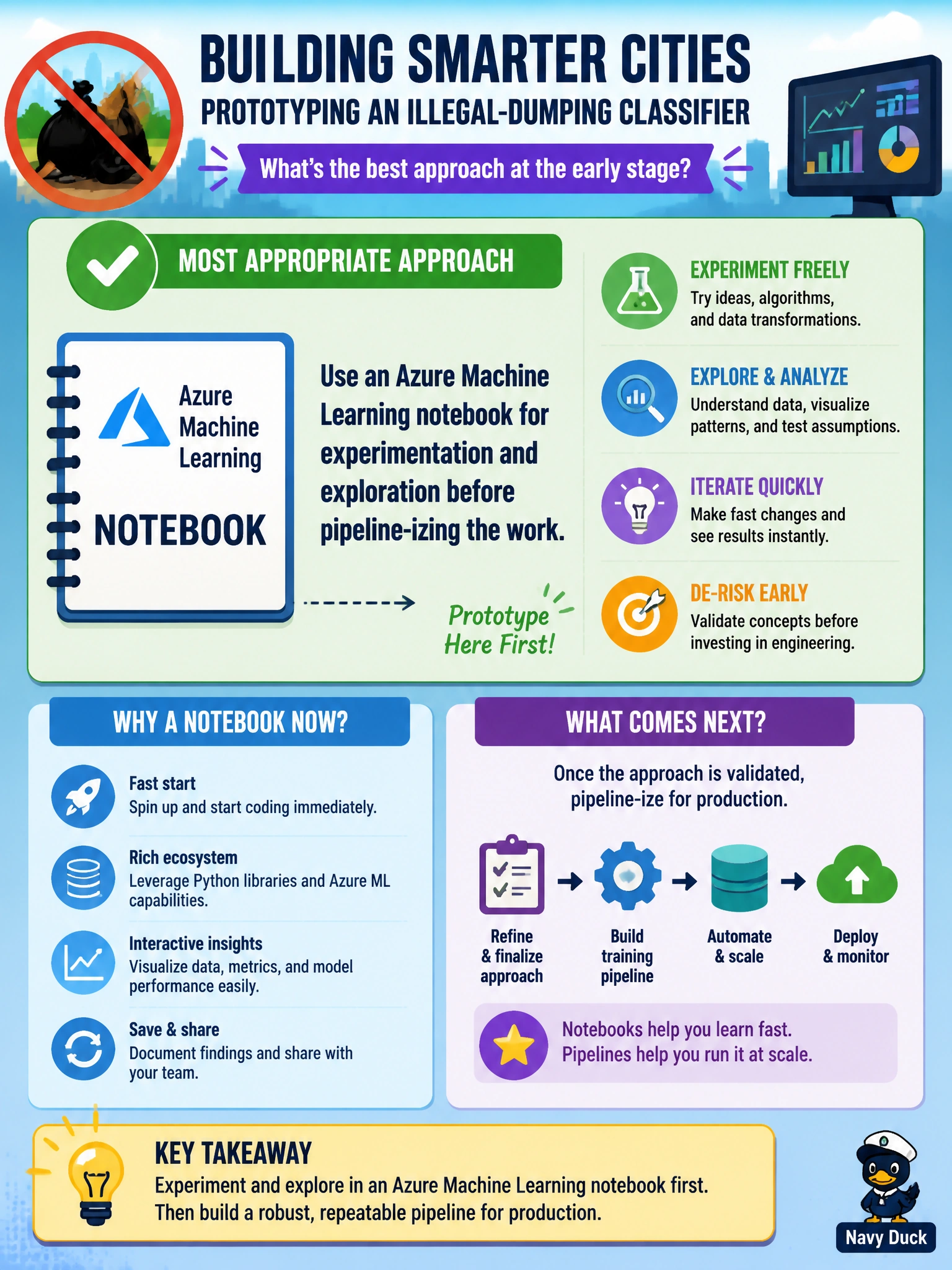
Notebooks are the whiteboard — messy on purpose. Prototype dumping-classifier features there, then graduate winners into a real pipeline. Don't start in the designer canvas — you'll get stuck with drag-and-drop blocks before you've tested your own feature ideas in a notebook.
Full Explanation
Using an Azure Machine Learning notebook for experimentation and exploration before pipeline-izing the work is the appropriate early stage for a city data scientist prototyping illegal-dumping classifier features. Notebooks support rapid feature ideation, visualization, and small trials inside the workspace without pretending the code is already production. Once features stabilize, the team graduates logic into scripts, environments, and training pipelines with tests and review.
Using an Azure Machine Learning AutoML job for quick model prototyping before pipeline-izing the work automates algorithm selection and tuning rather than manual feature ideation: it searches models and hyperparameters instead of letting the scientist write, visualize, and iterate on custom dumping-classifier features. Using an Azure Machine Learning designer canvas for visual prototyping before pipeline-izing the work relies on prebuilt drag-and-drop modules: it constrains custom code-based feature experimentation and visualization needed to test early illegal-dumping ideas. Using an Azure Machine Learning labeling project for iterative feature testing before pipeline-izing the work produces labeled data through annotation workflows: it creates training labels rather than testing custom feature transforms.
Exam caveat: Domain 2 distinguishes exploratory notebooks from production pipelines; when the stem says early prototyping before a production pipeline, notebooks are correct and direct-to-production paths are wrong. Operational check: prototype features in a workspace notebook on a sample dataset, record promising transforms, then create a training script/pipeline job that uses only reviewed feature code—confirm production scoring still runs the previous approved model until the new pipeline is validated.
Prefer to study offline? Printable PDF study book + test engine ($7.50, unofficial). These questions stay free here.