
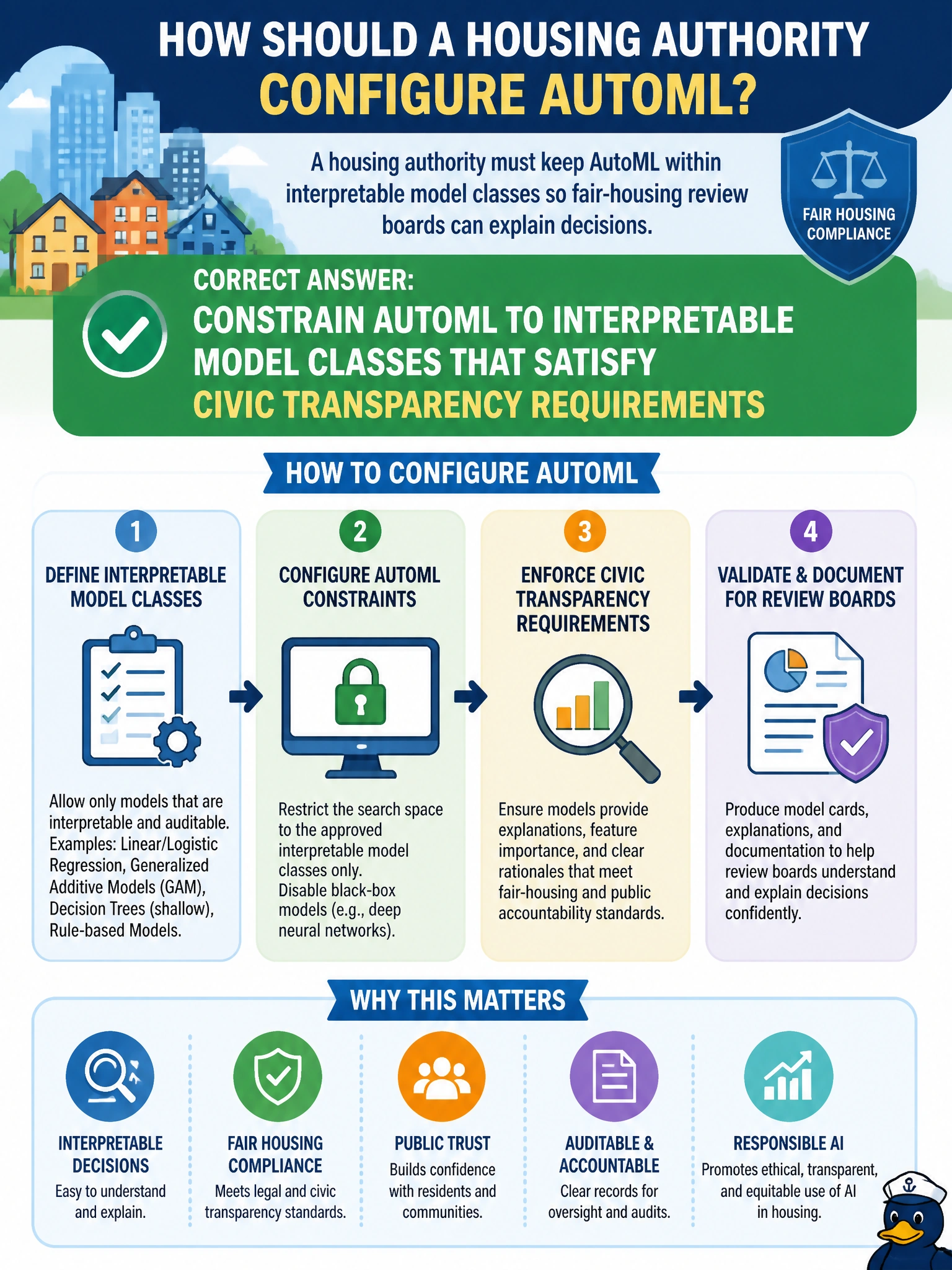
A housing authority must keep AutoML within interpretable model classes so fair-housing review boards can explain decisions. How should AutoML be configured?
Select an answer to reveal the explanation.
Short Explanation
Fair-housing boards need models they can open like a filing cabinet, not a sealed black box. You'll pass review when you constrain AutoML to interpretable classes so accuracy doesn't outrun explainability.
Full Explanation
Constraining AutoML to interpretable model classes that satisfy civic transparency requirements keeps housing-authority models explainable to fair-housing review boards. Azure Machine Learning AutoML can limit allowed algorithms so accuracy gains do not force opaque ensembles when policy requires open explanations. Interpretability constraints are a first-class configuration concern when municipal decisions affect housing access.
Tuning AutoML ranking for validation accuracy while logging interpretability for transparency reviews fails by concept: accuracy-driven ranking can still select opaque models, and treating interpretability as just a log does not satisfy the civic transparency requirement. Limiting AutoML inputs to non-demographic attributes with fairness reports to satisfy review standards fails transparency—removing demographic attributes and adding reports does not make an opaque model interpretable, and review boards still cannot see how individual features drive a decision. Constraining AutoML explanations to SHAP summaries for black-box ensembles to support board oversight fails the stem's requirement: approximate SHAP summaries layered onto an opaque ensemble are not the same as a model whose decisions are interpretable by design, which is what the review board asked for.
Exam caveat: When stems mention interpretability or fairness review, configure AutoML constraints (allowed model classes) rather than maximizing opaque accuracy and patching in explanations afterward. Operational check: set AutoML to the approved interpretable model set, train, generate explanation artifacts for the selected model, and walk a review board through feature influence on a sample housing decision without relying on hidden model types or after-the-fact explainers over a black box.
Prefer to study offline? Printable PDF study book + test engine ($7.50, unofficial). These questions stay free here.