
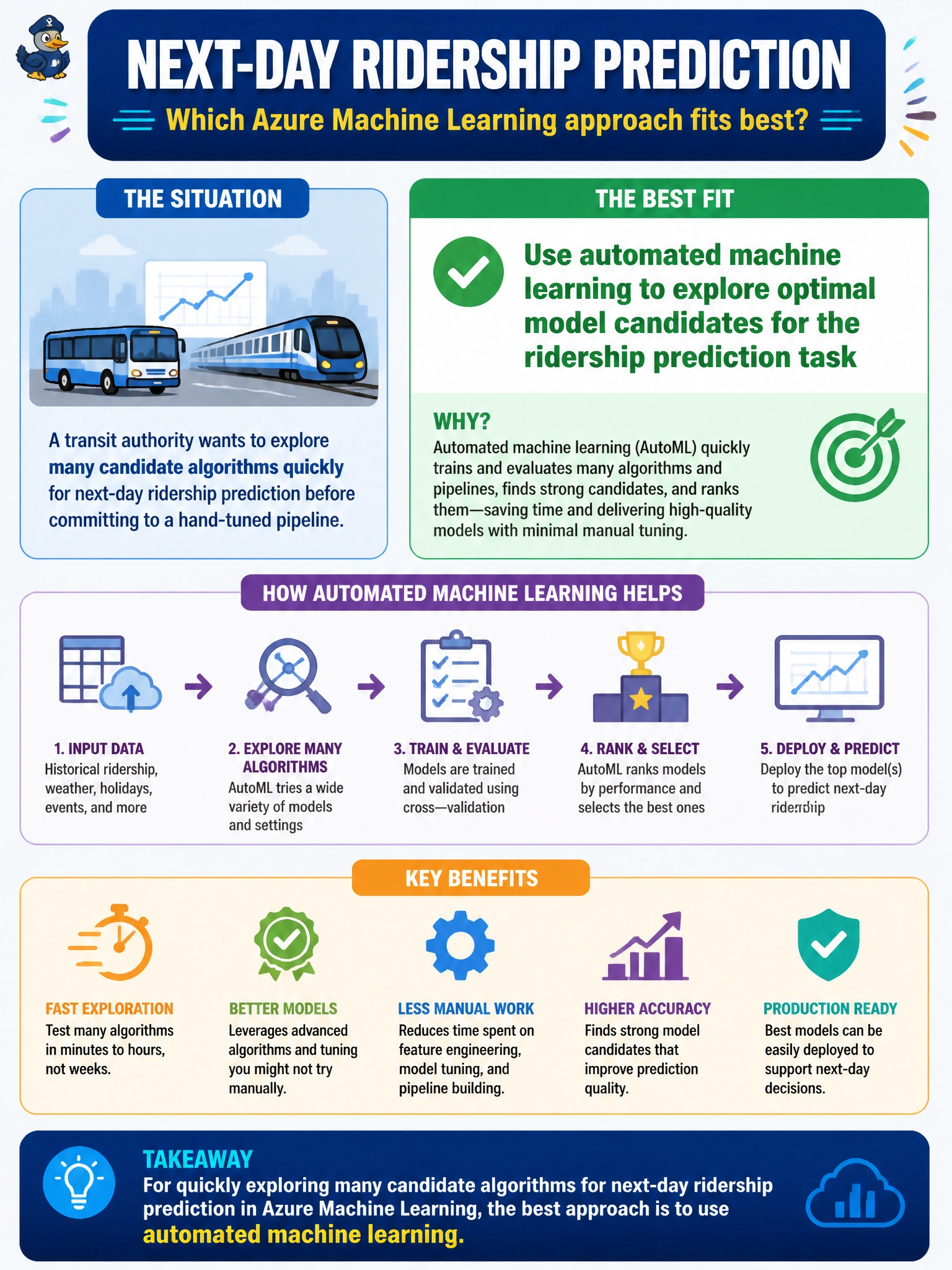
A transit authority wants to explore many candidate algorithms quickly for next-day ridership prediction before committing to a hand-tuned pipeline. Which Azure Machine Learning approach fits best?
Select an answer to reveal the explanation.
Short Explanation
AutoML is the transit yard that tries many engines so you do not rebuild each one by hand. Great for exploring ridership predictors early — then you can lock winners into a governed pipeline.
Full Explanation
Using automated machine learning to explore optimal model candidates for next-day ridership prediction lets the transit authority try many algorithms and featurization strategies quickly before committing to a hand-tuned pipeline. AutoML in Azure Machine Learning tracks trials, metrics, and candidate models so early exploration is structured rather than tribal. Once a winner emerges, the authority can still harden training into a governed pipeline, registration, and endpoint—AutoML accelerates search; it does not remove later MLOps discipline.
Running a Hyperdrive hyperparameter sweep on an XGBoost estimator to find candidate ridership prediction models still locks exploration to one algorithm family and only tunes hyperparameters instead of automatically comparing many algorithms and featurization strategies quickly. Using the Azure Machine Learning designer to compare regression modules for the ridership prediction task requires manually assembling and testing each branch and lacks AutoML's automated search and ranked tracking across many candidates. Using parallel notebook runs with MLflow tracking to compare candidates for the ridership prediction task leaves each variant hand-built while MLflow only records results, so it does not provide AutoML's automated exploration of many algorithms and featurization.
Exam caveat: AI-300 positions AutoML as the tool for rapid candidate exploration on tabular/prediction tasks; answers that run a Hyperdrive sweep on XGBoost only, manually compare designer regression modules, or compare hand-built candidates with parallel notebook MLflow runs miss the stem. Operational check: configure an AutoML ridership job with a proper validation split, review the ranked models and metrics in Azure ML, pick a shortlist, then plan a production pipeline that retrains the chosen algorithm under source control—not an unbounded AutoML free-for-all in production.
Prefer to study offline? Printable PDF study book + test engine ($7.50, unofficial). These questions stay free here.