
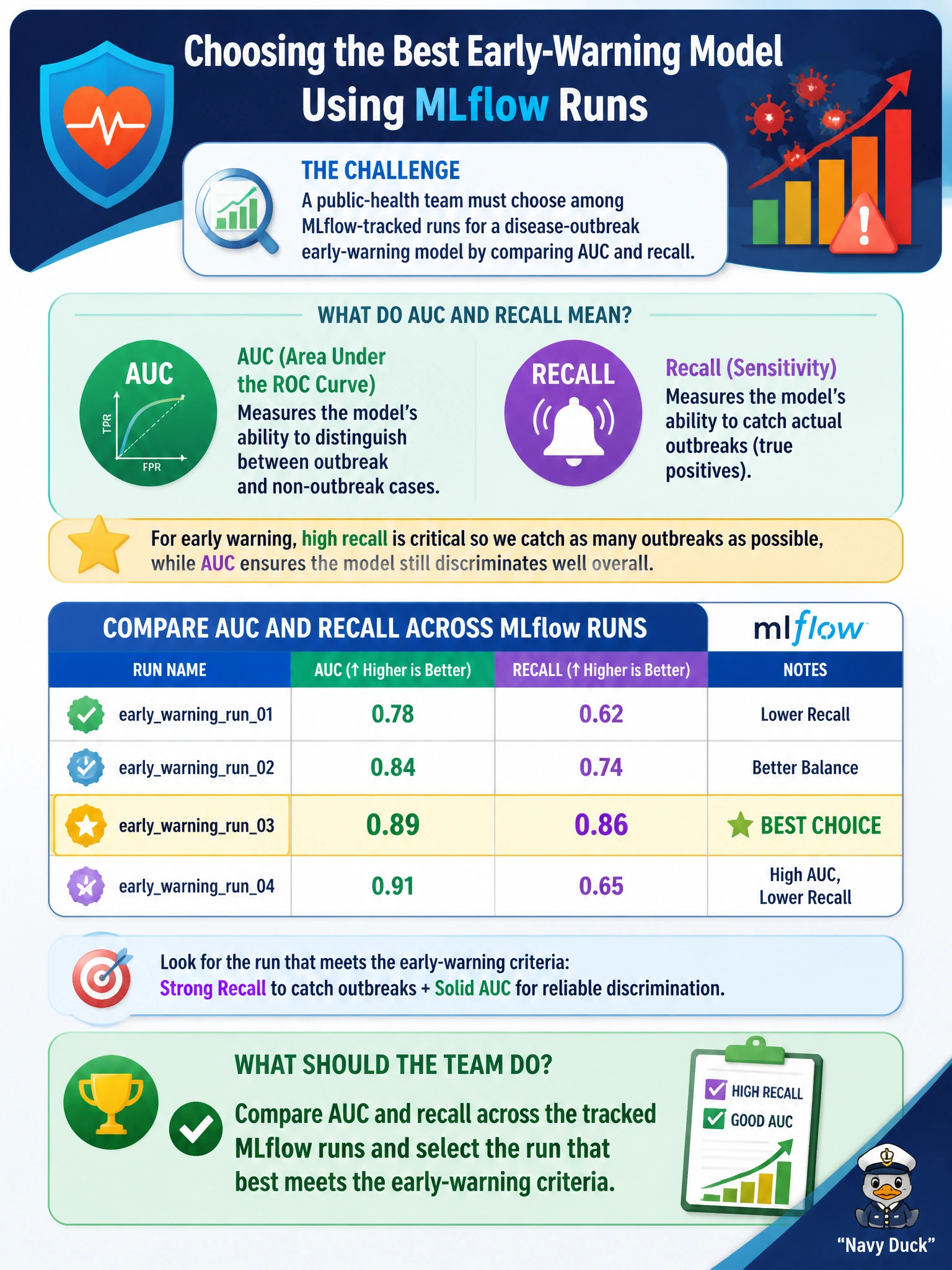
A public-health team must choose among MLflow-tracked runs for a disease-outbreak early-warning model by comparing AUC and recall. What should they do?
Select an answer to reveal the explanation.
Short Explanation
When outbreaks are on the line, read the scoreboard. Compare AUC and recall across MLflow runs and pick the civic early-warning model that actually meets the bar — you'll know it's not one that just meets training-split criteria.
Full Explanation
Comparing AUC and recall across MLflow-tracked runs and selecting the run that best meets early-warning criteria is how a public-health team should choose among Azure Machine Learning experiment candidates. Outbreak early-warning models often trade precision-like behavior against recall of true events; reading both metrics against policy thresholds beats picking by convenience. MLflow-tracked history makes those comparisons repeatable for after-action review. Choosing the run that best meets the training-split criteria fails by concept: it optimizes for reproducing training-split conditions rather than the early-warning acceptance thresholds for AUC and recall, so it can promote a run that looks good on the split but misses true outbreak cases. Choosing the run that best meets precision-focused criteria fails selection discipline: it prioritizes avoiding false alarms over catching true outbreaks, and it ignores the early-warning acceptance criteria the stem requires where recall of true events is critical. Selecting the run that best meets latency-based criteria fails governance: latency is an operational speed metric, not predictive quality, and optimizing for it skips applying the early-warning acceptance thresholds to AUC and recall that the stem required. Exam caveat: Domain 2 job/run comparison items expect metric-based selection (AUC and recall together against early-warning criteria); optimizing for training-split criteria, precision-focused criteria, or latency-based criteria are classic wrong answers. Operational check: list MLflow runs for the outbreak experiment, tabulate AUC and recall, apply the team's early-warning acceptance thresholds, register only the selected run's model, and document why others were rejected.
Prefer to study offline? Printable PDF study book + test engine ($7.50, unofficial). These questions stay free here.