
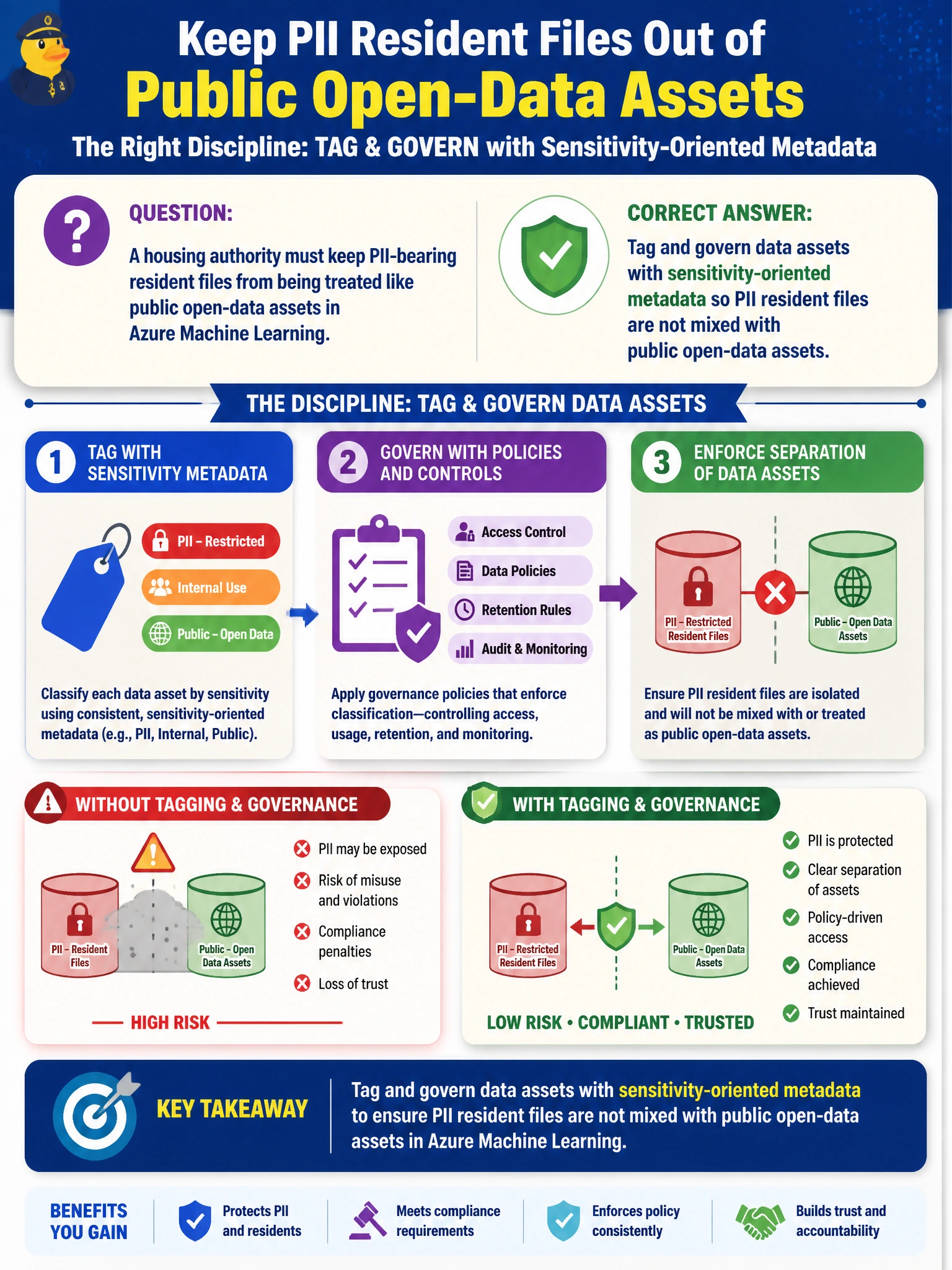
A housing authority must keep PII-bearing resident files from being treated like public open-data assets in Azure Machine Learning. What discipline should they apply to data assets?
Select an answer to reveal the explanation.
Short Explanation
Resident PII isn't park-hours open data—label the difference. Tag Azure ML data assets with sensitivity metadata so teams don't mix the two. Even immutable snapshots won't tag resident PII as sensitive, so you'll still risk treating it like public open data.
Full Explanation
Tagging and governing data assets with sensitivity-oriented metadata so PII resident files are not mixed with public open-data assets is the correct discipline because housing-authority resident PII and public open data have different legal, access, and retention postures. Sensitivity tags and governance metadata in Azure ML (aligned with broader Microsoft Purview/labeling practices where used) help stewards classify assets, apply access policies, and prevent accidental treatment of PII like park-hours open data. Clear labeling is foundational before sharing or training.
Versioning data assets with immutable snapshots retains reproducible lineage apart from public open-data assets, but it does not classify resident PII by sensitivity or prevent it from being treated like public open-data assets. Registering data assets in the workspace catalog with documentation aids traceability apart from public open-data assets, yet it does not apply sensitivity metadata to resident PII or keep it segregated from open data. Standardizing datastore connections with managed identity authentication to access secure compute separately supports secure access, but it does not tag PII as sensitive or stop PII-bearing files from being mixed with public open-data assets.
Exam caveat: governance is not optional decoration; sensitivity metadata drives how assets may be used. When stems contrast PII with open data, choose tagging/governance—not immutable-snapshot versioning, catalog registration with documentation, or managed identity for separate secure compute access alone—because those controls do not classify data by confidentiality.
Operational check: apply sensitivity-oriented tags to resident PII data assets, keep public open-data assets distinctly labeled, verify RBAC differs appropriately, and sample a training job configuration to ensure it does not point at PII under an open-data assumption.
Prefer to study offline? Printable PDF study book + test engine ($7.50, unofficial). These questions stay free here.