
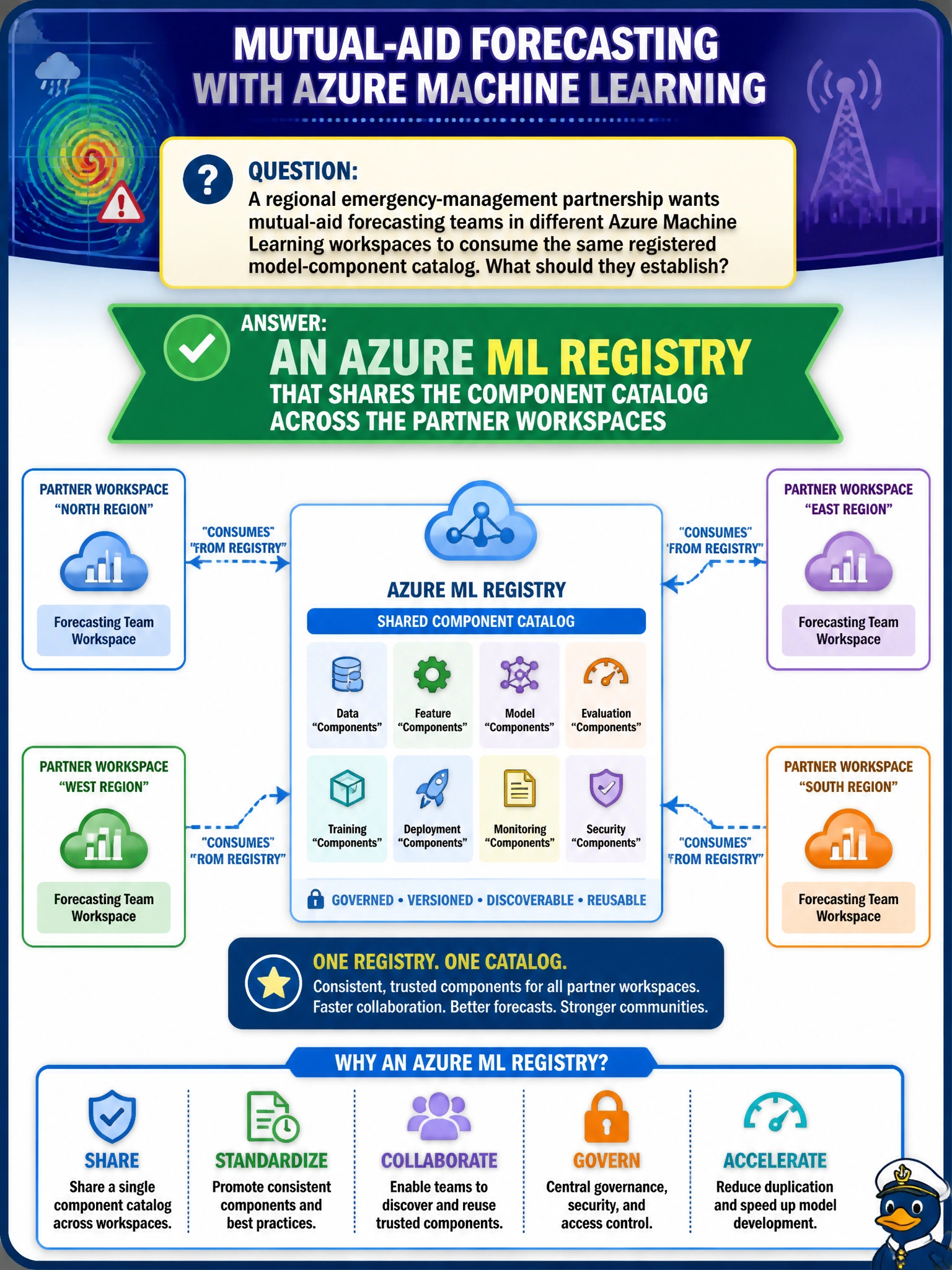
A regional emergency-management partnership wants mutual-aid forecasting teams in different Azure Machine Learning workspaces to consume the same registered model-component catalog. What should they establish?
Select an answer to reveal the explanation.
Short Explanation
You'll need a shared catalog for mutual aid, and a shared Azure Container Registry only distributes container images, not registered components. Stand up an Azure ML registry so every partner workspace can pull the same components. A shared compute cluster is just for training, and data assets only share datasets, so you don't get a registered component catalog from either.
Full Explanation
Establishing an Azure ML registry that shares the component catalog across the partner workspaces is correct for a regional emergency-management partnership because mutual-aid forecasting teams need a common, governed catalog of model components, not just a shared Azure ML compute cluster attached to partner workspaces for training. A registry provides identity, versioning, and cross-workspace consumption so each partner Azure ML workspace can pull the same registered components. That supports collaboration while preserving separate operational workspaces.
A shared Azure Container Registry that distributes container images to partner workspaces provides image storage and distribution, not a governed component catalog — partners cannot resolve the same versioned, registered model-component definitions because it lacks component identity and cross-workspace component consumption. A shared Azure ML compute cluster attached to partner workspaces for training provides compute capacity, but it is not a governed component catalog and does not scale regional model sharing. Versioned Azure ML data assets publishing the forecast datasets to partner workspaces share data, not components, and cannot serve as a shared registered component catalog.
Exam caveat: registries are the cross-workspace sharing fabric for components, environments, and models. Distinguishing "share catalog across workspaces" (registry) from "train on a shared Azure ML compute cluster" is a common exam discriminator.
Operational check: stand up or designate the partnership registry, publish the mutual-aid forecasting components, grant partner workspaces pull access, and verify each workspace can resolve the same component version in a pipeline.
Prefer to study offline? Printable PDF study book + test engine ($7.50, unofficial). These questions stay free here.