
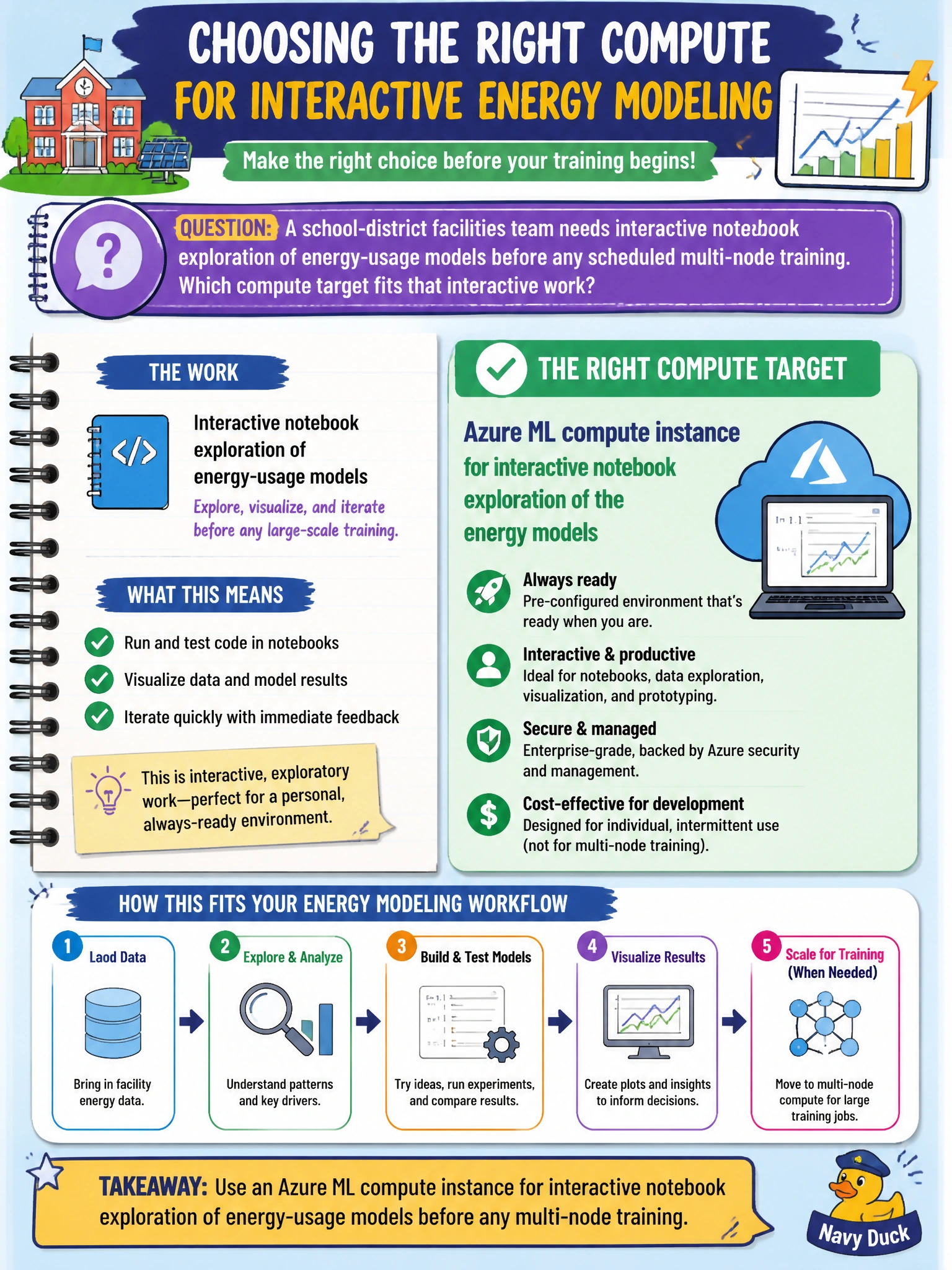
A school-district facilities team needs interactive notebook exploration of energy-usage models before any scheduled multi-node training. Which compute target fits that interactive work?
Select an answer to reveal the explanation.
Short Explanation
Interactive exploration is a personal workbench, not a factory floor. Spin up a compute instance for notebooks; you'll find a compute cluster for interactive notebook exploration is still job-based training compute, not your persistent workbench. Mixing those up wastes the facilities budget.
Full Explanation
An Azure ML compute instance for interactive notebook exploration of the energy models is correct because compute instances are the managed, single-node (or small) interactive targets intended for notebook development, debugging, and early facilities energy-usage modeling before any scheduled multi-node training. School-district data scientists get a governed workbench attached to the workspace without using an Azure ML compute cluster for interactive notebook exploration of the energy models, which remains queued, scalable job compute rather than a persistent interactive workbench during exploratory sessions. That separation keeps interactive work productive and cost-appropriate.
An Azure ML compute cluster for interactive notebook exploration of the energy models is still built for queued distributed training jobs that spin up and down per run, not for persistent interactive notebook sessions, so it cannot serve as the exploratory workbench. An Azure ML batch endpoint for interactive notebook exploration of the energy models is still an inference target for invoking a deployed model for batch scoring, not a development VM with notebook tooling for interactive model exploration. An Azure Foundry PTU deployment for interactive notebook exploration of the energy models still provides provisioned throughput for low-latency generative inference, not the Azure ML notebook compute needed for energy-usage model development.
Exam caveat: compute instance = interactive notebooks; compute cluster = scalable training; endpoints = scoring. Match the target to the phase named in the stem—here, interactive exploration before multi-node training.
Operational check: start a compute instance, open a notebook against the energy-usage dataset, confirm the instance can be stopped when idle, and only then schedule multi-node training on a cluster when the team is ready to leave interactive mode.
Prefer to study offline? Printable PDF study book + test engine ($7.50, unofficial). These questions stay free here.