
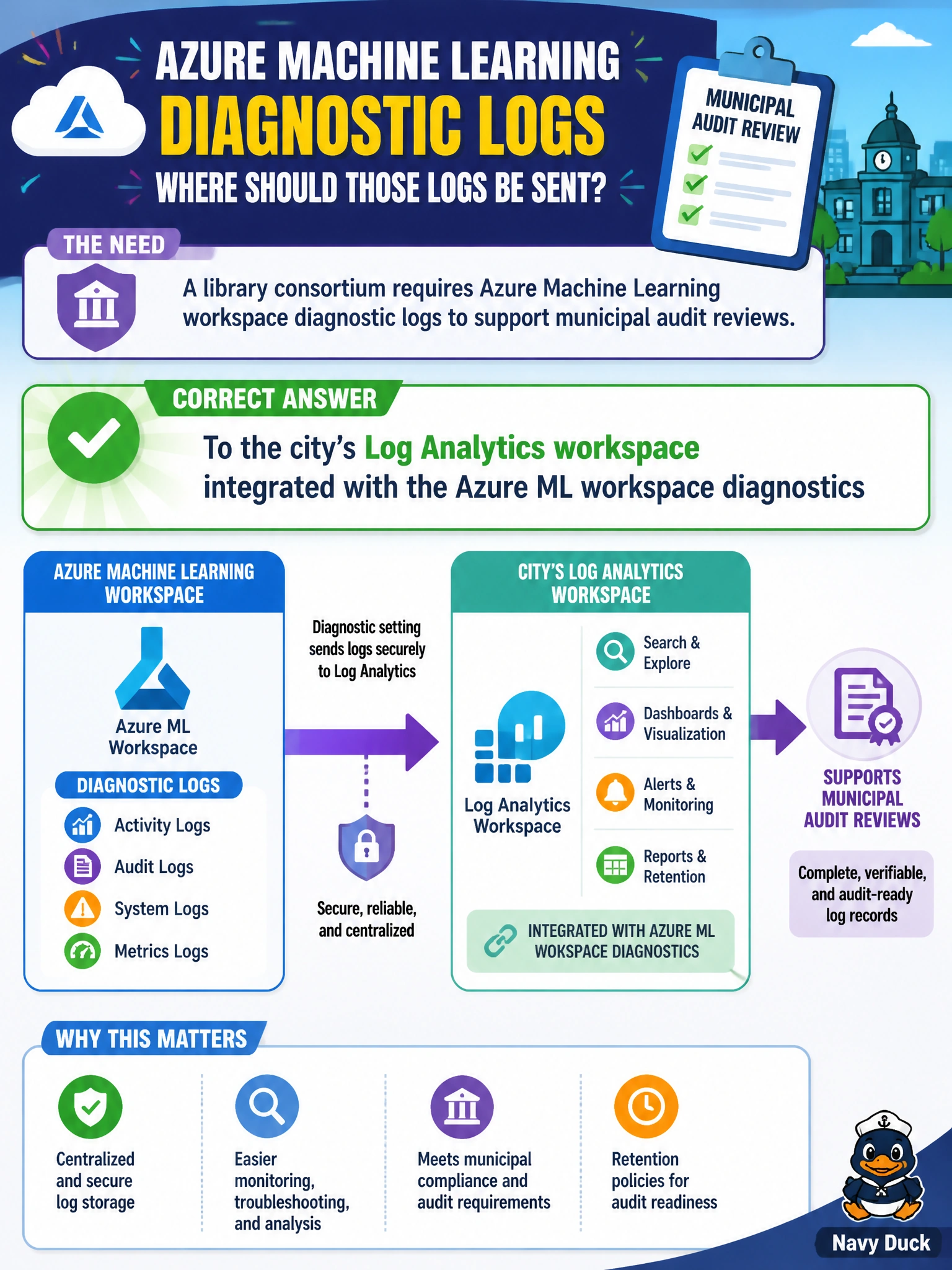
A library consortium requires Azure Machine Learning workspace diagnostic logs to support municipal audit reviews. Where should those logs be sent?
Select an answer to reveal the explanation.
Short Explanation
You don't want App Insights for online endpoint traces or the Activity Log archive for control-plane events alone—you need a full Log Analytics trail. Ship Azure ML workspace diagnostics into the city's Log Analytics workspace so access and ops events are queryable. Event Hubs for real-time scoring ingestion won't leave durable evidence for quarterly reviews.
Full Explanation
Sending Azure Machine Learning workspace diagnostic logs to the city's Log Analytics workspace integrated with the Azure ML workspace diagnostics is correct because municipal audit reviews need durable, queryable evidence of access and operational events. Diagnostic settings export platform logs and metrics into Log Analytics, where library-consortium auditors can run Kusto queries, retain evidence per civic policy, and correlate Azure ML activity with other city monitoring. That integration is the standard Azure operations pattern for governed workspaces.
Sending logs to Application Insights connected for online endpoint performance and trace collection fails completeness: Application Insights captures endpoint performance and trace data but misses the resource-level operational and access logs auditors specifically need from Azure ML diagnostic settings. Shipping diagnostics to an Event Hubs namespace configured for real-time scoring data ingestion fails the audit requirement: Event Hubs streams scoring data in real time but does not provide the durable, queryable, retainable log evidence municipal auditors need. Sending logs to the Activity Log archive for subscription-level control-plane events and policy compliance fails depth: the Activity Log archive captures control-plane operations but not the detailed data-plane and job-level events a library consortium audit requires.
Exam caveat: diagnostic settings destinations commonly include Log Analytics, storage accounts, and event hubs. When the stem emphasizes municipal audit reviews and queryable monitoring, Log Analytics with adequate retention and resource-specific categories is the best fit—do not confuse it with Application Insights for endpoint traces, an Event Hubs namespace for real-time scoring ingestion, or the Activity Log archive for control-plane events.
Operational check: enable Azure ML workspace diagnostics to the city's Log Analytics workspace, confirm tables receive recent events after a test portal action or job, validate retention matches audit policy, and restrict who can purge or alter the Log Analytics workspace.
Prefer to study offline? Printable PDF study book + test engine ($7.50, unofficial). These questions stay free here.