
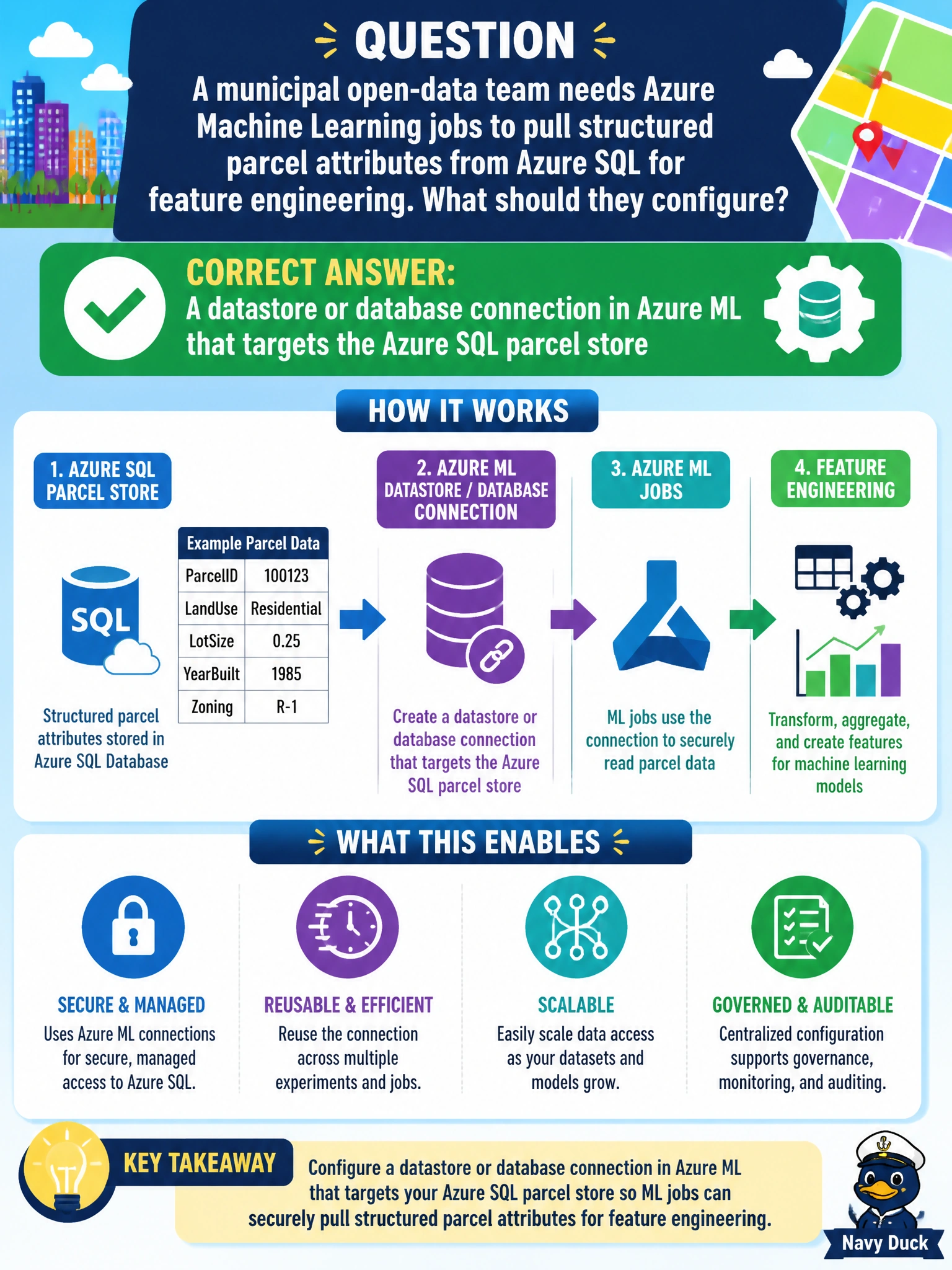
A municipal open-data team needs Azure Machine Learning jobs to pull structured parcel attributes from Azure SQL for feature engineering. What should they configure?
Select an answer to reveal the explanation.
Short Explanation
Parcel attributes already sit in Azure SQL—wire Azure ML to that database with a proper datastore/connection. A data asset using a SAS token, a managed identity by itself, or an environment with ODBC drivers won't give your job governed access to live parcel attributes for feature engineering.
Full Explanation
Configuring a datastore or database connection in Azure ML that targets the Azure SQL parcel store is correct because structured parcel attributes for feature engineering should be read from the system of record under governed connectivity. Azure ML can use registered database/datastore connections so jobs pull tabular municipal attributes with authentication, rather than inventing unofficial extracts. That keeps open-data and assessor-aligned parcel fields consistent for engineering pipelines.
A data asset in Azure ML that targets the Azure SQL parcel store using a SAS token fails authentication fit for this job: Azure SQL does not accept SAS tokens for database access since SAS tokens authorize Blob or Data Lake storage, so the asset could not authenticate to pull structured parcel attributes and you would still need a registered database/datastore connection with SQL or identity credentials.
A managed identity assigned to the training compute for the Azure SQL parcel store access does not solve the input problem by itself: an identity supplies a credential but provides no registered datastore or database connection defining server, database, and query access, so jobs still cannot pull parcel attributes for feature engineering.
An Azure ML environment with ODBC drivers installed for the Azure SQL parcel store jobs does not solve the input problem: installing ODBC drivers prepares the compute but still leaves the job without an actual registered connection or datastore pointing to the Azure SQL parcel store.
Exam caveat: when the stem specifies structured attributes in Azure SQL, the answer is a database/datastore connection—not a data asset using a SAS token, a managed identity by itself, or an environment with ODBC drivers by itself.
Distinguish feature retrieval (SQL/datastore) from credential setup (managed identity).
Operational check: register the Azure SQL connection with least-privilege database credentials or identity, run a sample query or job that materializes a known parcel feature set, and confirm network rules allow Azure ML compute to reach SQL without opening the database to the public Internet.
Prefer to study offline? Printable PDF study book + test engine ($7.50, unofficial). These questions stay free here.