
A housing authority needs overnight AutoML jobs for waitlist forecasting to run on scalable CPU capacity without leaving expensive compute online all day. Which compute choice best matches that need?
Select an answer to reveal the explanation.
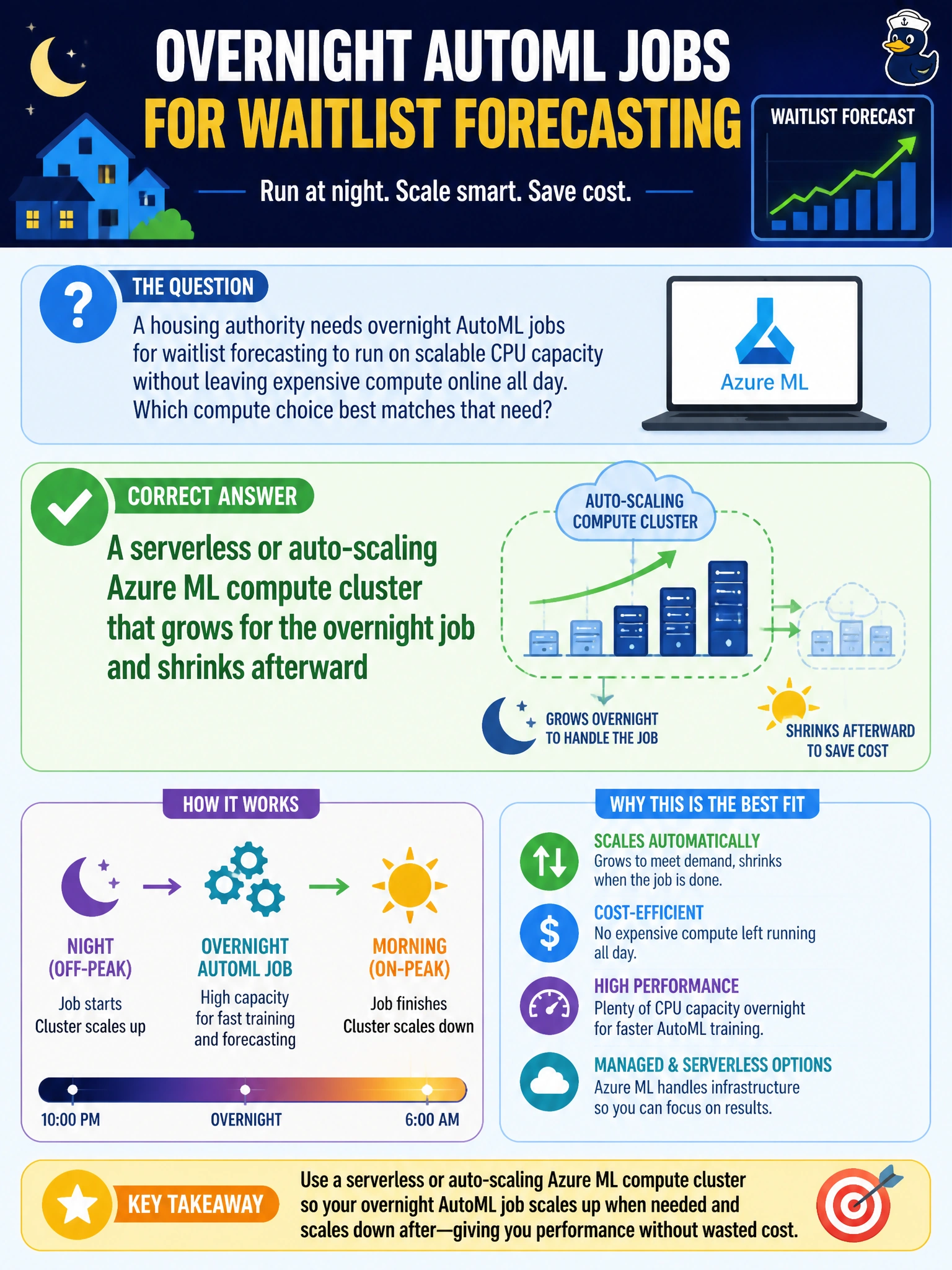
Short Explanation
Overnight AutoML is like calling in extra clerks for a night shift, then sending them home. Use a serverless or auto-scaling Azure ML cluster so CPUs appear for the job and disappear when idle. You also don't want an autoscale cluster stacked with GPU VMs, since that burns the housing budget on silicon this CPU job doesn't use.
Full Explanation
A serverless or auto-scaling Azure ML compute cluster that grows for the overnight job and shrinks afterward is the correct match for overnight AutoML waitlist forecasting because housing-authority budgets need scalable CPU capacity only while jobs run. AutoML experiments can request multiple nodes for a night batch, then scale to zero or a minimum when idle, avoiding continuous spend on unused capacity. That pattern aligns municipal MLOps cost control with bursty overnight training rather than permanent reservation.
An Azure ML compute cluster with autoscale configured for GPU VMs fails because it charges for GPU accelerators on a CPU-oriented overnight batch job, giving you costly silicon the waitlist forecasting workload does not need instead of the scalable CPU capacity the stem requires. An Azure ML compute instance started in the evening for interactive notebook scoring fails on workload fit: the stem calls for overnight AutoML training, not interactive scoring, and a single instance cannot provide the scalable, multi-node capacity a nightly batch job needs. An Azure Kubernetes Service cluster attached for managed online endpoints fails because it is built for hosting model inference, not for running overnight AutoML training jobs, and it does not provide the simple scalable CPU batch capacity the housing authority needs.
Exam caveat: compute instances suit interactive notebooks; compute clusters (including serverless/auto-scale) suit scheduled or distributed training. When the stem stresses overnight scale-up and idle scale-down, pick the auto-scaling cluster rather than a GPU VM cluster, an interactive notebook instance, or an AKS online-endpoints cluster.
Operational check: configure minimum nodes appropriately (often zero for true idle savings), set maximum nodes for AutoML concurrency, confirm the overnight schedule submits successfully, and review cost after a quiet day to ensure nodes scaled down.
Prefer to study offline? Printable PDF study book + test engine ($7.50, unofficial). These questions stay free here.