
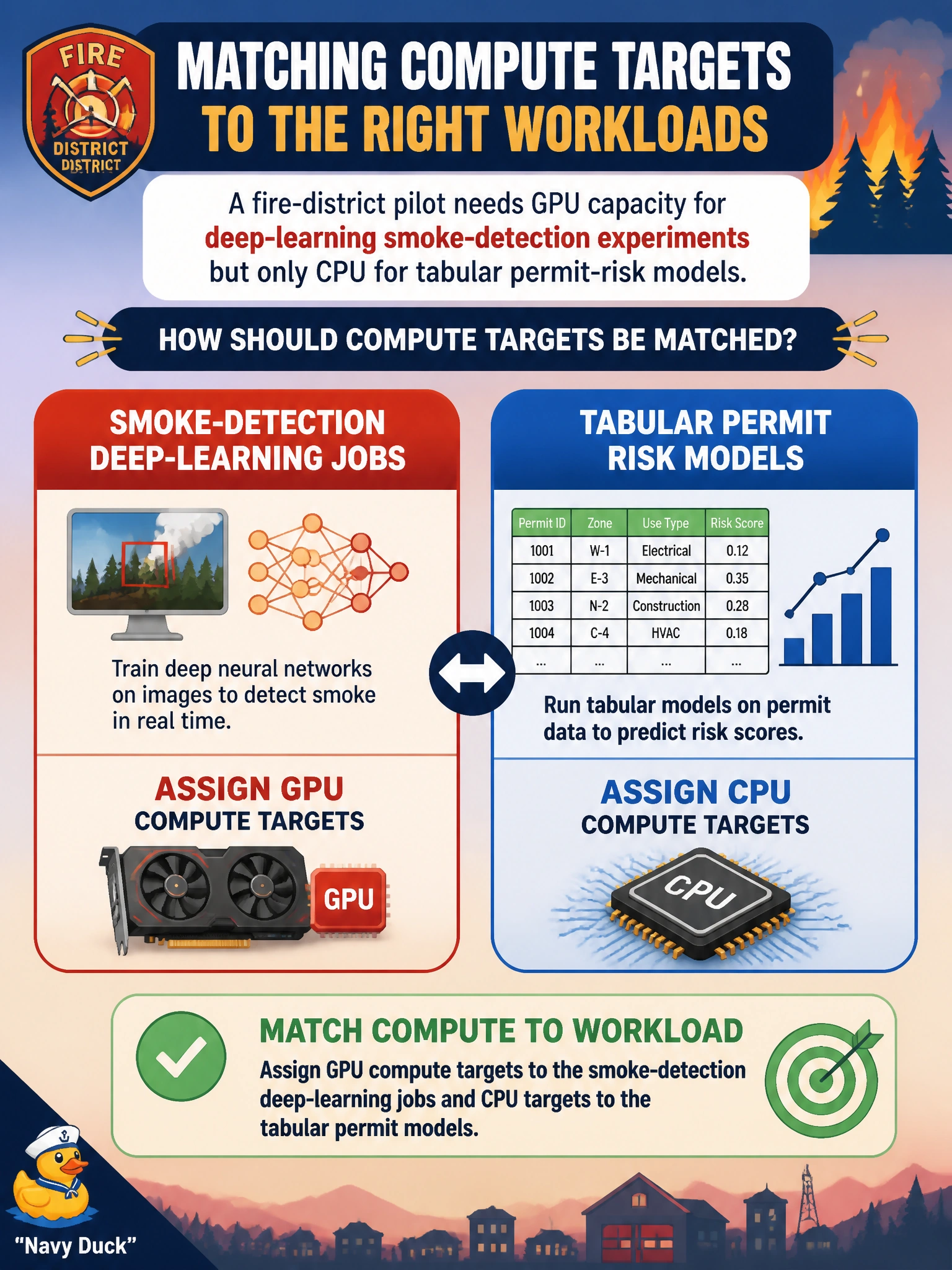
A fire-district pilot needs GPU capacity for deep-learning smoke-detection experiments but only CPU for tabular permit-risk models. How should compute targets be matched?
Select an answer to reveal the explanation.
Short Explanation
Don't haul a fire truck to deliver mail. GPU targets belong with the smoke-detection deep-learning jobs; plain tabular permit models are fine on CPU. Matching the compute type to the workload saves money and queue time.
Full Explanation
Assigning GPU compute targets to the smoke-detection deep-learning jobs and CPU targets to the tabular permit models is correct because compute should match algorithmic need. Convolutional or other deep models for visual smoke detection typically benefit from GPU acceleration, while tabular permit-risk models (tree ensembles, logistic regression, and similar) usually train efficiently on CPU. Matching targets reduces cost, queue contention, and unnecessary GPU reservation for work that does not need it—especially important in a fire-district pilot with mixed workloads. Assigning GPU notebook instances to the smoke-detection deep-learning jobs fails because notebook instances are for interactive development, not scalable training; deep-learning experiments need managed GPU compute targets with job scheduling and scaling that notebooks do not provide. Assigning GPU inference clusters to the smoke-detection deep-learning jobs fails because inference clusters are built to serve trained models for low-latency scoring, not to run training experiments; using serving infrastructure for training lacks training job management and ties up serving capacity. Assigning evictable spot GPU targets to the smoke-detection deep-learning jobs fails because evictable nodes can be preempted mid-training, interrupting long-running deep-learning experiments and forcing retries; pilot training needing reliable completion should use dedicated non-evictable GPU compute targets. Exam caveat: GPUs are not universally "better"—they are specialized. Scenario questions often test whether you map deep learning to GPU and tabular/classical ML to CPU rather than homogenizing hardware. Operational check: label compute targets clearly (e.g., gpu-smoke vs cpu-tabular), set job defaults so each pipeline selects the right target, and monitor utilization so GPUs are not idle while tabular jobs wrongly queue on them.
Prefer to study offline? Printable PDF study book + test engine ($7.50, unofficial). These questions stay free here.