
A lightweight parks recommender needs fast nearest-neighbor lookup. How can Azure Managed Redis help?
Select an answer to reveal the explanation.
Short Explanation
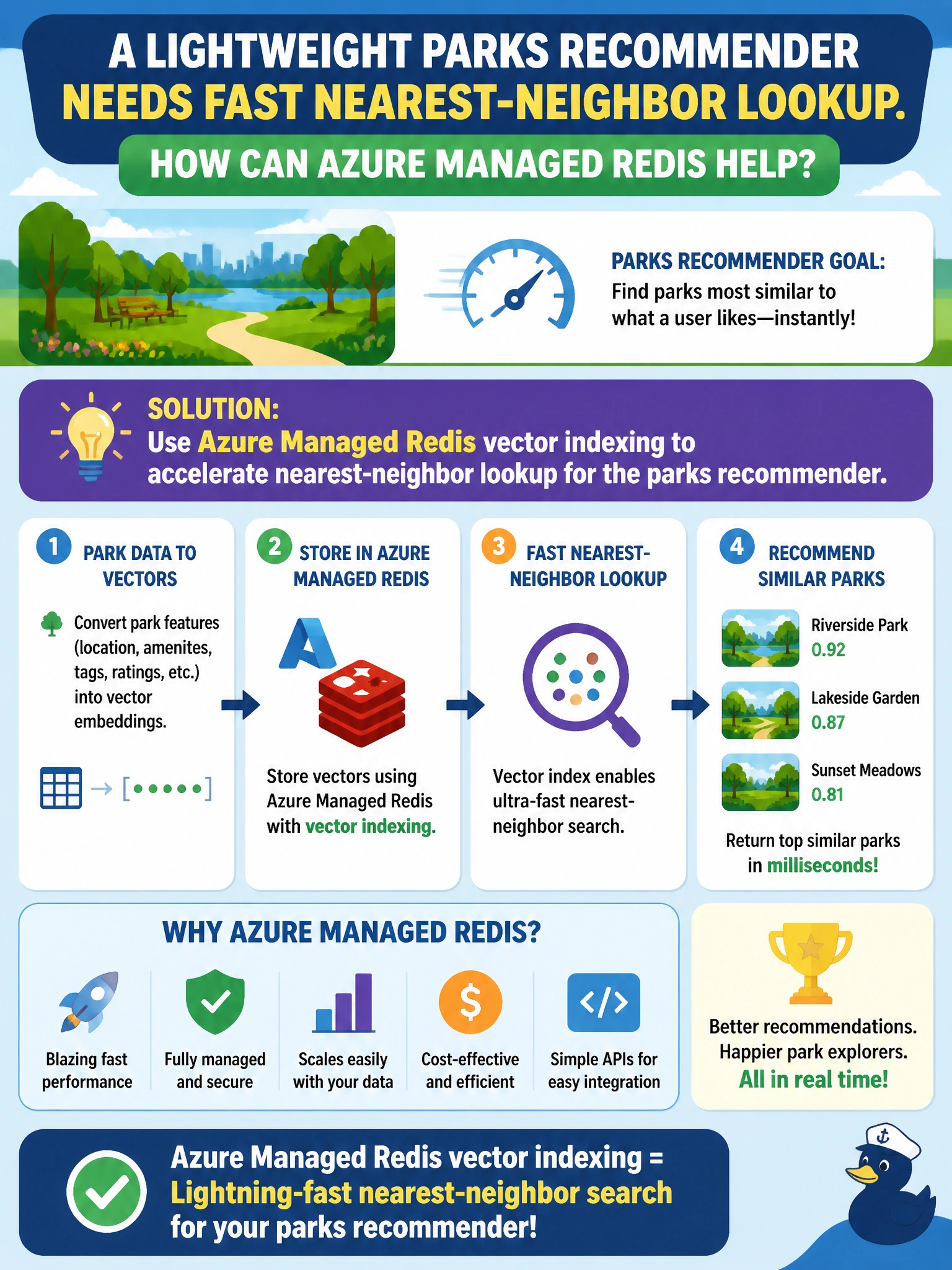
With Azure Managed Redis vector indexing, you can find parks similar to a resident’s choices without scanning the whole catalog each time. Nearest-neighbor lookup keeps this parks recommender responsive.
Full Explanation
Azure Managed Redis vector indexing can accelerate nearest-neighbor lookup for a lightweight parks recommender. By keeping park embeddings in Redis with vector search support, you can return low-latency similarity results for interactive “parks like this” recommendations without scanning a cold analytical store on every request. Storing park names only as unordered SET members supports membership checks, but not semantic nearest-neighbor search. Requiring every recommendation to scan a cold data lake without a cache or vector index adds latency and undermines a lightweight, responsive experience. Encoding park embeddings as printable PDFs in Blob Storage only stores opaque files; it does not provide a Redis vector index for online similarity lookup. Exam caveat: Redis vector features suit hot, relatively compact recommendation sets; a massive archival corpus may need a different scale strategy, with Redis serving a cache or hot shard, so match the service to the workload. Practical check: load park embeddings into Redis using the chosen vector-index configuration, run nearest-neighbor queries for sample seed parks, validate the results with parks staff, and monitor vector-index memory as the data grows.