
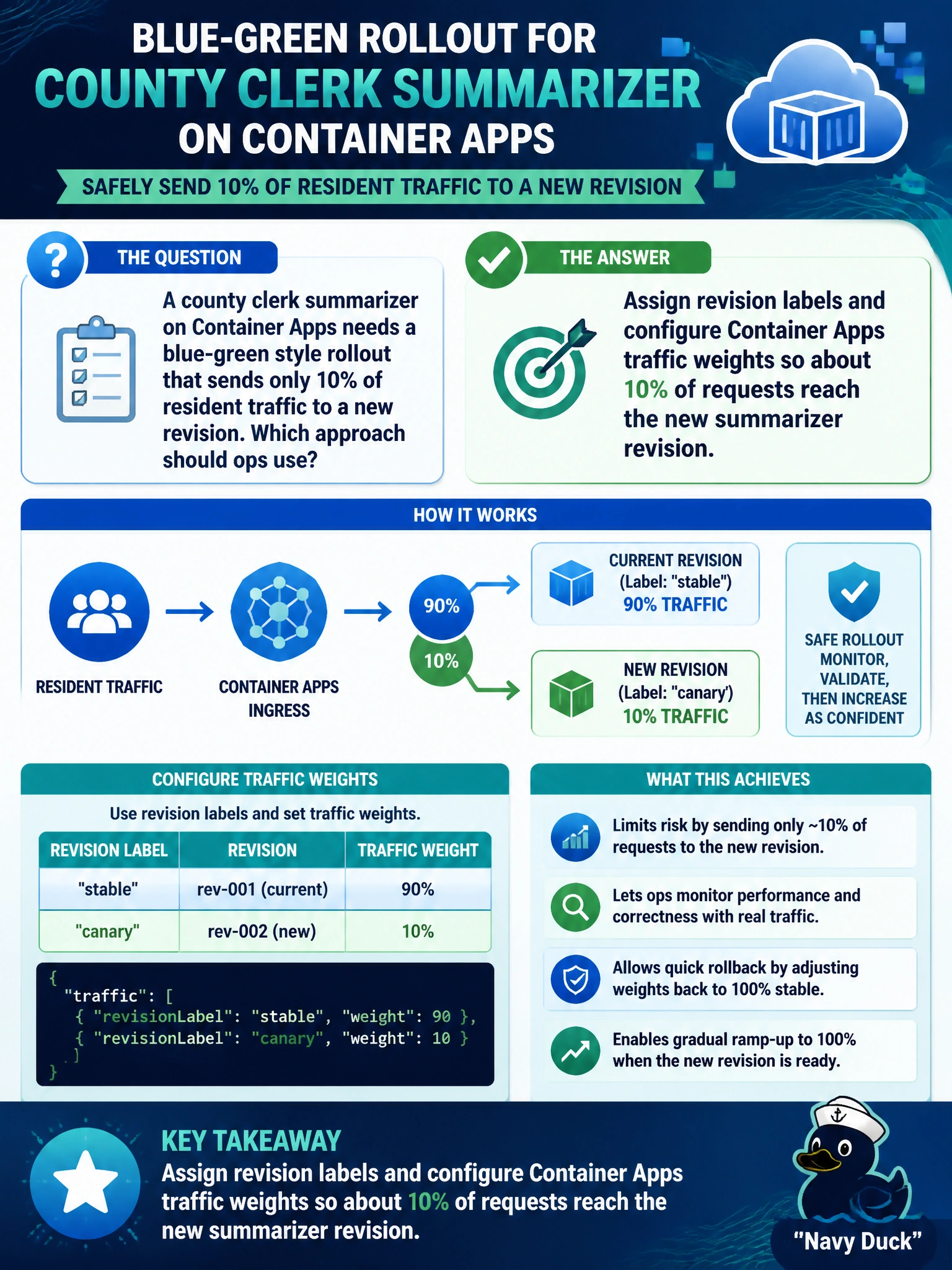
A county clerk summarizer on Container Apps needs a blue-green style rollout that sends only 10% of resident traffic to a new revision. Which approach should ops use?
Select an answer to reveal the explanation.
Short Explanation
Think of Container Apps traffic weights as opening one toll lane for the new clerk summarizer while most traffic stays on the proven path. You can use revision labels and a 10% traffic split, rather than deleting the previous revision, publishing only a desktop shortcut, or disabling ingress and sending residents to a phone tree.
Full Explanation
Azure Container Apps revisions and traffic weights enable a controlled blue-green or canary rollout: you label revisions and assign percentages so about 10% of resident requests reach the new county clerk summarizer while the prior revision serves the majority. This keeps a known-good path online, limits the blast radius if the new summarizer regresses, and supports progressive promotion after metrics look healthy. Labels make the split explicit and reversible without deleting capacity. Deleting the previous revision so 100% of traffic reaches the new one is a hard cutover, not a 10% canary; any defect reaches every clerk and resident at once, with no weighted rollback target. Publishing the new revision only as a desktop shortcut on clerk workstations does not route HTTP ingress traffic, so residents and APIs still reach whichever revision the active ingress serves. Disabling ingress and asking residents to call a phone tree abandons Container Apps traffic management and turns a software canary into an outage workaround. Exam caveat: Traffic splitting requires multiple active revisions and correctly configured weights that sum appropriately; labels help target named revisions. Blue-green and canary are related patterns, and exam questions often emphasize traffic weights rather than a separate load balancer product. Inactive revisions receive no traffic until weights or activation change. Practical check: Deploy the new revision without immediately shifting all traffic, assign labels, set approximately 10%/90% weights, and watch error rate, latency, and summarization quality. Promote the new revision or roll traffic back to the prior revision if civic SLOs break, and verify ingress continues serving the majority path during the canary window.