
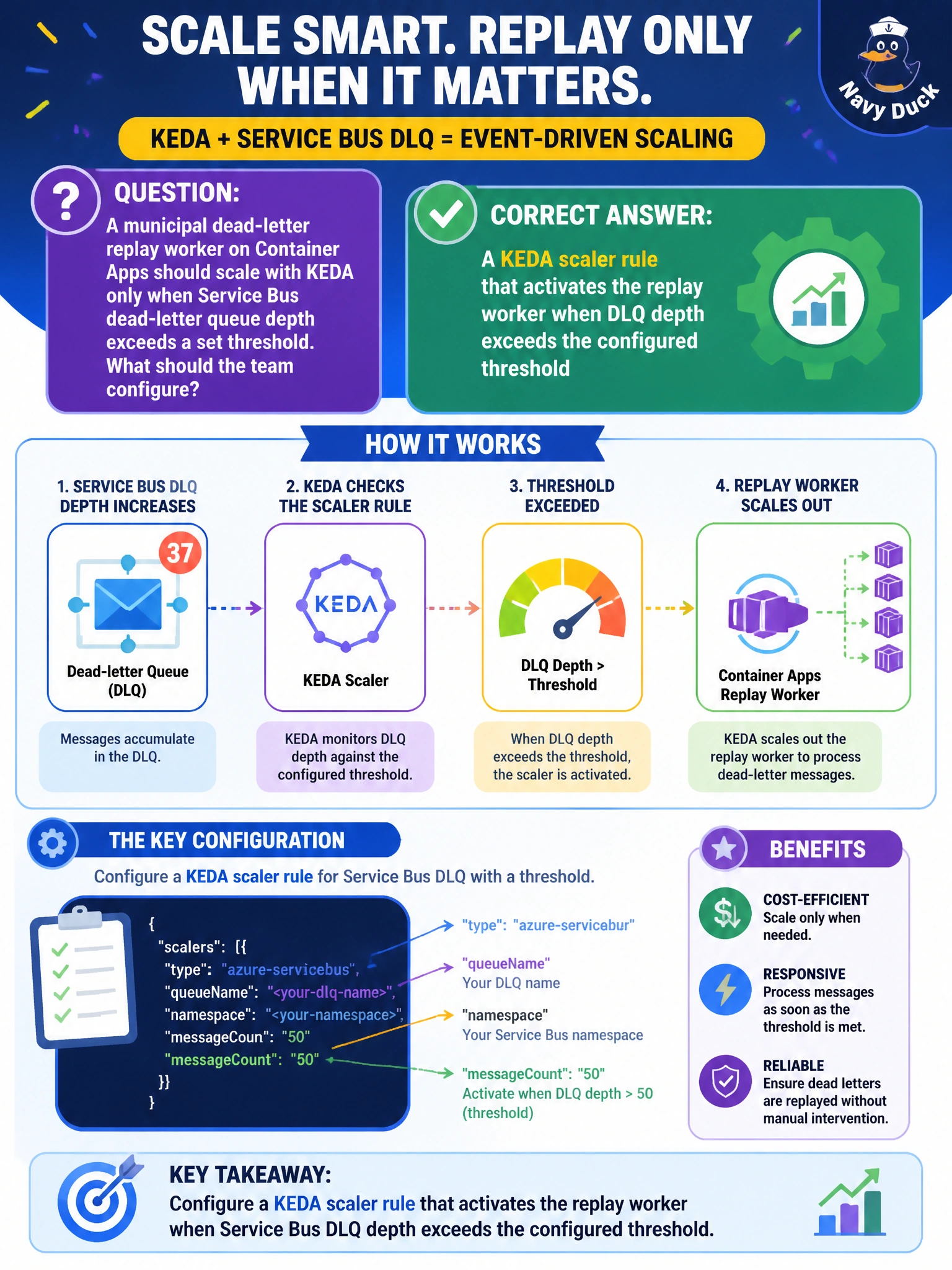
A municipal dead-letter replay worker on Container Apps should scale with KEDA only when Service Bus dead-letter queue depth exceeds a set threshold. What should the team configure?
Select an answer to reveal the explanation.
Short Explanation
The DLQ is the city's lost-and-found bin for failed messages—KEDA should wake the replay worker when that bin gets deep enough, not park fifty idle vans overnight or wait for someone to SSH in by feel.
Full Explanation
KEDA on Azure Container Apps can scale a municipal dead-letter replay worker from Azure Service Bus metrics, including dead-letter queue (DLQ) depth against a configured threshold. When DLQ depth exceeds that threshold, the scaler activates or increases replicas so failed messages can be inspected and replayed; when depth falls, capacity can scale down. That event-driven model matches bursty civic back-office work and avoids paying for idle replay fleets when the DLQ is empty.
Always keeping fifty idle replicas regardless of DLQ depth fails by concept because it replaces threshold-driven scale with permanent overprovisioning—costly and unrelated to actual backlog. Scaling only by wall-clock time every Monday at noon fails because DLQ depth is not correlated with a calendar slot; Monday noon may miss overnight spikes or run when the queue is empty. Replacing KEDA with manual SSH whenever someone notices the DLQ is full fails because it is reactive, non-automatable, and not an Azure Container Apps scaling rule tied to Service Bus metrics.
Exam caveat: Distinguish the main queue from the dead-letter sub-queue; the scaler must target the DLQ metric the scenario describes. KEDA needs permission to read Service Bus metrics or queue length, and scale rules must define activation thresholds carefully so a single poisoned message pattern does not thrash replicas without a fix.
Operational check: Validate the KEDA scaler authentication to Service Bus, confirm the rule watches DLQ depth (not only active queue length), load-test by intentionally dead-lettering messages past the threshold, and observe replica activation. After successful replay and DLQ drain, confirm scale-in behavior and that municipal replay logs show which messages were reprocessed.