
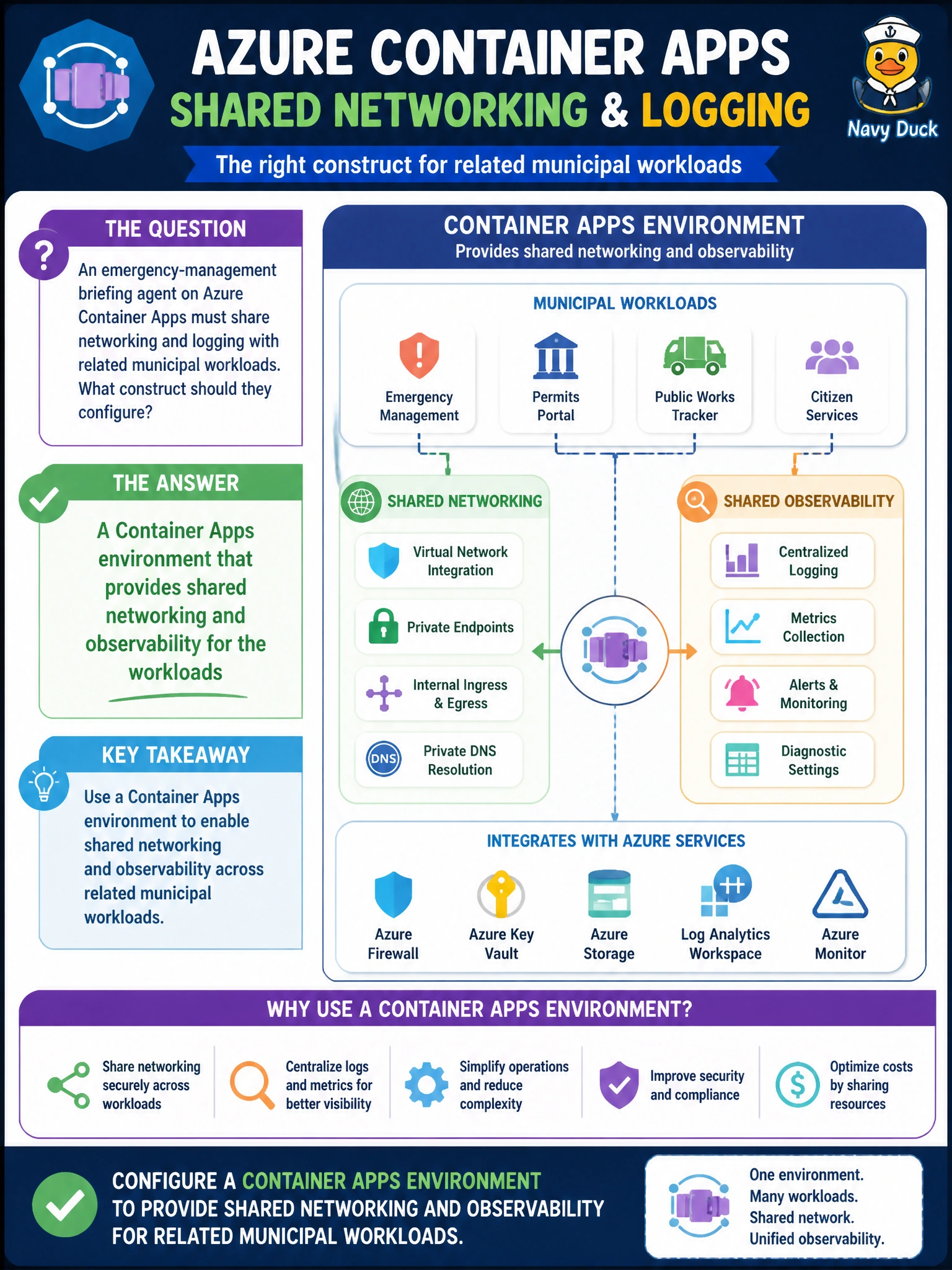
An emergency-management briefing agent on Azure Container Apps must share networking and logging with related municipal workloads. What construct should they configure?
Select an answer to reveal the explanation.
Short Explanation
A Container Apps environment is the shared municipal campus—networking and logging utilities the briefing agent and sibling apps plug into. Without that environment boundary, every container is a lonely trailer with its own generator and no common streetlights.
Full Explanation
A Container Apps environment is the shared boundary that provides networking, DNS, and observability for apps and related workloads inside it. An emergency-management briefing agent that must share networking and logging with sibling municipal services belongs in a Container Apps environment where those utilities are common. Environment-level diagnostics, virtual network integration options, and shared Dapr/logging patterns (where used) give operators one place to manage the campus of related containers rather than isolated one-off hosts.
A separate unmanaged Docker host per container with no shared environment fails the managed Container Apps model and loses shared networking/observability. Public internet exposure of every sidecar without a Container Apps environment fails secure co-location and shared platform logging. Individual consumer subscriptions for each container with no common boundary fails operational cohesion—billing and RBAC scatter without providing the environment construct the platform expects for related apps.
Exam caveat: One environment can host many Container Apps; not every municipal app must be alone in its own environment. Isolation boundaries still matter for blast radius, but the question asks for the construct that shares networking and logging—namely the environment—not “one subscription per container.”
Operational check: Place the briefing agent and related workloads in the same Container Apps environment (or verify they already are), confirm they resolve each other over environment networking as designed, and verify logs/metrics appear under that environment’s shared observability configuration rather than on unmanaged Docker hosts.