
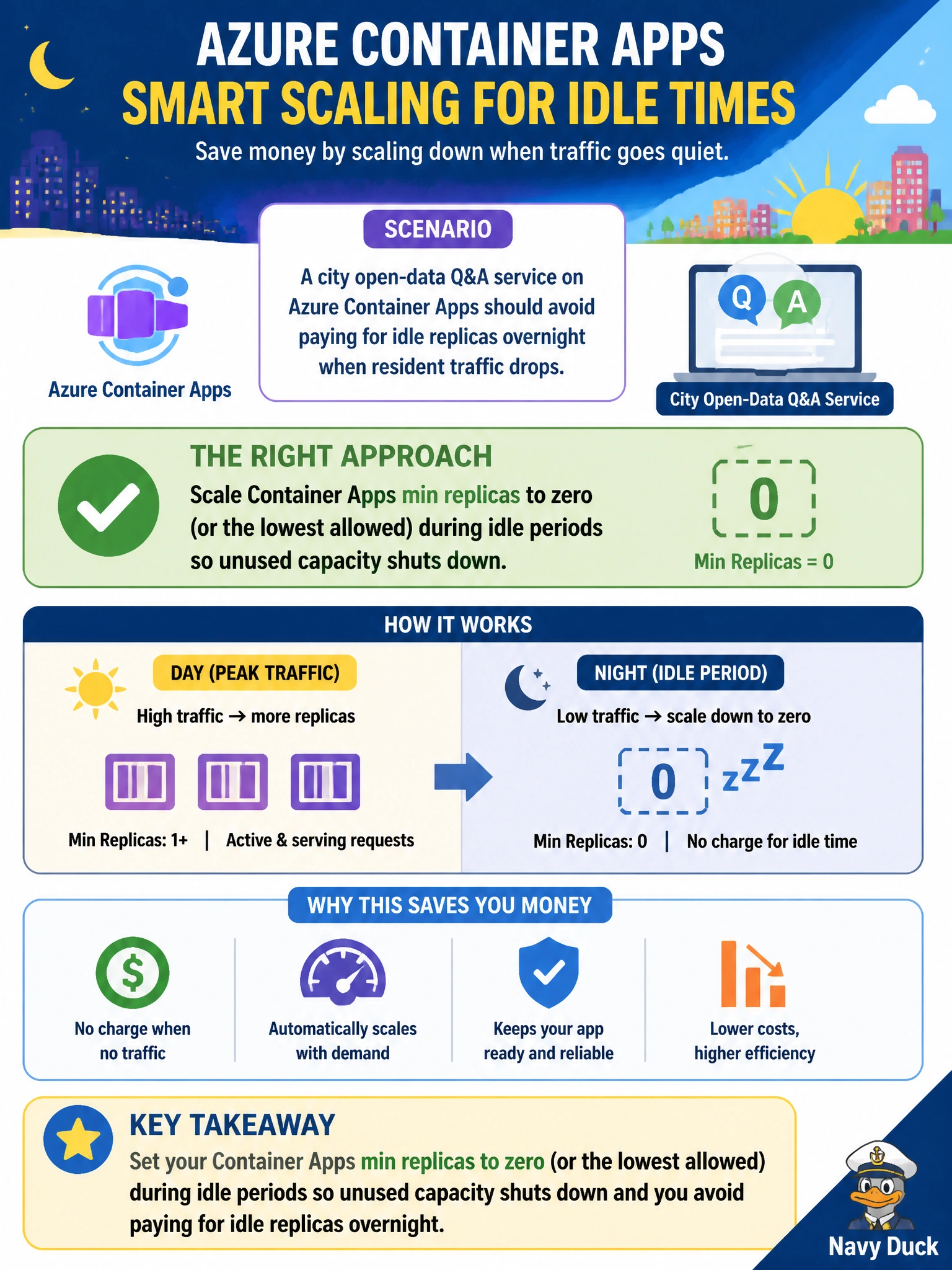
A city open-data Q&A service on Azure Container Apps should avoid paying for idle replicas overnight when resident traffic drops. Which scaling behavior should they apply?
Select an answer to reveal the explanation.
Short Explanation
Leaving peak-hour replicas humming all night is like leaving every streetlight on at stadium brightness when the park is empty. Let Container Apps scale toward zero when the open-data Q&A goes quiet so the city is not paying for idle AI capacity.
Full Explanation
Azure Container Apps scale rules can reduce replicas when traffic falls, including scaling toward zero (or the platform’s lowest allowed minimum) during idle periods. A city open-data Q&A service that is quiet overnight should not pay for peak Monday replica counts around the clock. Configuring min replicas appropriately and allowing scale-in when idle shuts down unused capacity while scale-out rules still handle daytime resident demand. That elastic behavior is a primary cost-control benefit of Container Apps for bursty civic APIs.
Pinning a large always-on replica count equal to peak Monday load every hour fails cost efficiency and wastes capacity overnight. Running the API only on a continuously powered physical server in the library basement fails the Container Apps scaling model and reintroduces fixed hardware. Disabling autoscaling and manually starting VMs from a spreadsheet each morning fails automated elasticity and is not how Container Apps min-replica scale-to-zero works.
Exam caveat: Scale-to-zero means cold starts on the first request after idle; some municipal SLAs may require min replicas ≥ 1 for latency. The exam still tests the concept of lowering idle capacity. HTTP and custom scale rules define when replicas return.
Operational check: Review the open-data Q&A Container App scale configuration: min replicas at zero or the approved floor, scale rules tied to HTTP or another signal, and overnight metrics showing replicas dropped when traffic was idle. Validate a morning request successfully scales out and serves residents after idle shutdown.