
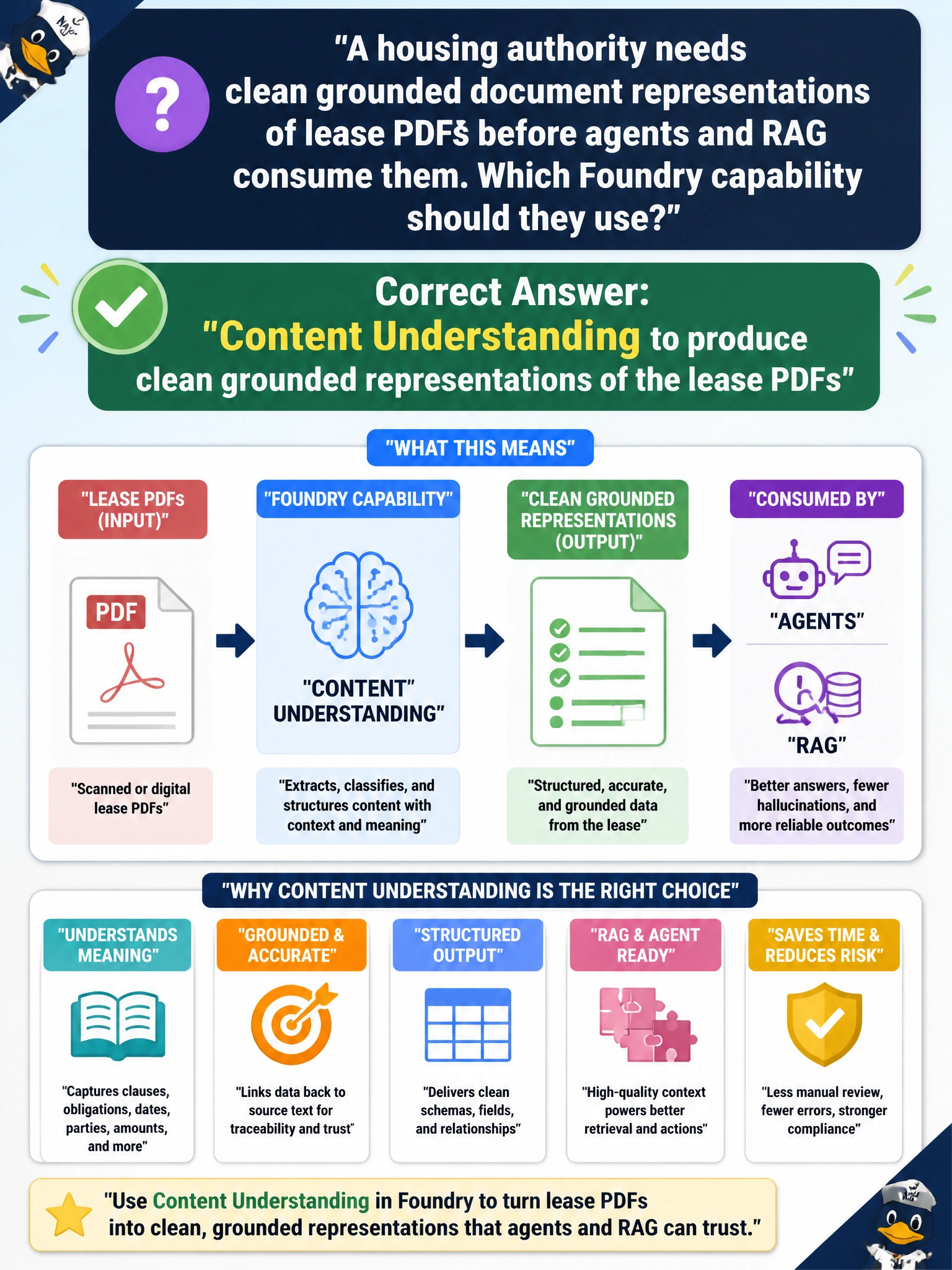
A housing authority needs clean grounded document representations of lease PDFs before agents and RAG consume them. Which Foundry capability should they use?
Select an answer to reveal the explanation.
Short Explanation
Agents and RAG hate dirty lease PDFs full of noise. You'll use Content Understanding to clean them into grounded representations the bots can trust. You'll only get grounded field values from Document Intelligence, grounded keyword indexes from Azure AI Search, and grounded content regions from Azure AI Vision, so you'll still miss the full cleaned representation you'll need for citations.
Full Explanation
A housing authority that needs clean grounded document representations of lease PDFs before agents and RAG consume them should use Content Understanding. That capability produces structured, cleaned representations—normalized text, layout-aware segments, grounded fields—that downstream agents can cite without wrestling raw PDF noise, headers, or duplicated boilerplate. Document Intelligence to produce clean grounded field values from lease PDFs leaves agents with isolated field values rather than the clean, grounded, full-document representations needed for clause citation. Azure AI Search to produce clean grounded keyword indexes over lease PDFs gives searchable indexes but does not produce the cleaned, layout-aware, grounded document representations agents and RAG need. Azure AI Vision to produce clean grounded content regions from lease PDFs recovers content regions but skips the layout-aware cleaning and segmentation that turns leases into clean, grounded, citable representations. Exam caveat: when the stem asks for clean grounded representations of municipal lease PDFs ahead of agents/RAG, Content Understanding is the Foundry-aligned choice—not clean grounded field values from Document Intelligence, clean grounded keyword indexes from Azure AI Search, or clean grounded content regions from Azure AI Vision. Operational check: run Content Understanding on approved lease PDFs; inspect grounded segments for clause boundaries and effective-date metadata; connect the cleaned representations to RAG and agent tools; reject clean grounded field values from Document Intelligence as the sole agent context in production policy.
Prefer to study offline? Printable PDF study book + test engine ($7.50, unofficial). These questions stay free here.