
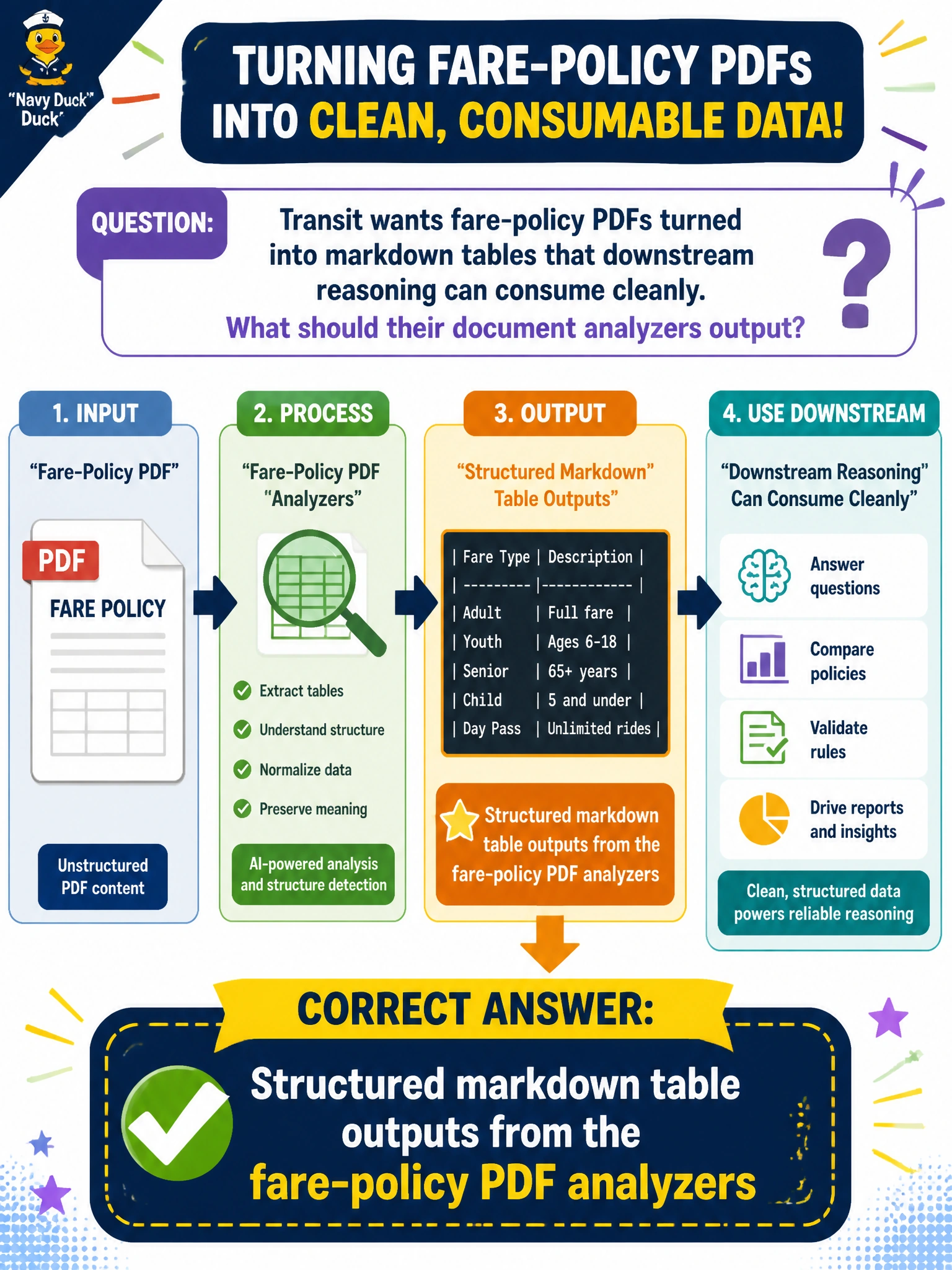
Transit wants fare-policy PDFs turned into markdown tables that downstream reasoning can consume cleanly. What should their document analyzers output?
Select an answer to reveal the explanation.
Short Explanation
You'll get cleaner reasoning from markdown tables than from validated markdown table outputs that only check content without building the grid. Point analyzers at structured markdown table output so downstream steps get clean rows. Validated markdown table outputs, indexed markdown table outputs, or referenced markdown table outputs won't keep the rates straight.
Full Explanation
Transit fare-policy PDFs should be turned into structured markdown table outputs by document analyzers so downstream reasoning can consume fare rows cleanly. Markdown tables preserve zones, fare products, and prices as discrete cells agents and workflows can compare, filter, and cite without re-parsing PDF layout each time. Validated markdown table outputs from the fare-policy PDF analyzers add a validation check on extracted content without guaranteeing structured row-and-cell tables, so downstream reasoning still lacks clean zone, product, and price cells to compare, filter, and cite. Indexed markdown table outputs from the fare-policy PDF analyzers build a search index over fare-policy documents for retrieval, but do not preserve zones, fare products, and prices as discrete table cells that downstream reasoning can consume cleanly. Referenced markdown table outputs from the fare-policy PDF analyzers attach source links or citations to document sections without converting fare rows into structured tables, forcing downstream reasoning to follow references before it can compare clean cells. Exam caveat: analyzers feeding municipal fare reasoning should emit complete structured markdown tables because validated markdown table outputs only check extraction, indexed markdown table outputs only support search, and referenced markdown table outputs only add links. Operational check: configure analyzers for table-aware markdown on fare-policy PDFs; spot-check zone and product rows against the published PDF; feed the markdown into the reasoning step and verify cited fares match the current tariff before the resident fare bot launches. Prefer analyzers that emit pipe- or markdown-delimited rows with stable column headers for zone, product, and price so regression tests can diff fare tables across tariff versions.
Prefer to study offline? Printable PDF study book + test engine ($7.50, unofficial). These questions stay free here.