
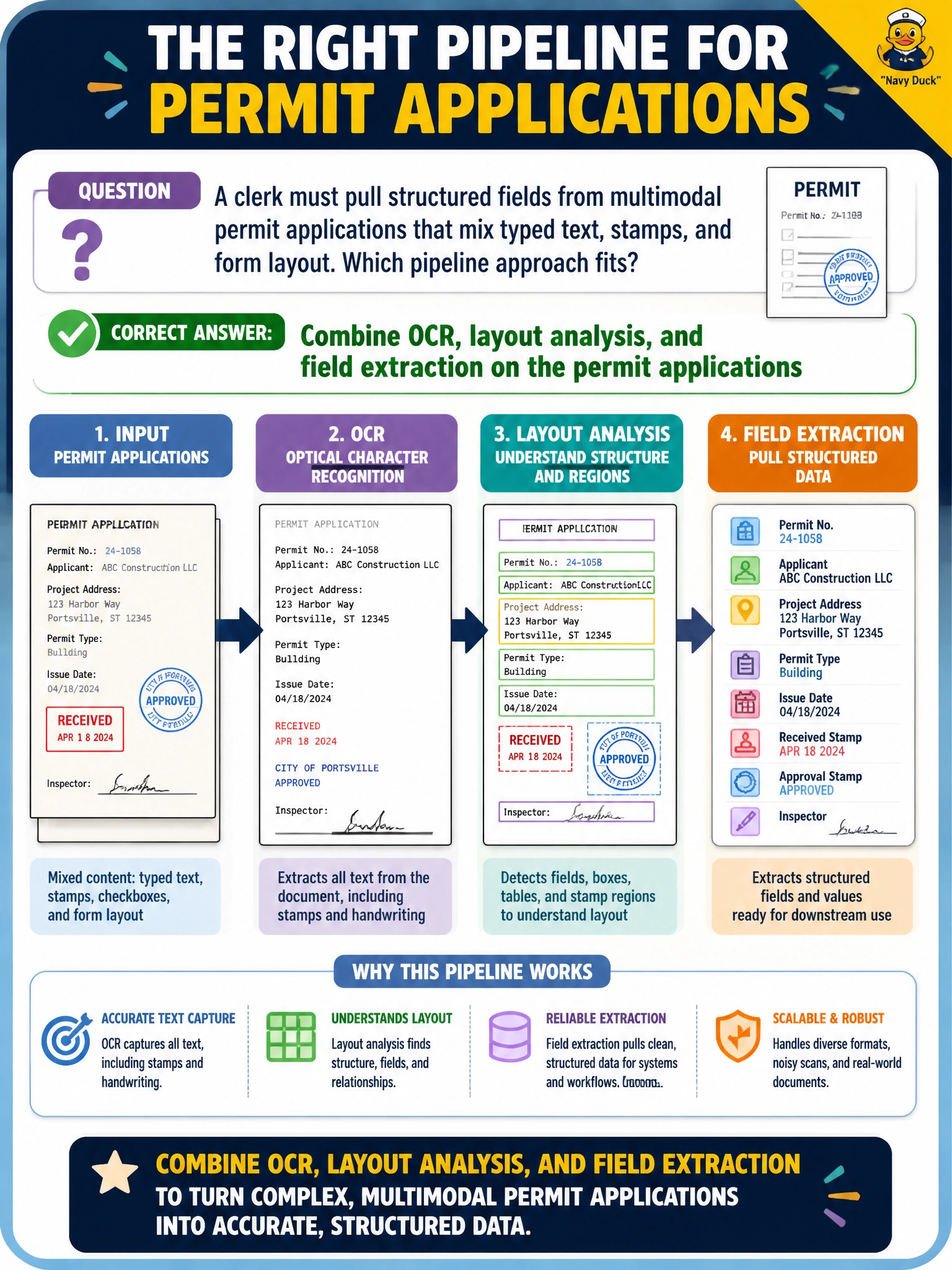
A clerk must pull structured fields from multimodal permit applications that mix typed text, stamps, and form layout. Which pipeline approach fits?
Select an answer to reveal the explanation.
Short Explanation
Permit apps are a sandwich of typed lines, stamps, and boxes. Combine OCR, layout analysis, and field extraction so those pieces become structured fields. You'll come up short if you rely on image classification or only table detection without full layout, or if you settle for key phrases that aren't mapped to parcel, applicant, and fee fields.
Full Explanation
A clerk extracting structured fields from multimodal permit applications that mix typed text, stamps, and form layout should combine OCR, layout analysis, and field extraction. OCR recovers characters; layout analysis recovers reading order, tables, and box regions; field extraction maps those regions to permit schema fields such as parcel, applicant, and fee codes. Combining OCR, image classification, and field extraction on the permit applications classifies document type but omits layout analysis, so reading order, box regions, and stamp placement are lost and field extraction cannot reliably map text to parcel, applicant, or fee values. Combining OCR, table detection, and field extraction on the permit applications detects tables but omits full layout analysis, so multi-column reading order, form boxes, and stamp regions are missed and field extraction cannot reliably populate parcel, applicant, or fee fields. Combining OCR, layout analysis, and key phrase extraction on the permit applications recovers characters and layout but produces summaries rather than mapped fields, so it never delivers labeled parcel, applicant, or fee values the clerk's system needs. Exam caveat: multimodal municipal permit packets need OCR plus layout plus field extraction—not OCR plus image classification plus field extraction, OCR plus table detection plus field extraction, or OCR plus layout plus key-phrase extraction. Operational check: process sample permits with stamps and multi-column forms; validate extracted fields against known ground truth; measure field-level accuracy and low-confidence rates before routing extractions into the permitting system of record.
Prefer to study offline? Printable PDF study book + test engine ($7.50, unofficial). These questions stay free here.