
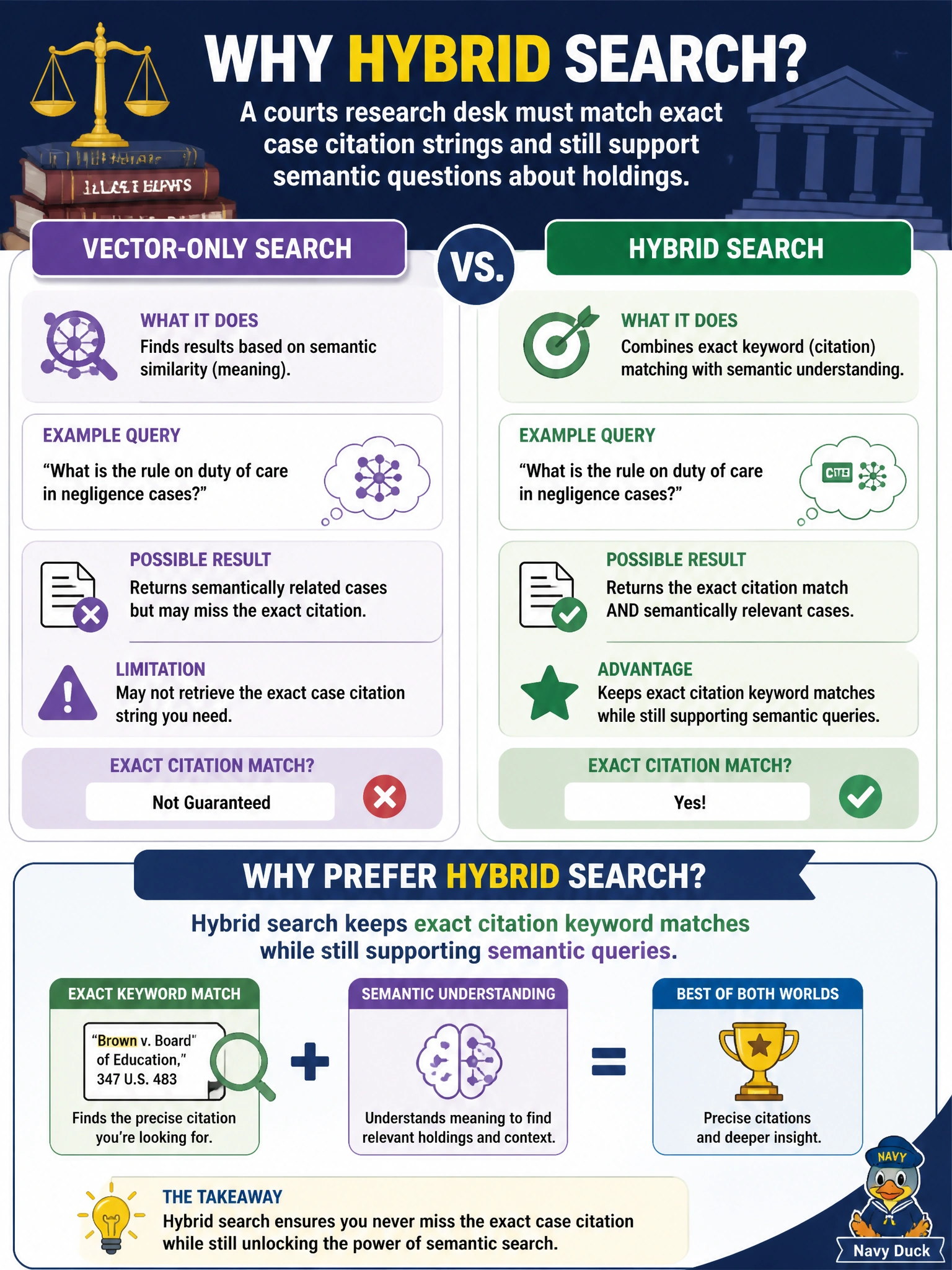
A courts research desk must match exact case citation strings and still support semantic questions about holdings. Why prefer hybrid search over vector-only?
Select an answer to reveal the explanation.
Short Explanation
Case citations are picky strings—you need the keywords—while "what did the court say about notice?" needs meaning. Hybrid keeps both. You've got citations covered with keywords, but you'll miss paraphrased holdings if you're ranking them with BM25 keyword scores—you need vectors for meaning.
Full Explanation
Courts research desks prefer hybrid search over vector-only because exact case citation strings and semantic questions about holdings demand different matching behaviors in one system. Citations are brittle identifiers—volume, reporter, page, pinpoint—where keyword or lexical matching preserves exactness. Semantic queries about notice, standing, or injunctive relief need vectors over opinion text. Hybrid ranking keeps both paths so clerks can paste a citation or ask what the court held. Hybrid search keeping citation keyword matches while still ranking holdings with BM25 keyword scores gets citations right but fails holdings, because paraphrased questions about notice, standing, or injunctive relief need semantic vectors over opinion text, which BM25 lexical scores alone cannot capture. Hybrid search keeping citation keyword matches while still expanding holdings with synonym graphs keeps citations exact but understates holdings, because paraphrased holding questions need semantic vectors over opinion text, not just synonym expansion, to capture meaning beyond word variants. Hybrid search keeping citation keyword matches while still concatenating holdings vectors for recall misdescribes the semantic side, because holdings questions require ranked vector similarity fused with lexical scores to answer what the court held, not merely concatenating vectors for recall. Exam caveat: when the stem pairs exact legal citations with semantic holding questions, hybrid is preferred because of complementary matching—not because it keeps citation keyword matches while still ranking holdings with BM25 keyword scores, which leaves paraphrased holdings to lexical match instead of semantic vectors. Operational check: index opinion PDFs with citation keywords and passage embeddings; evaluate with exact citation queries and paraphrased holding questions; confirm both query types retrieve the correct opinions before the research desk depends on the index.
Prefer to study offline? Printable PDF study book + test engine ($7.50, unofficial). These questions stay free here.