
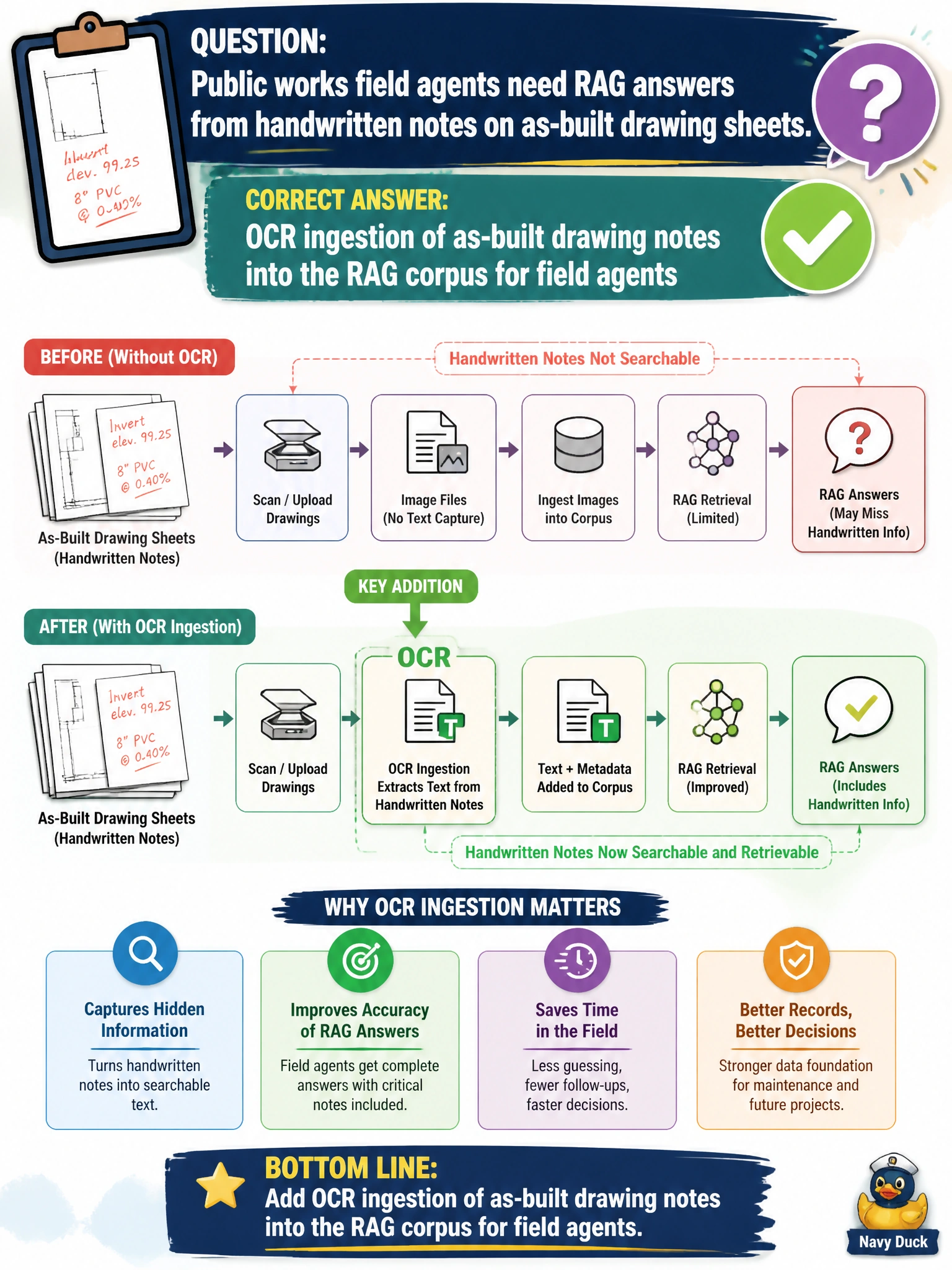
Public works field agents need RAG answers from handwritten notes on as-built drawing sheets. What should ingestion add to the corpus pipeline?
Select an answer to reveal the explanation.
Short Explanation
Handwritten notes on as-builts are gold for the field crew—if OCR gets them into the RAG corpus. Indexing title-block metadata from as-built notes, CAD geometry vector embeddings of notes, or image similarity embeddings of drawing notes won't make those handwritten notes searchable. You'll need OCR on the notes themselves, or agents won't find the answers they need.
Full Explanation
Public works field agents needing RAG answers from handwritten notes on as-built drawing sheets require OCR ingestion of those notes into the RAG corpus. Field-written markups—valve locations, pipe sizes, as-found deviations—are the operational truth only after OCR makes them text for chunking and retrieval. Indexing title-block metadata from as-built notes captures administrative fields but does not OCR the handwritten notes, so the valve locations and as-found deviations agents need remain unretrievable. Ingesting CAD geometry vector embeddings of notes encodes linework and structure but does not convert handwritten margin notes into text for chunking and retrieval. Adding image similarity embeddings of drawing notes matches visual appearance but does not make handwritten note content searchable for field RAG. Exam caveat: handwritten as-built notes enter a municipal RAG corpus through OCR ingestion—not title-block metadata only, CAD geometry embeddings, or image similarity embeddings. Operational check: OCR representative as-built note regions with sheet and asset IDs; spot-check critical dimensions against the paper sheets; run field-agent questions that depend on handwritten deviations rather than title-block metadata, CAD geometry, or image similarity; verify retrieved answers cite the note text before deploying the mobile RAG tool to crews. Prefer region OCR on note callouts over full-sheet rasterization when sheets are large, and retain the original sheet image as an audit attachment linked from each retrieved chunk.
Prefer to study offline? Printable PDF study book + test engine ($7.50, unofficial). These questions stay free here.