
An open-data team records podcast clips and wants newsletter drafts that start from speech, then apply summarization. Which pipeline order is correct?
Select an answer to reveal the explanation.
Short Explanation
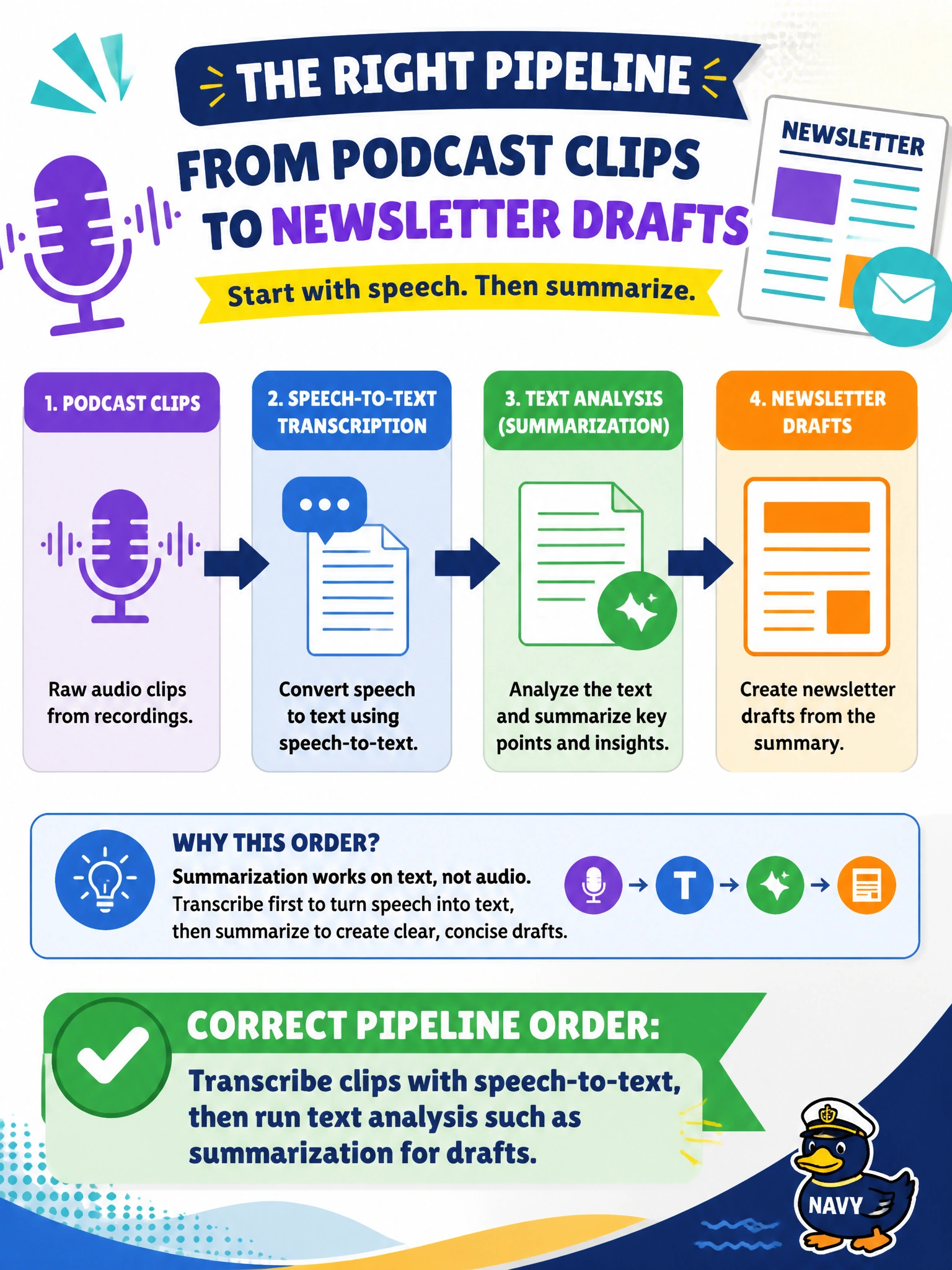
You cannot summarize what you have not written down yet. Transcribe the podcast with speech-to-text, then hand that text to summarization for the civic newsletter draft. You'll miss it since speech synthesis makes audio and can't summarize, you can't summarize clips before transcribing them, and you've got clips and drafts backwards if you transcribe drafts to summarize clips.
Full Explanation
The open-data team records podcast clips and wants newsletter drafts that start from speech, then apply summarization. The correct pipeline order is: transcribe clips with speech-to-text, then run text analysis such as summarization for drafts. Speech must become text before text-analysis summarization can produce a civic newsletter draft grounded in what was actually said.
Transcribing clips with speech-to-text, then running speech synthesis such as summarization for drafts, uses the wrong service family because speech synthesis creates audio from text and has no summarization capability, while summarization is a text analysis feature.
Summarizing clips with text analysis, then transcribing summaries with speech-to-text for drafts, reverses the pipeline order because text analysis requires text input and cannot summarize raw audio, so transcription must precede summarization.
Transcribing drafts with speech-to-text, then running text analysis such as summarization for clips, swaps the inputs and outputs because the podcast clips are the speech to transcribe and the newsletter drafts are the text to produce, not the reverse.
Each distractor either reverses the pipeline order, swaps clips and drafts, or substitutes speech synthesis for text analysis.
Exam caveat: modality order matters—STT then text analytics is the standard pattern. Do not mistake speech synthesis for summarization because it creates audio from text rather than condensing text into a draft. For classic AI-102 speech + text items, transcription precedes summarization.
Operational check: transcribe a podcast clip, summarize into a newsletter draft, have editors compare bullets to the transcript timestamps, and retain the transcript link in the CMS. Measure hallucination by checking every draft claim against the STT output before the civic newsletter sends.
Prefer to study offline? Printable PDF study book + test engine ($7.50, unofficial). These questions stay free here.