
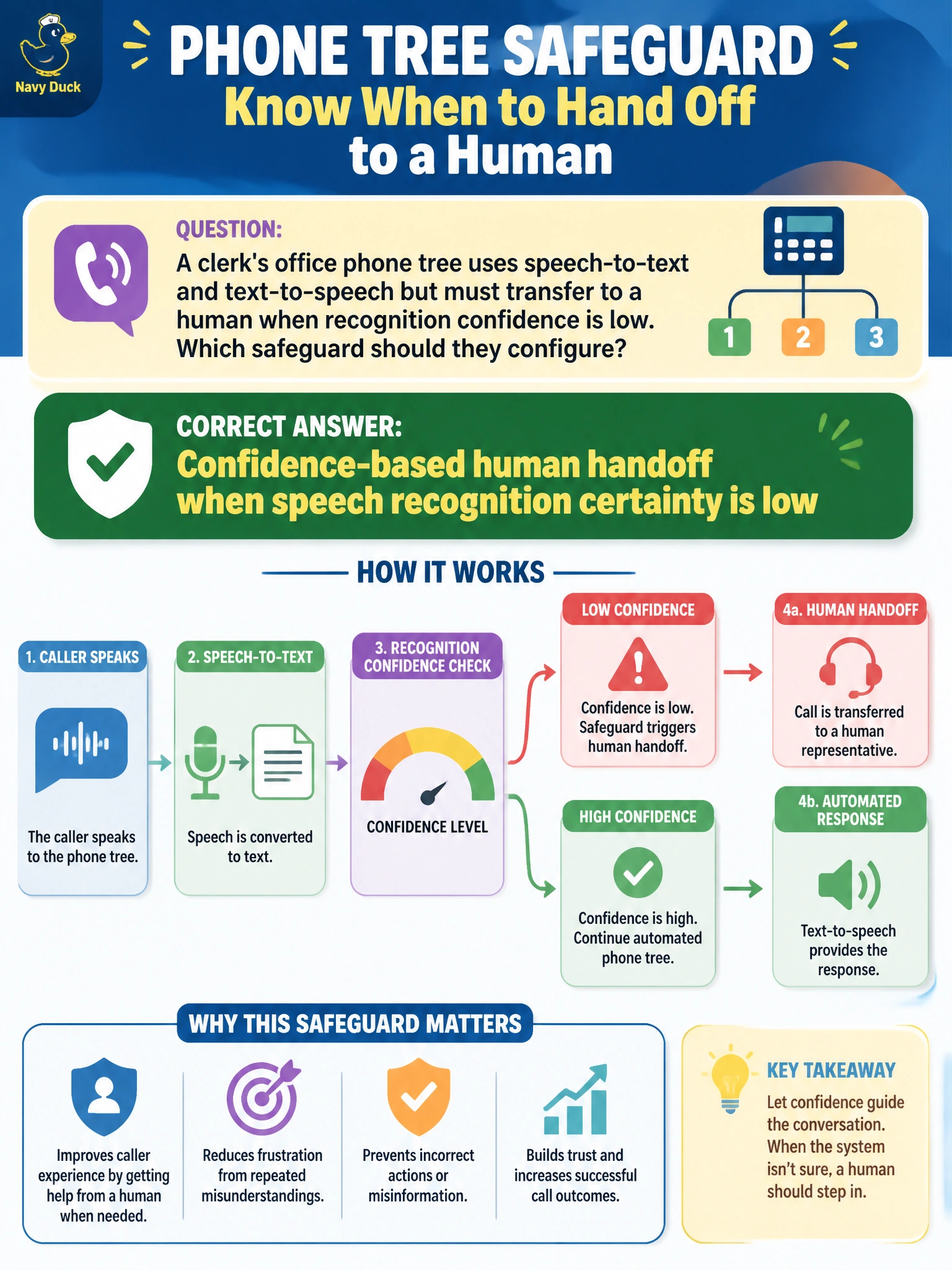
A clerk's office phone tree uses speech-to-text and text-to-speech but must transfer to a human when recognition confidence is low. Which safeguard should they configure?
Select an answer to reveal the explanation.
Short Explanation
When the bot’s squinting at the words, hand the call to a person. Confidence-based handoff keeps your STT/TTS phone tree safe instead of guessing. If you'll only hand off on model accuracy, audio sampling, or phrase latency, you're watching the wrong signal and you'll leave misunderstood callers stuck.
Full Explanation
The clerk’s office phone tree uses speech-to-text and text-to-speech but must transfer to a human when recognition confidence is low. Configure confidence-based human handoff when speech recognition certainty is low so callers are not trapped by a guessing bot. In municipal clerk services—licenses, records, court dates—wrong automated answers create legal and citizen-trust risk; low-confidence STT should escalate.
Configuring confidence-based human handoff when speech recognition model accuracy is low watches the wrong level, because overall model accuracy does not show whether this caller’s request was recognized correctly, so a misunderstood caller can still be trapped by the bot. Configuring confidence-based human handoff when speech recognition audio sampling is low triggers on capture sampling rather than recognition confidence, so a misrecognized request at normal sampling still goes through the bot without a reliable path to a person. Configuring confidence-based human handoff when speech recognition phrase latency is low ties the transfer to recognition speed rather than recognition confidence, so a slow but misunderstood caller can still be trapped by the bot while fast, correctly recognized calls would hand off needlessly. Those options all use the wrong trigger — model accuracy, audio sampling, or phrase latency — instead of speech recognition certainty for the real-time human contact the caller needs right now.
Exam caveat: confidence thresholds are an operational safety pattern for speech agents; they are not the same as model-accuracy, audio-sampling, or phrase-latency routing. When stems mention low recognition confidence, choose human handoff rather than “try harder” generation.
Operational check: set an STT confidence threshold from labeled calls, route below-threshold calls to clerks with the partial transcript attached, measure containment versus handoff rates, and review invent-attempts as critical defects. Publish a clear “press zero for a person” path even when confidence is high, for accessibility and trust.
Prefer to study offline? Printable PDF study book + test engine ($7.50, unofficial). These questions stay free here.