
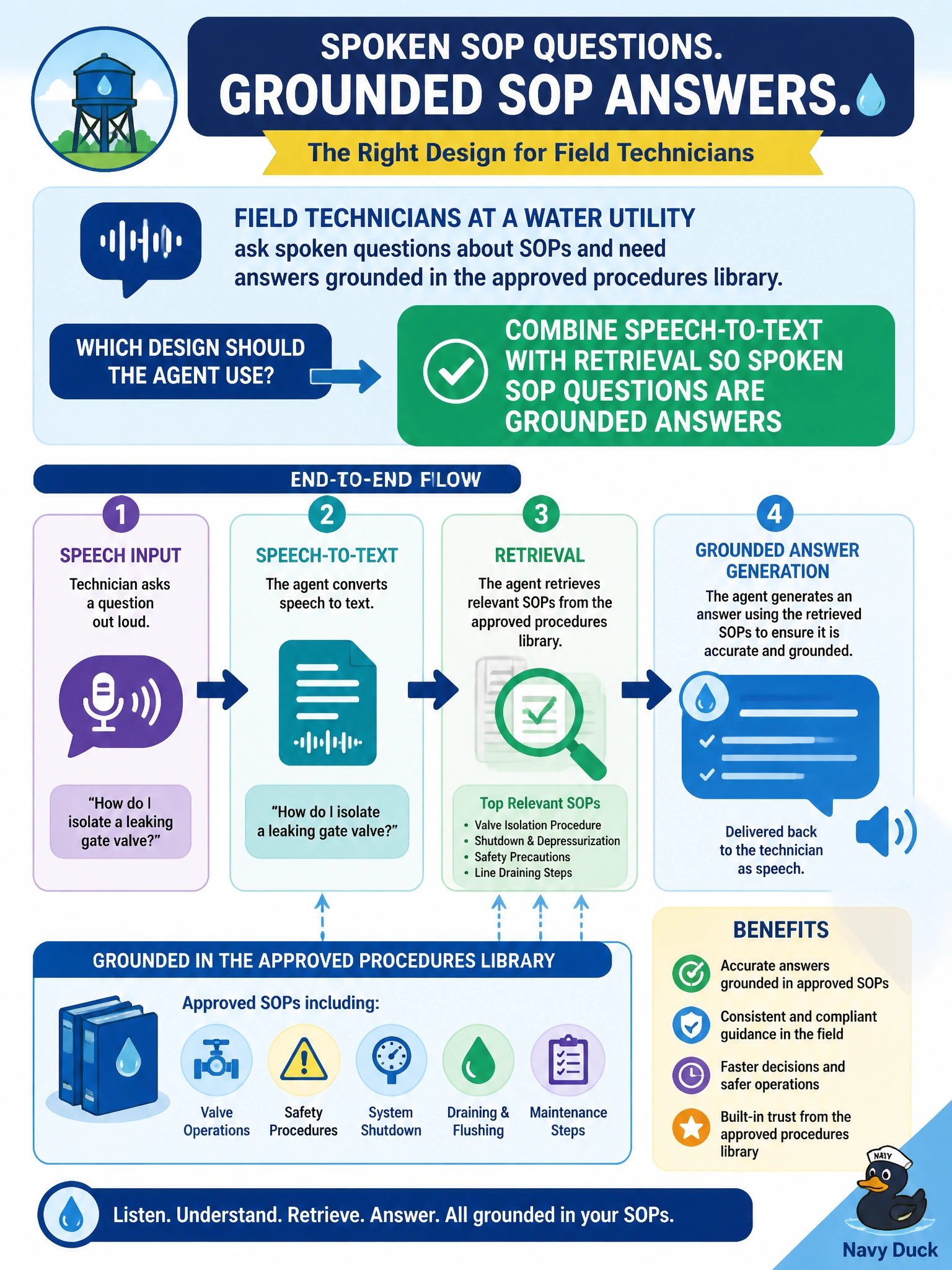
Field technicians at a water utility ask spoken questions about SOPs and need answers grounded in the approved procedures library. Which design should the agent use?
Select an answer to reveal the explanation.
Short Explanation
Fine-tuning won't ground you in approved rules; you'll get stale weights without live SOP citations. Pair speech-to-text with retrieval so your spoken asks become grounded answers from approved procedures. Translating your ask twists your terms and summarizing without retrieval won't give you the real, approved SOP.
Full Explanation
Field technicians at a water utility ask spoken questions about SOPs and need answers grounded in the approved procedures library. The agent should combine speech-to-text with retrieval so spoken SOP questions become grounded answers from approved procedures—not fine-tuning that bakes static knowledge into weights without live library grounding. Grounding protects safety-critical municipal water operations where wrong valve sequences or chemical steps can cause real harm.
Combining speech-to-text with fine-tuning instead of retrieval leaves answers ungrounded in static model weights that can go stale and cannot cite the approved SOP version. Combining speech translation with retrieval mistakes the interface need, since translation converts between languages rather than transcribing the technicians' spoken SOP questions and risks distorting valve and chemical terms. Combining speech-to-text with summarization condenses text but does not retrieve approved SOP passages, so answers lack grounding and can omit safety-critical steps. Those options either freeze knowledge without live retrieval, mistarget the speech interface, or condense without grounding in the approved library.
Exam caveat: speech enables the interface; retrieval grounding ensures factual SOP alignment. Exams often pair STT with RAG-style retrieval when the stem says "grounded in the approved … library." Summarization may shorten the answer for delivery, but grounding is the correctness control.
Operational check: ask spoken questions that paraphrase SOP titles, verify citations to the correct procedure versions, refuse answers when retrieval confidence is low, and keep offline SOP packets for dead zones. Log which procedure IDs were cited so utility QA can audit field guidance.
Prefer to study offline? Printable PDF study book + test engine ($7.50, unofficial). These questions stay free here.