
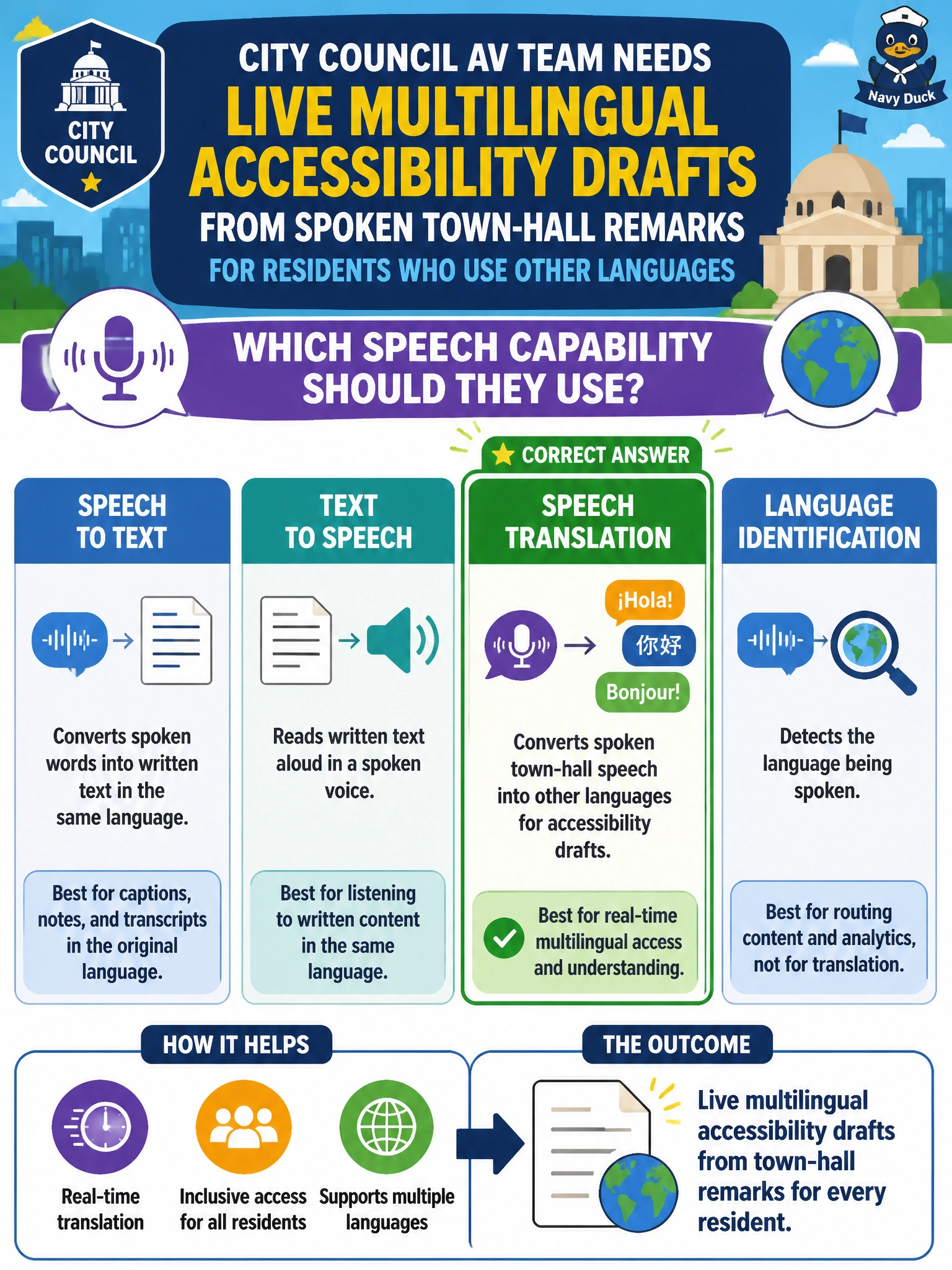
A city council AV team needs live multilingual accessibility drafts from spoken town-hall remarks for residents who use other languages. Which speech capability should they use?
Select an answer to reveal the explanation.
Short Explanation
Town halls get wider when the words travel across languages in near real time. Speech translation turns spoken remarks into multilingual accessibility drafts residents can follow. Captioning without translating, labeling voices, or voicing remarks aloud as audio don't give you the translated text drafts you'll share with residents.
Full Explanation
The city council AV team needs live multilingual accessibility drafts from spoken town-hall remarks for residents who use other languages. Speech translation that converts town-hall speech into other languages for accessibility drafts is the matching capability: spoken remarks become translated text (and optionally speech) residents can follow. This expands civic participation beyond speech-to-text transcription that captions town-hall speech for other-language accessibility drafts but only transcribes words without translating them into other languages.
Speech-to-text transcription that captions town-hall speech for other-language accessibility drafts fails multilingual accessibility because it only transcribes the spoken words and produces no translation into other languages. Speaker identification that labels town-hall voices to separate other languages for accessibility drafts only identifies who spoke and does not translate remarks, so it provides no accessibility draft in any other language. Text-to-speech synthesis that voices town-hall remarks aloud in other languages for accessibility drafts produces spoken audio instead of translated text drafts and does not translate live speech to text, so it misses the accessibility drafts residents need. Each wrong option skips translation of the spoken town-hall content into the other languages residents need.
Exam caveat: speech translation serves live or near-live multilingual access; post-hoc document Translator on a finished transcript is a different workflow. When the stem stresses spoken remarks and accessibility drafts, prefer speech translation. Still plan human review for official minutes versus informal accessibility drafts.
Operational check: run a rehearsal town hall with bilingual reviewers scoring draft quality, label outputs as unofficial accessibility aids if required by counsel, store language-tagged drafts with the meeting record, and escalate named-entity errors (district names, ordinance numbers) before public posting.
Prefer to study offline? Printable PDF study book + test engine ($7.50, unofficial). These questions stay free here.