
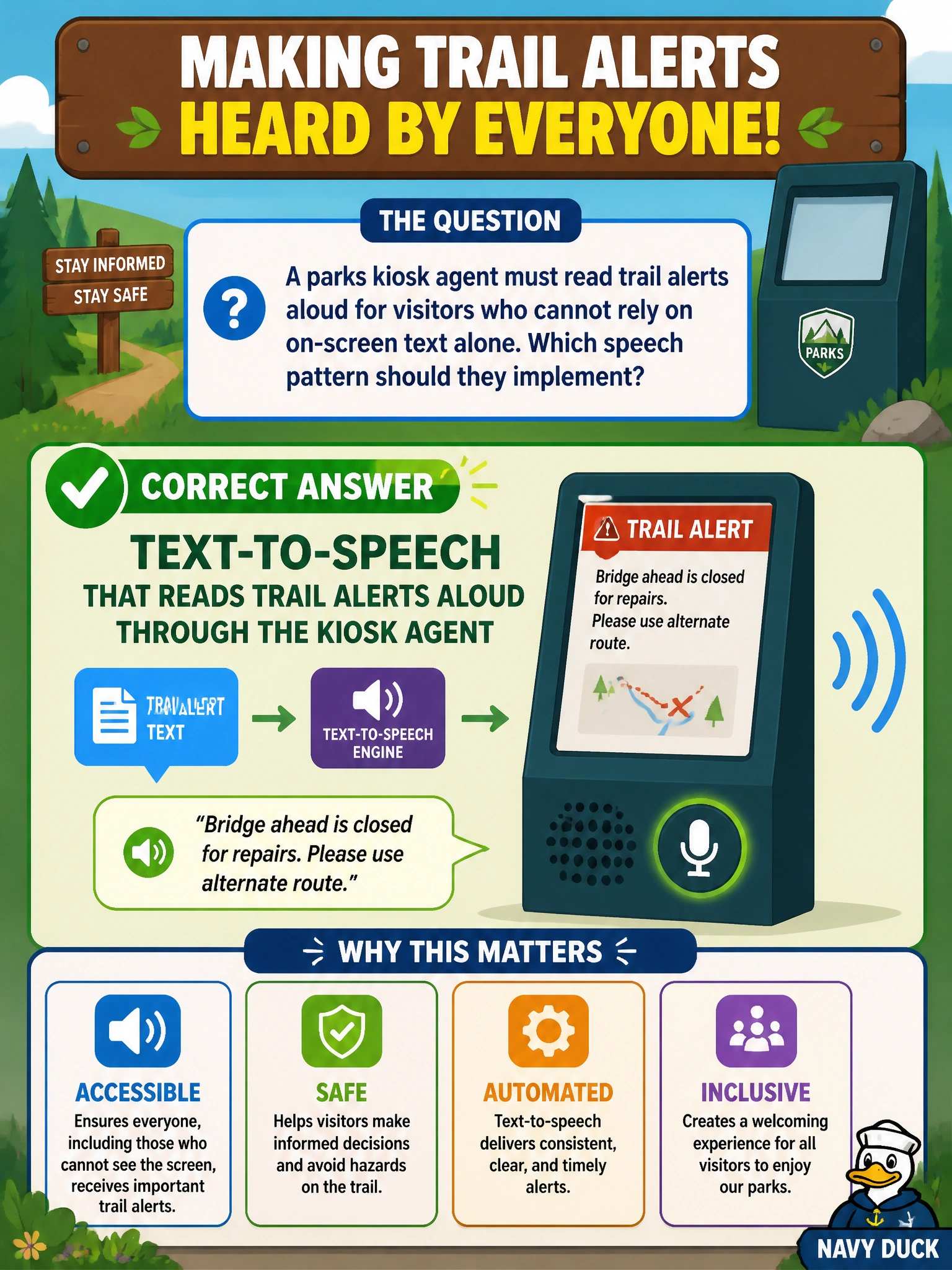
A parks kiosk agent must read trail alerts aloud for visitors who cannot rely on on-screen text alone. Which speech pattern should they implement?
Select an answer to reveal the explanation.
Short Explanation
Trail alerts belong in the ear when eyes are busy or vision is limited. Text-to-speech on the kiosk agent reads the warning aloud so visitors actually get the message. You'll still miss it if it's labeled speech translation, prerecorded audio, or voice conversion, since none of those turns live alert text into speech.
Full Explanation
A parks kiosk agent must read trail alerts aloud for visitors who cannot rely on on-screen text alone. Text-to-speech that reads trail alerts aloud through the kiosk agent is the correct speech pattern: alert text becomes spoken audio at the point of decision—trailhead or visitor center. This civic accessibility pattern helps visitors with vision limitations, glare, or hands occupied with gear.
Speech translation that reads trail alerts aloud through the kiosk agent gets the technology backwards: speech translation converts spoken input between languages, it does not turn alert text into spoken audio, so it cannot read the warning to anyone's ears. Prerecorded audio that reads trail alerts aloud through the kiosk agent misstates the capability: prerecorded audio only plays fixed recordings, it does not convert the live alert text itself into audio. Voice conversion that reads trail alerts aloud through the kiosk agent misstates the capability: voice conversion only transforms one voice to sound like another, it does not synthesize full alert sentences into speech once the kiosk is active. Those options use the right aloud wording but the wrong speech pattern, so none of them delivers spoken rendering of alert text.
Exam caveat: TTS for kiosk agents is outbound speech; do not trust speech translation, prerecorded audio, or voice conversion labels just because they say reads aloud, as only TTS synthesizes alert text into speech. When alerts are the content, ensure the same text powers both screen and speech for consistency.
Operational check: push sample closures and hazard alerts through the kiosk TTS path, verify volume against outdoor noise, offer language selection, and keep a large-print on-screen duplicate. Test that expired alerts stop speaking when the alert feed clears so visitors are not warned about yesterday’s storm.
Prefer to study offline? Printable PDF study book + test engine ($7.50, unofficial). These questions stay free here.