
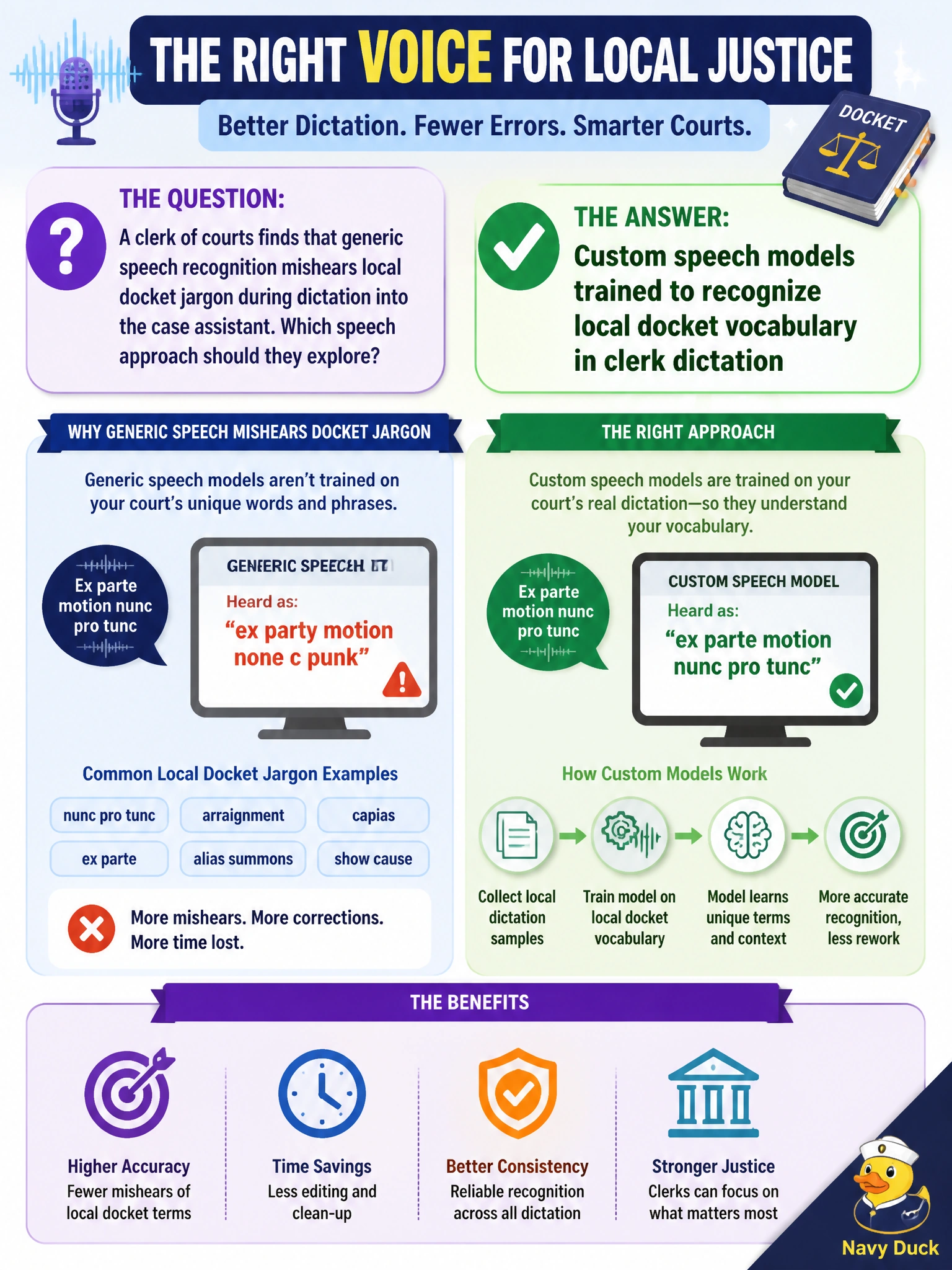
A clerk of courts finds that generic speech recognition mishears local docket jargon during dictation into the case assistant. Which speech approach should they explore?
Select an answer to reveal the explanation.
Short Explanation
Docket jargon is like a hometown accent the stock recognizer has never heard. Custom speech models learn those clerk phrases so dictation stops mangling case talk. A voice-synthesis model, a bigger generic recognizer, or noise tuning aimed at the courtroom won’t fix a vocabulary gap.
Full Explanation
The clerk of courts finds that generic speech recognition mishears local docket jargon during dictation into the case assistant. They should explore custom speech models trained to recognize local docket vocabulary so clerk dictation maps accurately into the case assistant. Municipal court language—case styles, motion names, local acronyms—often falls outside general acoustic and language models; customization closes that vocabulary gap.
Custom voice models adapted to synthesize clerk dictation for audio case records point the customization at the wrong direction entirely: a voice-synthesis (text-to-speech) model generates audio output, it does not improve how well the system recognizes the clerk’s spoken docket terms, so the mishearing problem is untouched. A larger but still general-purpose speech recognition model gains vocabulary in general, but without training on the court’s own docket terms it can still mishear register-specific phrases the way the original generic model did. Acoustic tuning focused on courtroom background noise addresses a different failure mode—ambient sound interfering with the signal—not the vocabulary gap the stem describes, where the recognizer mishears specific docket terms even in clean audio because those words were never in its training vocabulary. Those distractors either optimize the wrong pipeline stage (synthesis instead of recognition), only partially customize the model, or target noise instead of vocabulary, leaving the actual docket jargon gap unresolved.
Exam caveat: custom speech models (or phrase lists / custom lexicons, depending on product framing) are the exam-facing remedy when domain vocabulary breaks generic STT. Do not confuse recognition customization with voice synthesis, generic model upsizing, or noise-focused acoustic tuning—the stem points to recognition of local jargon during dictation.
Operational check: collect consented clerk dictation samples rich in docket terms, train or configure the custom speech model, measure word error rate on held-out jargon, and only then enable production dictation into the case assistant. Maintain a change log of new terms as local rules of court evolve.
Prefer to study offline? Printable PDF study book + test engine ($7.50, unofficial). These questions stay free here.