
A public library wants its internet-PC assistant to accept spoken questions and reply with spoken answers for patrons who struggle with keyboard-only interaction. What should they enable?
Select an answer to reveal the explanation.
Short Explanation
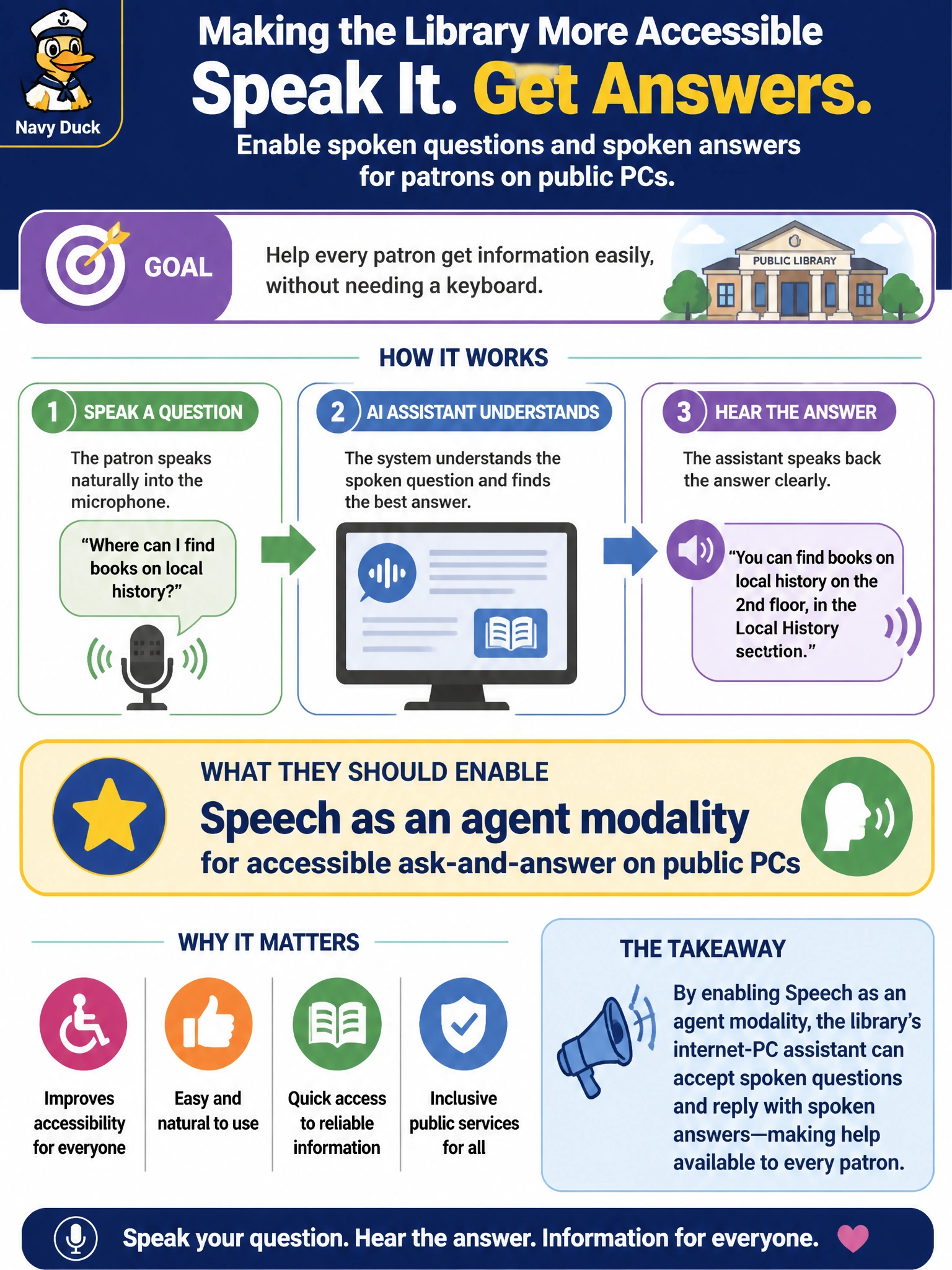
Accessibility here means the library PC can talk and listen, not just wait for perfect typing. Enabling speech as an agent modality opens ask-and-answer for patrons who need audio. Text-only chat, speech input that doesn't talk back, or spoken output where you still must type aren't that full two-way spoken channel.
Full Explanation
The public library wants its internet-PC assistant to accept spoken questions and reply with spoken answers for patrons who struggle with keyboard-only interaction. Enabling speech as an agent modality—speech-to-text for questions and text-to-speech for answers—opens accessible ask-and-answer on public PCs. In a civic library setting, this reduces barriers for patrons with literacy, motor, or vision challenges while keeping the same grounded assistant logic.
Text as an agent modality for accessible ask-and-answer on public PCs keeps the interaction typed on keyboards and screens and does not let patrons ask spoken questions or hear spoken answers, so it does not create the two-way spoken ask-and-answer channel. Speech-to-text input for accessible ask-and-answer on public PCs only lets patrons speak their questions but provides no spoken answers back, so it covers listening without speaking and falls short of the required spoken ask-and-answer. Text-to-speech output for accessible ask-and-answer on public PCs only reads answers aloud but still requires typed questions, so it covers speaking without listening and does not deliver the full spoken ask-and-answer. Each wrong option either stays text-only, listens without speaking back, or speaks without listening instead of enabling full spoken ask-and-answer with the assistant.
Exam caveat: “speech as a modality” means integrating STT/TTS (and sometimes speech translation) into the agent loop, not replacing retrieval or tools. Exams often contrast full speech modality with text-only or one-way speech-to-text-only and text-to-speech-only options.
Operational check: place headsets or push-to-talk controls at library PCs, test noisy floor environments, confirm privacy notices for microphone use, and verify spoken answers cite the same knowledge sources as typed answers. Provide an easy mute and a typed fallback so patrons remain in control of the audio modality.
Prefer to study offline? Printable PDF study book + test engine ($7.50, unofficial). These questions stay free here.