
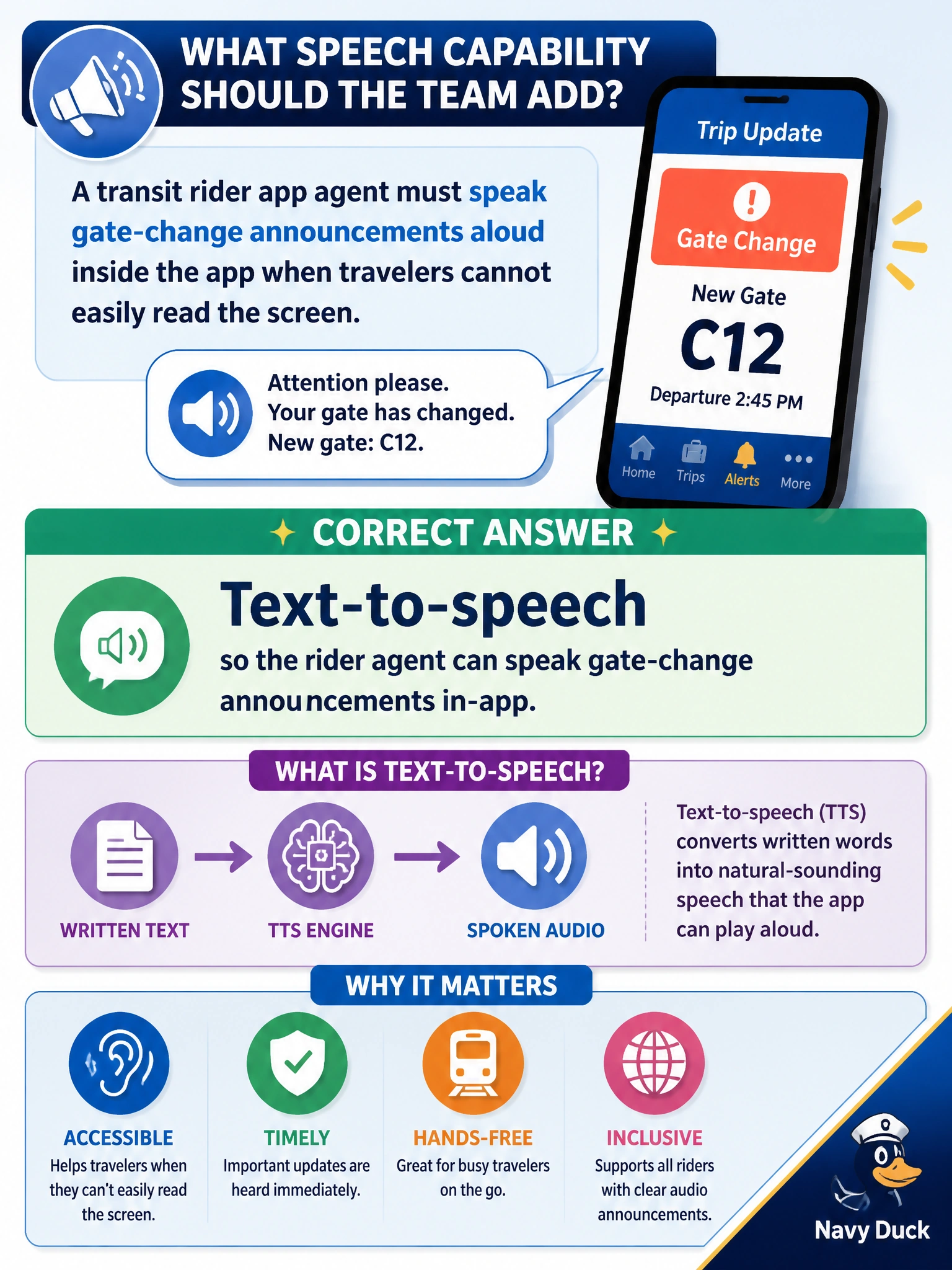
A transit rider app agent must speak gate-change announcements aloud inside the app when travelers cannot easily read the screen. Which speech capability should the team add?
Select an answer to reveal the explanation.
Short Explanation
Gate changes need a voice in your ear when your hands and eyes are full. Text-to-speech lets the rider agent say the announcement aloud instead of hoping everyone can stare at the screen. Speech translation for switching languages or a personal voice that clones one person's voice won't get you the simple spoken update you need.
Full Explanation
The transit rider app agent must speak gate-change announcements aloud inside the app when travelers cannot easily read the screen. Text-to-speech is the required speech capability: convert the gate-change text into spoken audio the rider agent plays in-app. This accessibility and situational-awareness pattern matters when hands are full, eyes are on luggage, or vision is limited in a busy civic transit environment.
Speech translation so the rider agent can voice gate-change announcements in-app translates between languages rather than simply converting the gate-change text to spoken audio. Personal voice so the rider agent can speak gate-change announcements in-app builds a custom voice modeled on a specific person instead of providing the general text-to-speech capability to speak the announcement. Batch synthesis so the rider agent can speak gate-change announcements in-app performs asynchronous bulk synthesis for large volumes of audio rather than real-time in-app playback for immediate gate changes. Those options miss the outbound spoken announcement requirement.
Exam caveat: TTS is synthesis for speaking; speech translation is translation between languages. When the stem says the agent must “speak … aloud,” choose TTS. Optional speech translation may apply for multilingual riders, but the core ask here is speaking the announcement, not translating it.
Operational check: generate TTS for sample gate-change strings, verify playback latency under station Wi-Fi conditions, offer volume and language preferences, and ensure announcements interrupt politely without drowning critical system alerts. Include a visual transcript for Deaf and hard-of-hearing riders so the accessibility pattern is dual-channel.
Prefer to study offline? Printable PDF study book + test engine ($7.50, unofficial). These questions stay free here.