
A mayor's office receives constituent emails that need nuanced, context-aware rephrasing into another language beyond straightforward phrase substitution. When should they prefer an LLM-powered translation flow over basic Translator usage?
Select an answer to reveal the explanation.
Short Explanation
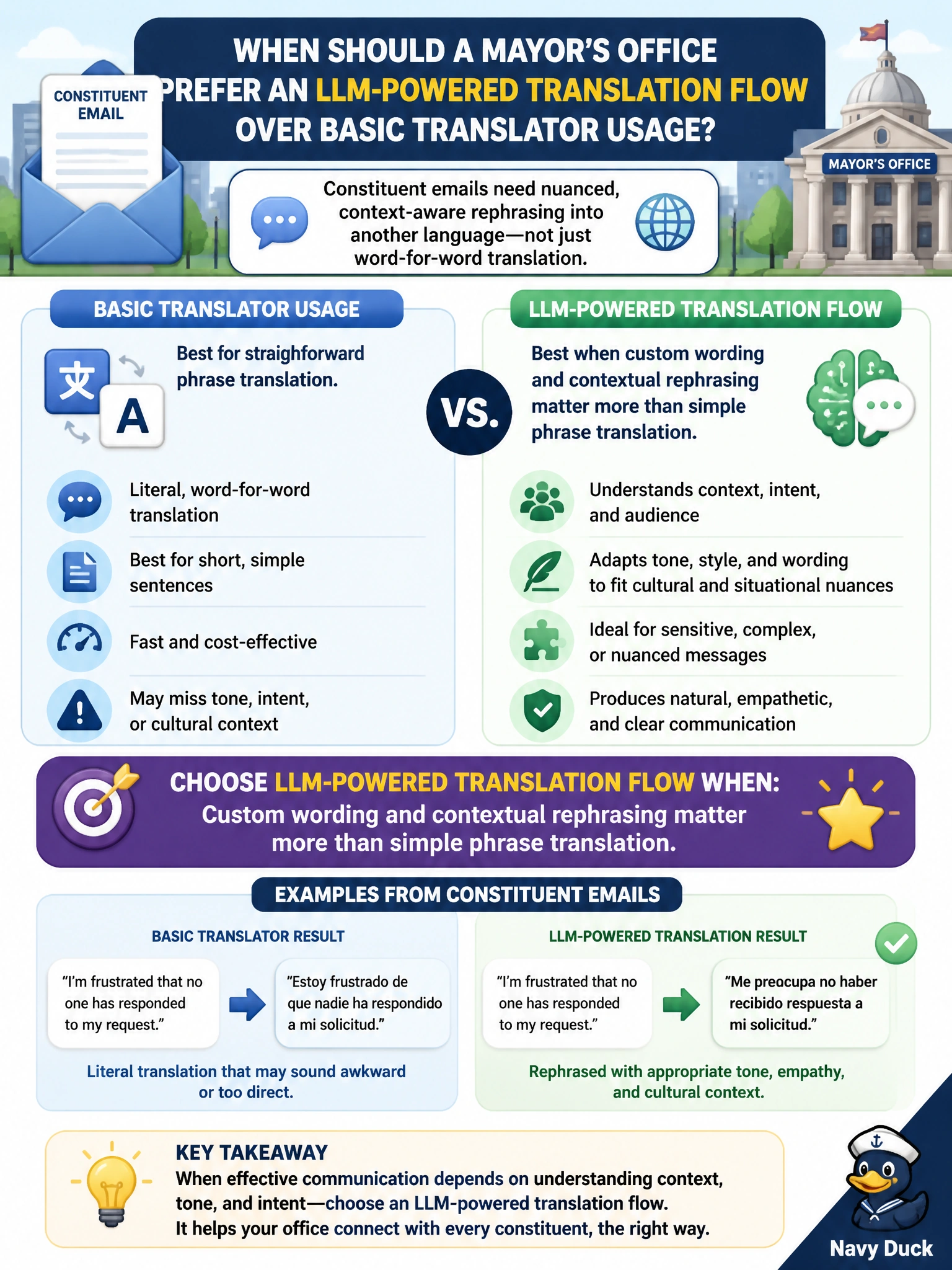
Sometimes you need a skilled interpreter, not just a pocket phrasebook. An LLM translation flow shines when constituent emails need contextual rephrasing, while basic Translator fits straightforward swaps. If you've got consistent terminology that favors standardized phrase translation, you don't need that heavier contextual path.
Full Explanation
The mayor’s office receives constituent emails that need nuanced, context-aware rephrasing into another language beyond straightforward phrase substitution. Prefer an LLM-powered translation flow when custom wording, tone preservation, and contextual rephrasing matter more than literal phrase mapping. Basic Translator excels at consistent, lower-latency phrase and document translation; an LLM path is justified when civic correspondence must retain intent, soften bureaucratic edges, or adapt register for the audience while staying faithful to policy facts. When consistent terminology for constituent emails favors standardized phrase translation is a classic Translator job, not an LLM-first scenario, because fixed terminology calls for consistent substitution rather than nuanced rephrasing. When high-volume throughput for constituent emails prioritizes fast standard translation is exactly the case where simple substitution is applied, which is the opposite of the nuanced-rephrasing need in the stem, because fast standard translation does not provide LLM-level contextual rewriting. When archived constituent emails require low-cost bulk conversion with simple translation is a basic Translator bulk job, not an LLM-first scenario, because simple bulk conversion calls for efficient straightforward translation rather than nuanced contextual rephrasing. Those distractors all describe scenarios where basic Translator already suffices, none of which matches the nuanced-rephrasing trigger the stem describes.
Exam caveat: “LLM translation” is not automatically better; it can hallucinate, drift from approved terminology, or cost more. Exam items often contrast simple Translator usage versus generative rephrasing—choose LLM when the stem stresses context and nuance, and Translator when the stem stresses straightforward substitution or glossary fidelity.
Operational check: A/B a set of constituent emails through Translator and an LLM rewrite prompt with civic style guides; have bilingual reviewers score faithfulness and tone; pin mandatory terms (ordinance names, program titles); and require human approval on high-stakes replies. Log model version, prompt, and source text so the mayor’s office can audit how a translated answer was produced.
Prefer to study offline? Printable PDF study book + test engine ($7.50, unofficial). These questions stay free here.