
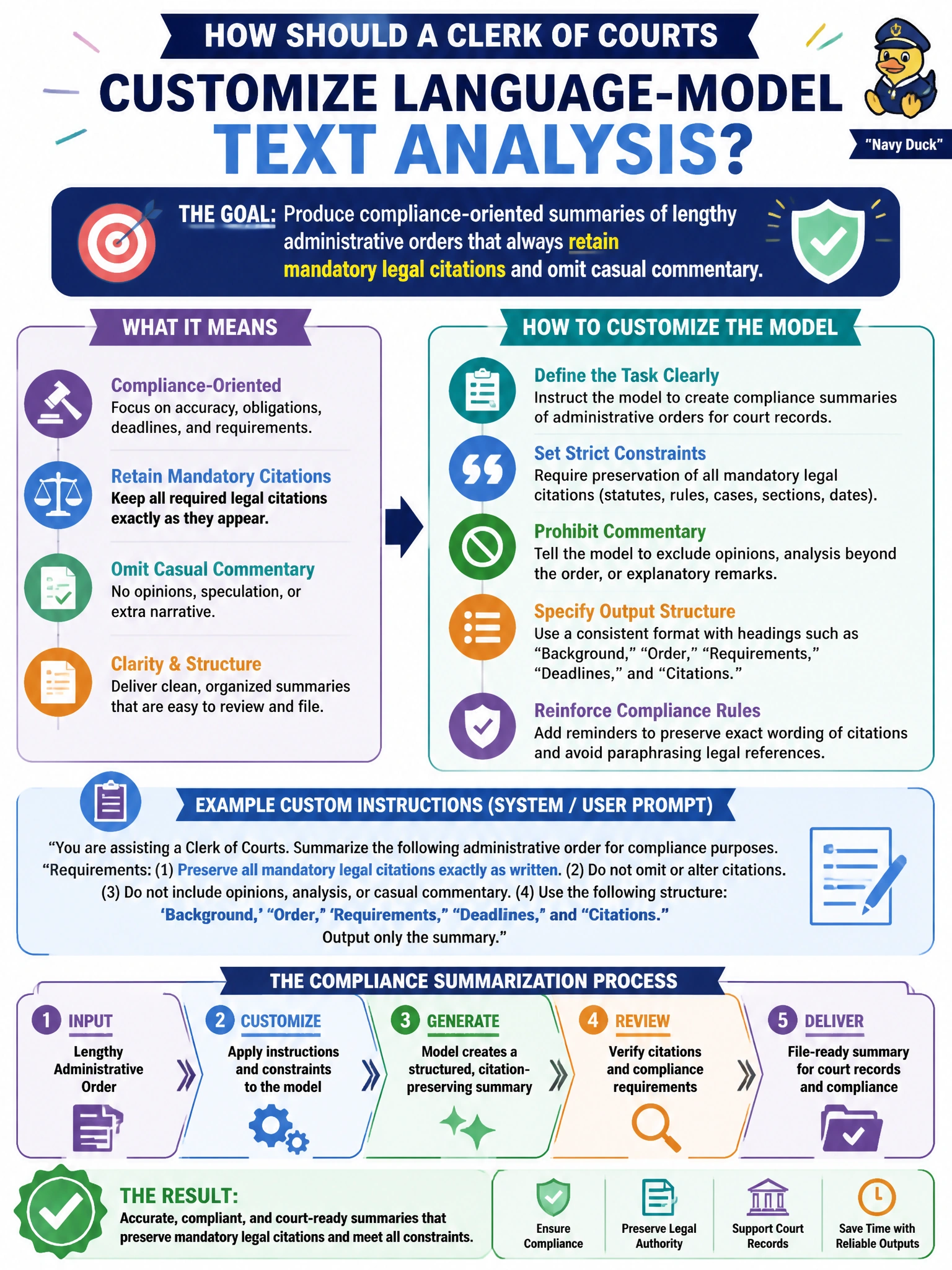
A clerk of courts must produce compliance-oriented summaries of lengthy administrative orders that always retain mandatory legal citations and omit casual commentary. How should they customize language-model text analysis?
Select an answer to reveal the explanation.
Short Explanation
Court summaries are like packing a go-bag with the statutes you must keep and leaving the hallway chatter behind. Customize the language model so compliance summarization preserves required citations and drops casual noise. Tuning abstractive summarization for public briefings, ranking sentences for docket review, or extracting key phrases for cataloging won't keep your citations safe or cut the commentary.
Full Explanation
The clerk of courts must produce compliance-oriented summaries of lengthy administrative orders that always retain mandatory legal citations and omit casual commentary. Customizing language-model text analysis means constraining summarization so required citations, effective dates, and ordered parties survive, while hallway chatter and speculative remarks are dropped. In a courts setting, a summary that loses a statute citation is worse than no summary; customization encodes those compliance rules into the generation or extraction pipeline.
Tuning abstractive summarization for concise public briefings covering outcomes and timelines reads well yet fails the mandatory-citation requirement the clerk's office depends on for compliance review, because it prioritizes public-facing brevity over preserving every statutory reference and filtering out casual commentary.
Configuring extractive summarization with ranked sentences to shorten lengthy orders for docket review treats the order as material to compress and has no built-in compliance rule to protect citations or filter commentary.
Enabling key phrase extraction to surface recurring topics for cataloging court orders yields topics for a catalog rather than a structured compliance brief, and still provides no guarantee that citations survive intact.
Each option fails the dual requirement: retain mandatory citations and omit casual commentary.
Exam caveat: customization can mean prompt constraints, fine-tuning, few-shot schemas, or structured-output contracts—exams care that you preserve mandatory fields rather than “summarize somehow.” Do not confuse this with open-ended creative rewriting; compliance summarization is deliberately lossy on fluff and lossless on citations.
Operational check: define a citation allowlist and required fields, run the customized summarizer on a sealed sample of administrative orders, and have clerks verify every citation against the source PDF. Fail closed if a mandatory citation is missing. Track hallucination rates on party names and effective dates, and keep the full order linked beside every generated brief for judicial staff.
Prefer to study offline? Printable PDF study book + test engine ($7.50, unofficial). These questions stay free here.