
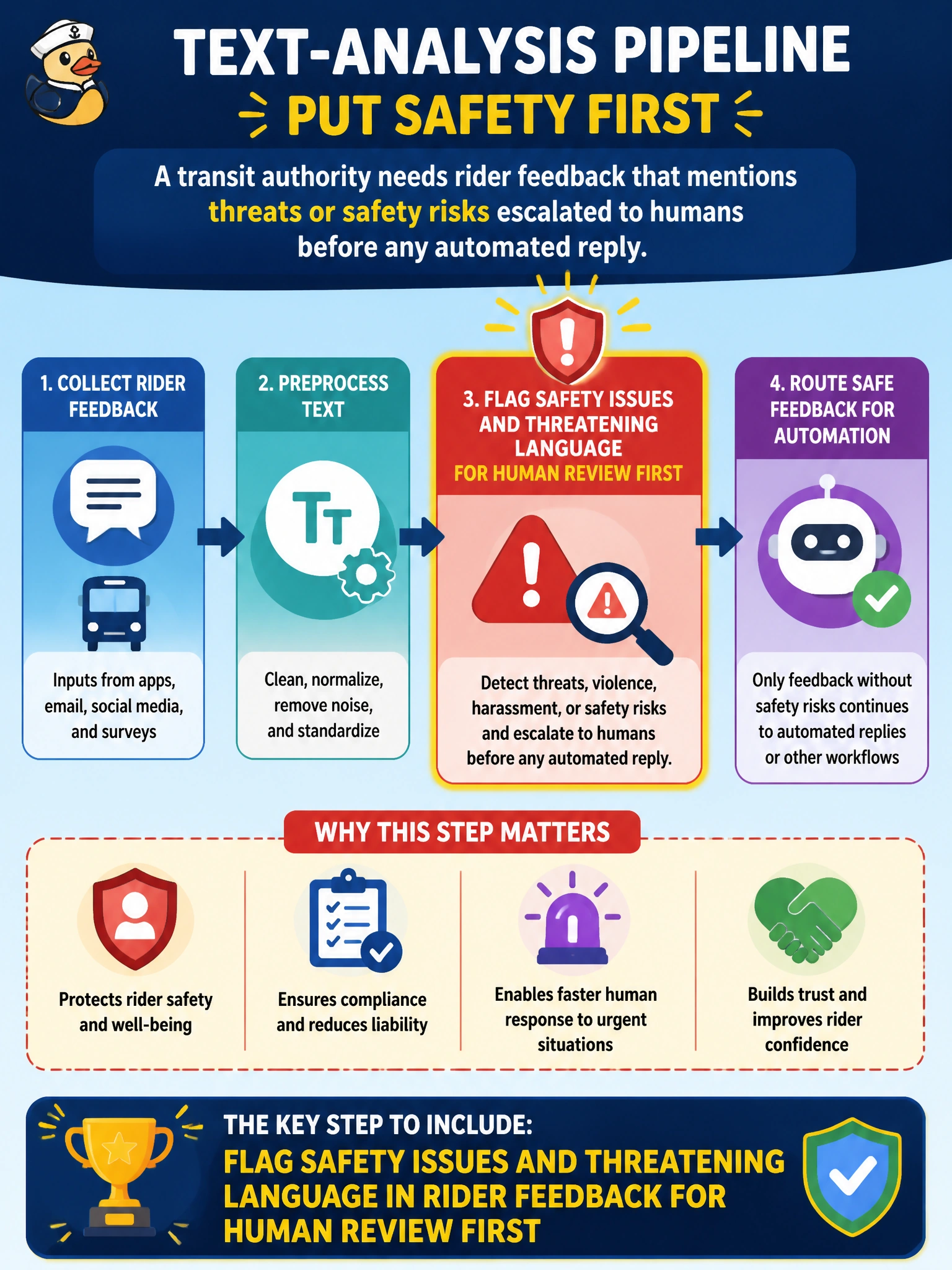
A transit authority needs rider feedback that mentions threats or safety risks escalated to humans before any automated reply. Which text-analysis step should the pipeline include?
Select an answer to reveal the explanation.
Short Explanation
Think of this like a station agent hearing raised voices before the PA replies. Safety and threat detection parks risky rider feedback for a human first so automation does not shrug past real danger. Flagging safety issues and threatening language using sentiment scores tells you how negative feedback is but doesn't catch real threats, flagging using text summaries just compresses feedback without detecting risk, and flagging using entity masking just hides personal data without escalating danger, so none gives you that safety gate you'll need before automation replies.
Full Explanation
The transit authority needs rider feedback that mentions threats or safety risks escalated to humans before any automated reply. That is a content-safety / risk-detection step in the text-analysis pipeline: scan incoming messages for threatening language and safety-related cues, park those items for human review, and only then allow routine automation on the remainder. In a civic transit setting, this protects riders and staff while still letting benign compliments and schedule questions flow through agentic replies.
Flagging safety issues and threatening language in rider feedback using sentiment scores first does not detect threats; it only measures positive versus negative tone and can miss calm-worded safety risks while over-flagging merely frustrated complaints, so it cannot substitute for safety flagging. Flagging safety issues and threatening language in rider feedback using text summaries first compresses the content but does not detect threats in the first place and may strip critical safety details, so a threatening message still passes through unflagged until someone reads the summary. Flagging safety issues and threatening language in rider feedback using entity masking first protects privacy by redacting identifiers but does not detect threats or block automation for safety, so a threat can slip through without the human checkpoint the stem requires. Each wrong option misuses a legitimate pipeline technique to try to flag safety issues, but none of them gates risky content for human review before automation proceeds.
Exam caveat: threat and safety flagging is a moderation or custom classification concern, not something you can do reliably using sentiment scores. A frustrated delay complaint can be negative without being a threat; conversely, a calm-sounding message can still describe a weapons concern. Choose the control that blocks automation until a person reviews risky content.
Operational check: define explicit safety taxonomies for transit (assaults, self-harm, weapons, trespass), tune thresholds with historical tickets, require dual-channel logging of flagged items, and measure time-to-human-handoff. Periodically red-team the classifier with paraphrased threats so automation never “shrugs past” real danger on the rider feedback line.
Prefer to study offline? Printable PDF study book + test engine ($7.50, unofficial). These questions stay free here.